Competitor Pricing Page Monitoring: Changes You Can Verify
How Should You Monitor Competitor Pricing Pages?
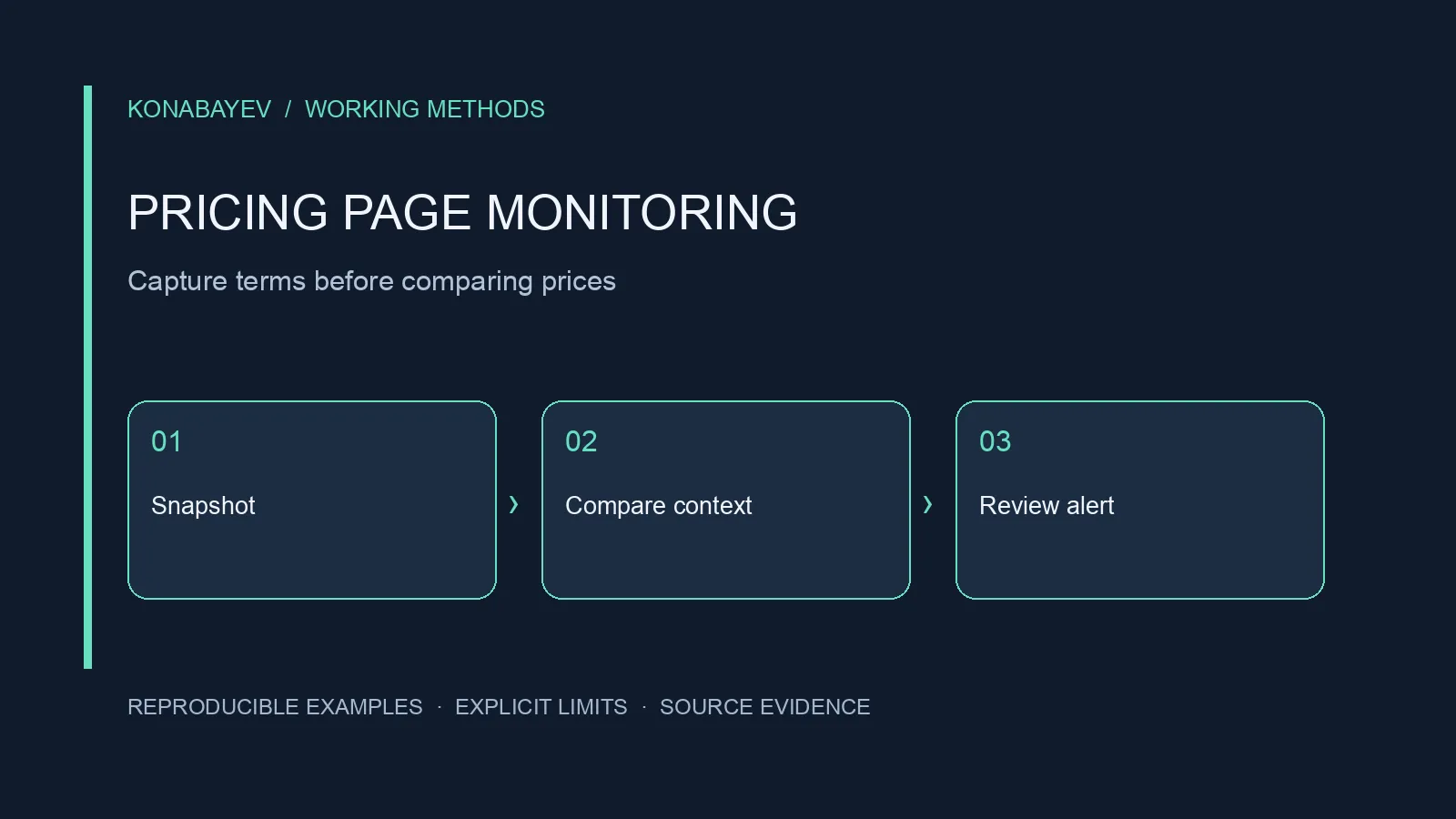
Compare equivalent page states, retain evidence for the difference, and ask a reviewer to confirm its meaning before acting. A changed number is not necessarily a changed price. Billing cadence, currency, promotion eligibility, quantity and geographic presentation can all change what a visible amount means.
This guide builds a review queue for publicly accessible pricing pages. A completed fictional example shows an unchanged price with a changed promotion, a genuine authored amount change and an unavailable capture. It makes no claim about a real competitor’s current rates. The website change detection test dataset provides reusable authored before-and-after cases, not a benchmark of monitoring vendors.
The output is a small evidence log that a pricing or product-marketing owner can use. It is not an automatic repricing system, a commitment to scrape restricted sources or a forecast of sales impact.
Define What Counts as a Decision-Relevant Change
Write the alert rule in business terms before choosing a monitoring interval. “Anything changed” is usually too broad to tell a reviewer what to do next. A page can change because its footer year, cookie message or navigation changed while its commercial offer stayed the same.
For a particular product category, useful watch fields might include advertised base amount, billing period, minimum seats, included capacity, trial conditions, overage wording, support eligibility or the presence of a sales-only plan. The right list depends on your buying and positioning decisions. Do not assume all competitors expose comparable fields.
Assign an action owner to each field. A base-price change might need product marketing review; a new usage cap might matter to a solution consultant; a changed privacy term belongs with the appropriate specialist. The person receiving an alert should understand both the evidence and the boundary of their authority.
Use an initial inventory with a reason for each URL. Monitoring every link in a competitor’s site is a different scope from monitoring a handful of named pricing and packaging pages. Include a stop condition when a source changes access requirements, becomes unavailable or repeatedly exceeds the agreed collection cost.
The competitive analysis framework can help connect a page observation to a hypothesis. Keep “their page changed” separate from “customers dislike the change” or “we should lower our price.” The latter claims require evidence beyond a diff.
Capture Comparable Conditions Before Comparing Values
A comparison needs a stable observation context as well as a stable URL. The same URL can display monthly or annual billing, different currencies, an experiment or a temporary offer. Record what you actually observed instead of guessing which variant is normal.
| Context field | What to retain | When it blocks comparison |
|---|---|---|
| Source URL | Requested and resolved location | Redirect now leads to a different product |
| Currency | Explicit currency label and amount text | A dollar sign alone has an unknown currency |
| Billing period | Monthly, annual or unknown | One capture is annualized and the other monthly |
| Quantity basis | Per seat, per account, per unit or unknown | Quantity meaning changed or is missing |
| Display conditions | Region, selected toggle, observed offer label | Conditions cannot be reproduced or compared |
| Collection state | Accepted, partial, unavailable or failed | Missing capture could be mistaken for a removed price |
| Evidence time | Actual capture timestamp | Ordering or freshness cannot be established |
Do not infer an annual contract merely because a page displays a monthly equivalent. Preserve both the displayed amount and any stated payment commitment. Similarly, a crossed-out amount and a promotional amount should not be merged into one unexplained numeric field.
For permitted collection, use an appropriate official or public route and respect published restrictions and rate limits. This tutorial does not authorize login bypass, rotating identities to defeat restrictions or collecting nonpublic negotiated quotes. A source that your allowed route cannot read remains a coverage gap.
Choose the minimum capture needed to interpret the fields, while retaining surrounding qualifications. Cropping away the footnote can make a clean screenshot misleading. A source snapshot, relevant text and extraction version should be traceable from the observation record.
For a concrete capture-format reference, Firecrawl’s scrape documentation illustrates Markdown, HTML and metadata in the response. That interface example does not establish that a chosen page state, pricing footnote or dynamic selector was captured correctly. Inspect your actual permitted source before accepting the record.
Work Through a Fictional Before-and-After Example
Label the observation, the interpretation and the proposed action separately. The following invented “Example Service” is an authored fixture; its amounts are not market prices or vendor quotes.
Before: the fictional plan is displayed as USD 29 per account per month. A banner says “Introductory offer available to eligible new customers.” After: the displayed base amount is still USD 29 per account per month, while the banner says “Offer ends October 31.” The price field did not change, but the eligibility context warrants a packaging note.
A second fictional after-state displays USD 35 per account per month under the same declared conditions. That is a candidate amount change of USD 6, approximately 20.69% relative to the fictional USD 29 base. The arithmetic describes this example only. It does not establish a revenue effect, customer response or market-wide increase.
| Pair | Evidence difference | Queue decision | What remains unknown |
|---|---|---|---|
| A | Banner wording changes; base amount unchanged | Promotion/context review | Whether eligibility or redemption terms changed elsewhere |
| B | 29 becomes 35; currency, period and unit match | Amount-change review | Whether the public page applies to existing customers |
| C | Second capture unavailable | Collection incident | Current page content and commercial terms |
Pair C must not produce a “price removed” alert. Absence of captured evidence is different from evidence that the page removed a field. Preserve the last accepted observation with its original time, and mark the current state unknown.
The example’s completed reviewer note for Pair B is: “Confirmed within the authored fixture: advertised monthly per-account amount changes from USD 29 to USD 35. Existing-customer applicability is not stated. Route to product marketing; do not change our prices automatically.”
Implement a Small Local Comparison Contract
A field comparison should refuse to calculate a percentage when its inputs are not comparable. The following self-contained Node.js example operates only on authored records. It does not fetch a page or implement a vendor API.
Save it as pricing-change-fixture.mjs and run it with Node.js:
import assert from 'node:assert/strict';

const before = {
  status: 'accepted', currency: 'USD', period: 'month',
  unit: 'account', amountMinor: 2900, promotion: 'Introductory offer'
};

function compare(a, b) {
  if (a.status !== 'accepted' || b.status !== 'accepted') {
    return { kind: 'capture_review' };
  }
  const dimensions = ['currency', 'period', 'unit'];
  if (dimensions.some(key => !a[key] || !b[key] ||
      a[key] === 'unknown' || b[key] === 'unknown' || a[key] !== b[key])) {
    return { kind: 'context_review' };
  }
  if (![a.amountMinor, b.amountMinor].every(value =>
      Number.isSafeInteger(value) && value >= 0)) {
    return { kind: 'amount_review' };
  }
  if (a.amountMinor === b.amountMinor) {
    return { kind: a.promotion === b.promotion ? 'unchanged' : 'terms_review' };
  }
  return {
    kind: 'amount_review',
    deltaMinor: b.amountMinor - a.amountMinor,
    percent: a.amountMinor === 0 ? null :
      (b.amountMinor - a.amountMinor) / a.amountMinor * 100,
    termsChanged: a.promotion !== b.promotion
  };
}

const promotion = compare(before, { ...before, promotion: 'Offer ends October 31' });
const amount = compare(before, { ...before, amountMinor: 3500 });
const unavailable = compare(before, { status: 'unavailable' });
assert.equal(promotion.kind, 'terms_review');
assert.equal(amount.deltaMinor, 600);
assert.equal(Math.round(amount.percent * 100) / 100, 20.69);
assert.equal(unavailable.kind, 'capture_review');
assert.equal(compare(before, { ...before, period: 'year' }).kind, 'context_review');
assert.equal(compare({ ...before, amountMinor: 0 }, before).percent, null);
console.log(JSON.stringify({ promotion, amount, unavailable }, null, 2));
The output routes the three cases to terms review, amount review and capture review. A zero prior amount deliberately produces no percentage rather than an infinite growth claim. This example assumes USD minor units and already-normalized integer amounts; it is not a universal currency parser. A production implementation needs verified currency precision, input parsing and error handling.
The contract compares only the fields shown. It does not identify a changed seat minimum, extract a footnote or establish whether a plan was renamed. Expand the schema according to your decision requirements, then add independent fixtures for each new rule.
Distinguish Meaningful Change From Page Noise
Suppress noise by declaring irrelevant regions, while keeping an audit path to the original evidence. Do not delete every inconvenient difference until a monitor looks quiet.
Navigation, timestamps, rotating testimonials and dynamic counters may not matter to a pricing task. But a short phrase such as “billed annually” can change the interpretation of the whole price card. A broad cleanup rule that removes all small text could erase exactly the qualification a reviewer needs.
The changedetection.io project README documents controls such as “Trigger on text,” “Remove text by selector” and “Ignore text.” These are concrete configuration approaches to evaluate. Its promotional language about noise reduction is not a measured result for your pages, so retain labeled positive and negative cases when configuring filters.
Maintain a transformation ledger: input snapshot, extraction configuration, normalized fields and the comparison result. If a parser update changes output, first compare old and new parser versions on the same saved fixture. Otherwise, a software change can masquerade as a competitor change.
For alerts, distinguish candidate changes from reviewer-confirmed changes. On a manually labeled evaluation sample, a confirmed fraction is confirmed material alerts divided by reviewed candidate alerts. Do not report that number as recall: missed changes require a separate set of known source changes. Also distinguish reviewed alerts from all alerts when some remain pending.
The change detection dataset helps exercise these distinctions with authored labels. A test corpus is useful for regression checks, but its composition does not describe the prevalence of real pricing changes. Passing it does not prove that your monitor will handle every competitor layout.
Give the Reviewer Enough Evidence to Decide
An alert should contain a claim someone can verify, not just “change detected.” Include source, capture context, before/after excerpt, affected field, collector version and the reason the comparison passed or failed.
For the fictional amount-change case, a complete alert record would say:
Example Service, authored fixture Pair B. USD per account per month, before 29, after 35. Difference 6; relative difference 20.69%. Matching declared currency, period and unit. Existing-customer applicability unknown. Manual approval required before this observation enters a competitive brief.
Record the reviewer, decision time and disposition separately from the capture. Useful dispositions include confirmed material change, expected noise, extraction defect, insufficient evidence and duplicate alert. Retain the reason for dismissal so that an operator can improve a rule without erasing the history.
The reviewer should inspect qualifications and linked terms when they affect the conclusion. A public pricing card may not settle contract renewal, regional taxes, minimum purchase or a negotiated account. If those details were not captured, the published internal note must preserve the unknowns.
Do not automatically email customers, change advertisements or update your own checkout from a page diff. A monitoring observation supports a decision; it does not supply the authorization or business reasoning for those actions. This tutorial creates no recurring monitor or outbound notification job.
Choose a Monitoring Route by the Work Required
Evaluate routes against your target pages, required fields and review process instead of choosing a universal winner. A simple text comparison may suffice for a stable public document. Visually organized pricing cards may need a different collection method. A few manually reviewed sources can be a better starting point than a large scheduled crawl.
For each candidate, confirm current source support, region or page-state controls, snapshot retention, export semantics, alert behavior, permissions and cost boundaries. Product marketing pages can suggest capabilities to investigate but are not proof of performance on your targets. Do not infer coverage from a vendor’s supported-site count.
The reviewed Cotera monitoring guide usefully distinguishes published page observations from unpublished negotiated pricing. Its founder anecdotes and agent recommendations are not comparative benchmark evidence. Likewise, the changedetection.io README’s as-is disclaimer is a reminder to define your own acceptance and operating responsibilities when evaluating that route.
If you evaluate an Apify-based route, check the current Actor and platform contracts in Apify’s documentation. The web scraping platform guide and scraping pricing evidence provide adjacent buying context with their own source dates. They do not establish a current quote for your particular monitoring configuration. I also own paid Apify Actors and earn from their usage; none was tested by this fictional monitoring example.
Ask for an observable pilot result: requested sources, accepted captures, candidate alerts, reviewed outcomes and total included cost. Include retries and review work when estimating operations. Do not equate a low price per request with a low cost per useful, verified alert.
Set an Operating Policy Before Scheduling
Monitoring frequency, retention and escalation should follow the decision’s urgency and the source’s permitted access conditions. There is no universal optimal hourly or daily interval.
Define what happens after one unavailable capture, repeated extraction failures or an unexpected charge. Use a bounded retry policy for transient failures and pause when the issue requires a human decision. Respect a rate limit or access restriction; collecting the same failure more aggressively does not make the evidence better.
Store versioned accepted observations so that a brief can cite the exact basis for its statement. When a page returns to a prior value, record another transition rather than rewriting the previous log. This allows you to distinguish a temporary offer from a permanent packaging change without claiming to know the vendor’s intent.
Give the workflow an owner and a review queue budget. If nobody reviews alerts, generating more of them does not improve competitive intelligence. A useful monthly operating review asks which observations informed a decision, which alerts were noise, which sources were missing and whether the collection remains worth its included cost.
For implementation, request a web scraping automation scope with a bounded source list and an agreed acceptance worksheet. A scoped pilot can define the handoff; it does not promise universal source coverage, a fixed delivery time or a commercial advantage.
Frequently Asked Questions
Can a monitor tell me a competitor’s actual customer price?
Usually it establishes only the public offer that was captured. Negotiated contracts, renewals, eligibility, taxes and account-specific terms may differ. Preserve the observed scope instead of labeling a public card as every customer’s price.
Should an annual price be divided by twelve for comparison?
Only as an explicitly labeled monthly equivalent, with the payment commitment retained. That calculation does not turn annual billing into a monthly contract. Compare equivalent periods and conditions before calculating a change.
What if the source displays only a dollar sign?
Keep the currency unknown until the source context establishes it. Do not silently assign USD based on language or a familiar symbol. An unresolved currency blocks a like-for-like amount comparison.
Is a missing capture evidence that a plan disappeared?
No: it is a collection gap. A removed plan requires an accepted capture that supports that interpretation. Keep the last accepted version’s time visible and route the failure separately.
Can an AI summary replace manual approval?
It can assist a reviewer, but it does not establish the underlying terms. Require source excerpts and comparable conditions. Do not let an unsupported summary trigger pricing, advertising or customer communications automatically.
Does this tutorial benchmark monitoring products?
No: the values, page states and comparison outputs are authored examples. Product evaluation requires actual permitted captures, independently reviewed changes and a declared cost boundary. The fixtures support testing; they do not prove market performance.
Last verified: October 4, 2026. The Cotera guide, Firecrawl scrape reference and changedetection.io README were read for the specific boundaries and configuration approaches cited. The worked prices are fictional; no real competitor price or measured monitoring performance is asserted.
Web Scraping Automation
Apify scrapers, data extraction pipelines, and scheduled monitoring workflows.
View service detailsGoogle Preferred Sources
See more of my research in Google
Add Konabayev.com as a preferred source to find more fresh marketing and AI research in Google Search.
Have a relevant product or documented use case? View sponsorship formats and editorial requirements.