AI Citation Tracking Template: Prompts, Answers and Cited URLs
Download the schema
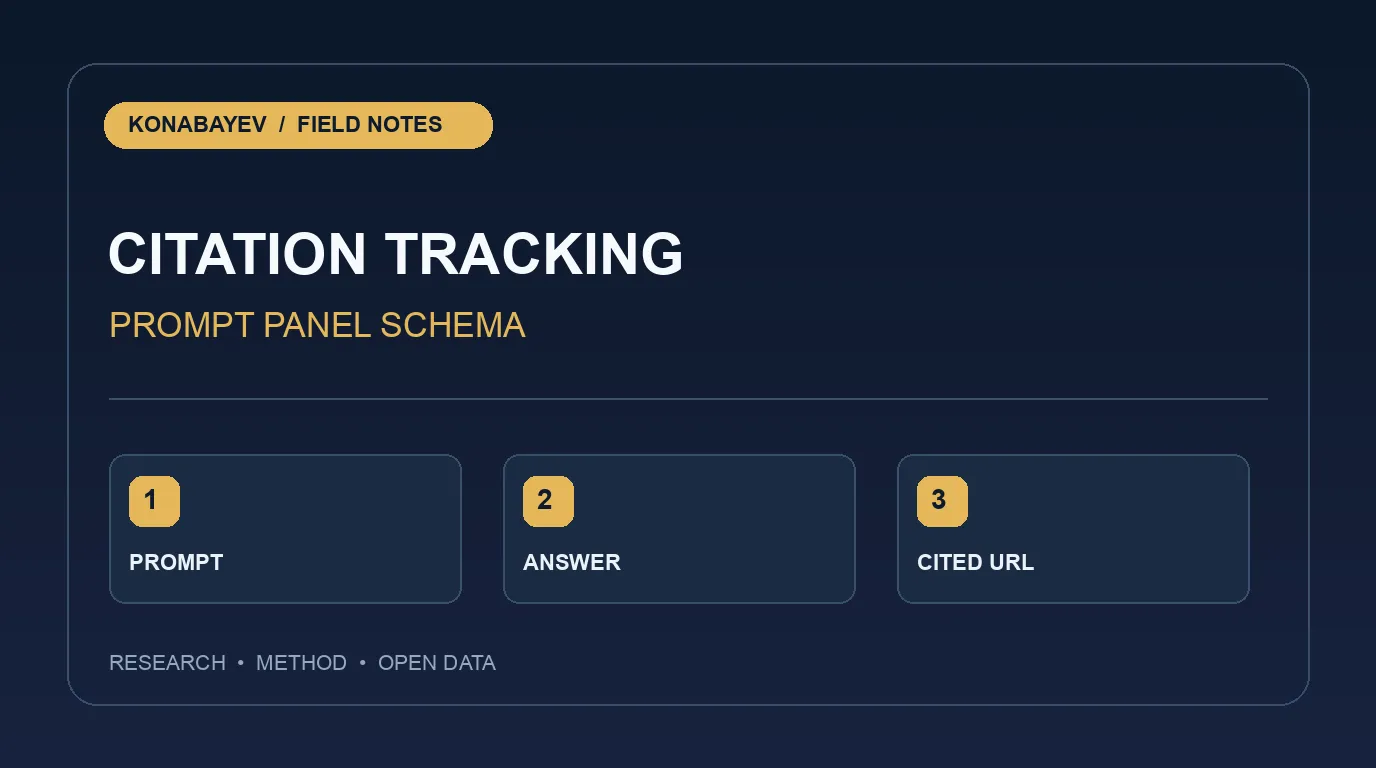
Log a dated answer for a fixed prompt, then record each cited URL on its own row. The blank citation log is ready to fill and the field dictionary defines each column. The row grain is answer ID × cited URL; use one citation_type = none row when an answer has no relevant citation so absences remain countable. The files are templates, not a dataset of tested AI answers. They contain no observed citation results. Limit: the schema cannot prove citation coverage until a fixed prompt panel is actually run and its answers saved.
| Field | Why it matters |
|---|---|
prompt_id, prompt_text, intent, panel_version | Keeps the question set stable and separates informational from buyer questions |
platform, model_or_mode, market, language, collected_at, run_number | Makes repeated answer collection reproducible |
answer_id, answer_url_or_evidence, cited_url, citation_type, citation_position | Preserves the answer and each linked source or explicit absence |
our_site_cited, our_brand_mentioned, competitor_domain, notes | Separates a linked site citation from an unlinked brand mention |
In the dictionary, required = yes means the column belongs in every row; a value may be blank when it does not apply, such as cited_url on a none or unlinked brand_mention row. Record each distinct cited URL once per answer. Set our_site_cited for a linked URL on the declared domain and our_brand_mentioned for an unlinked name in the answer.
Choose a useful prompt panel
Start with questions a real buyer asks before selecting a tool or service. Include brand-neutral informational questions, product comparisons and problem-specific questions. Freeze the prompt text, location and language for a reporting period. If you change the panel, start a new version; otherwise a trend can be caused by your own prompt edits.
For example, a B2B marketing site might monitor “How do I measure AI referral traffic in GA4?” and “Which analytics tool records assistant referrers?” Those are candidate prompts, not claims that we have run them or earned citations. Record a competing source only when it actually appears in a saved answer. Keep screenshots or answer URLs where the platform permits; redact personal data.
Sampling answers is inherently unstable. A tool may personalize, rotate sources or change retrieval between runs. Repeated observations improve your understanding of volatility, but a fixed convenience panel cannot estimate the percentage of all AI answers that cite a domain. Label the report “citation coverage in our tracked prompt set,” with numerator, denominator, platform and date.
Keep three measurement layers separate
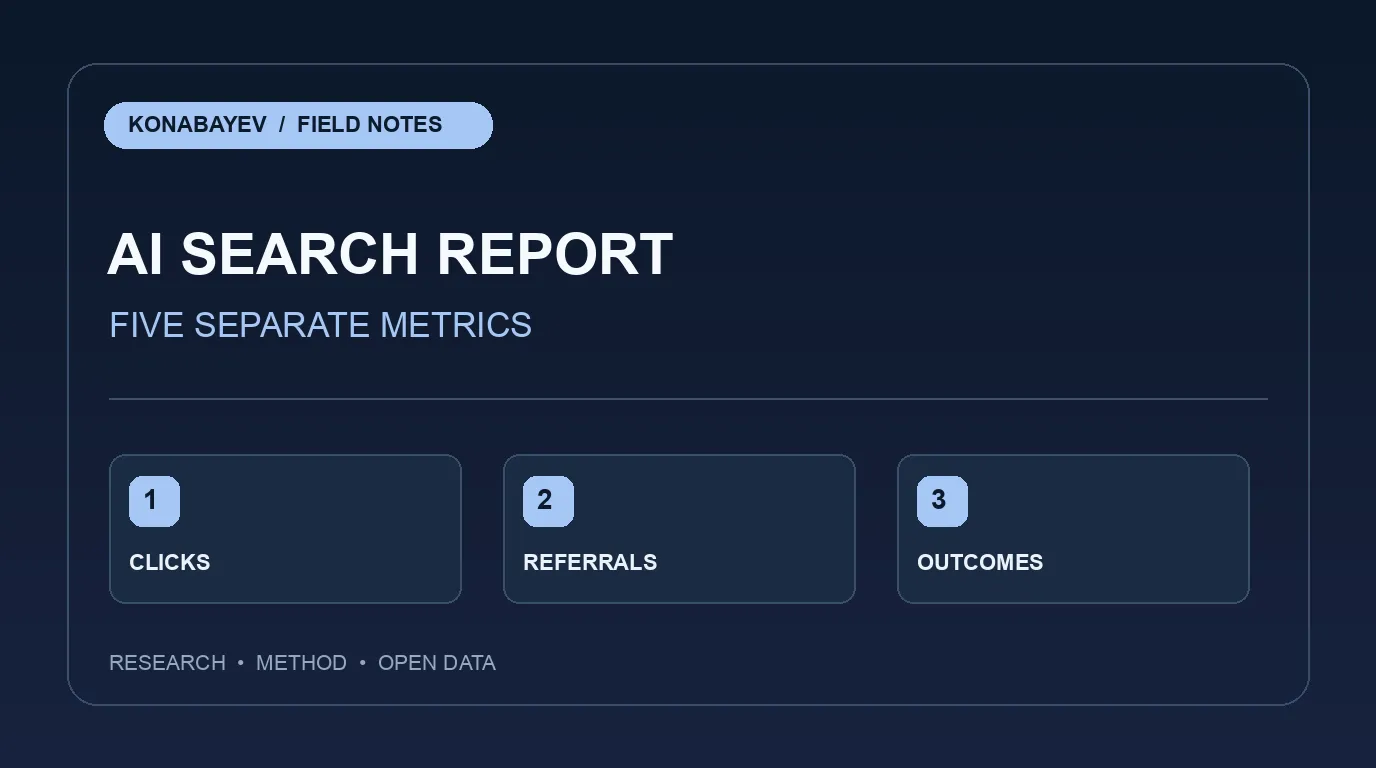
Citation layer: Did the answer contain our URL, a plain brand mention, or neither? Referral layer: Did GA4 or PostHog observe a session or pageview from a recognizable assistant source? Outcome layer: Did a visitor perform a defined qualified action? A citation may have no click. A direct visit might have been influenced by an answer but cannot be attributed to it from missing referrer data. Keep referral and action aggregates in a separate report, not duplicated on every cited-URL row.
Join layers only when there is a defensible key such as an exact landing URL and aligned reporting window. Do not infer individual user journeys from aggregate tables. The GA4 and PostHog workflow covers source classification; the five-metric report keeps aggregate outcomes separate. Our Perplexity measurement guide illustrates why a citation and referral are different events.
Review and act
Each month, compare the same prompt panel by platform. For lost citations, inspect the exact question, saved answer and cited alternatives, then check whether your page remains accurate and useful. Prioritize prompts with qualified commercial intent and a relevant destination. If a citation improves but leads do not, inspect the landing page and offer before calling the experiment successful.
For reporting, publish coverage, not a vanity total: “X of Y fixed buyer prompts cited us on platform Z on date D.” Keep the same number of run_number repeats for every prompt. Count a distinct prompt_id as covered if any recorded run on that date linked to our site; use the number of distinct tested prompt IDs in that panel version as Y. Report the repeat count because an “any run” rule becomes easier to satisfy when more runs are added. Brand mentions should be reported separately from linked citations. Attach the method and note answer variability. A field dictionary and a dated sample make the claim reusable by colleagues and credible to outside readers.
FAQ: recording and reporting citations
Does an unlinked brand mention count as a citation?
No. Record a brand mention with our_brand_mentioned and a linked URL with our_site_cited. A product can be named without a source link, and a source link can appear without a brand name in the answer text. Combining the two would exaggerate citation coverage. The field dictionary defines both flags so a later analyst can reproduce the classification. If you use a different definition, publish it alongside the result.
What is the denominator for prompt coverage?
Use distinct prompt_id values actually tested for the stated platform, panel version and date, with the declared number of repeated runs per prompt. Count a prompt as covered if at least one saved answer in those runs linked to the site, and label that any-run rule. Do not divide by every possible buyer question or by Ahrefs’ modeled response total. A change in prompt count or repeats can change the coverage rate without any change in the underlying answer system.
How often should the prompt panel be refreshed?
Keep the same panel long enough to compare repeated observations, then version intentional changes. A monthly pass may suit a small B2B site, while volatile high-priority prompts may justify more frequent checks. There is no universal sample size in this template. Record date, market, language, platform and run number for every saved answer so a future chart does not silently compare different conditions. Google’s GA4 traffic acquisition guidance defines a separate session measure; it must not be substituted for this answer-level sample.
Last verified: September 2026. The downloadable files are a blank schema and dictionary, not observed AI answer results.
Ready to grow your business?
Get a marketing strategy tailored to your goals and budget.
Start a ProjectGoogle Preferred Sources
See more of my research in Google
Add Konabayev.com as a preferred source to find more fresh marketing and AI research in Google Search.