A One-Page, Five-Metric AI Search Report for B2B Teams
The report to send, and the claim each metric permits
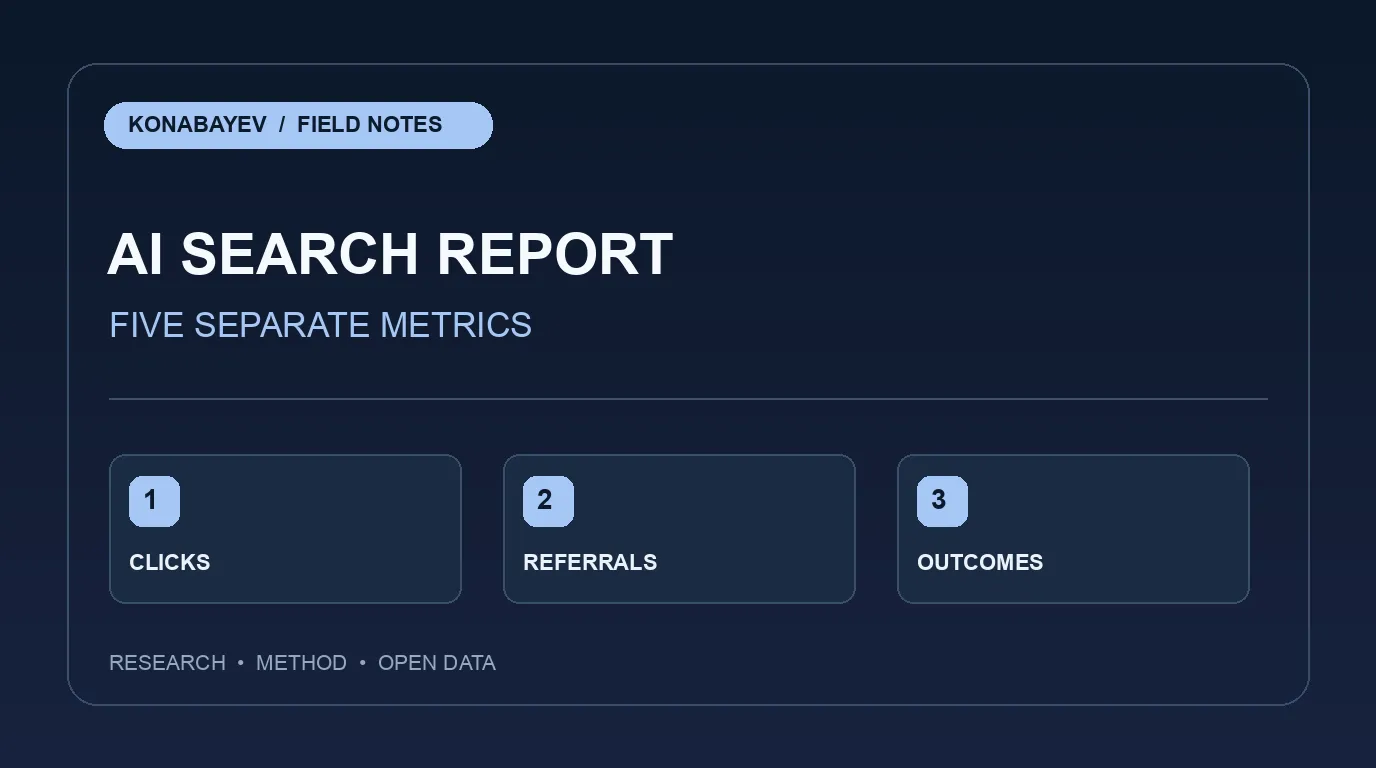
Report Google clicks, assistant-attributed sessions, modeled AI visibility, tracked citation coverage and qualified actions separately. Each row needs its own source, denominator and window. Limit: this report schema cannot prove a causal link between the five rows. The downloadable report schema includes example site aggregates from the equal August 1–28 and August 29–September 25, 2026 windows and blanks where no defensible aligned observation exists.
| Metric | Example for Konabayev.com | Do not infer |
|---|---|---|
| Google Search clicks | 390 vs 380 in equal 28-day windows ending Sep 25 and Aug 28 | That all pages grew |
| GA4 AI Assistant sessions | 78 vs 123 in those same windows | That all AI citations fell 37% |
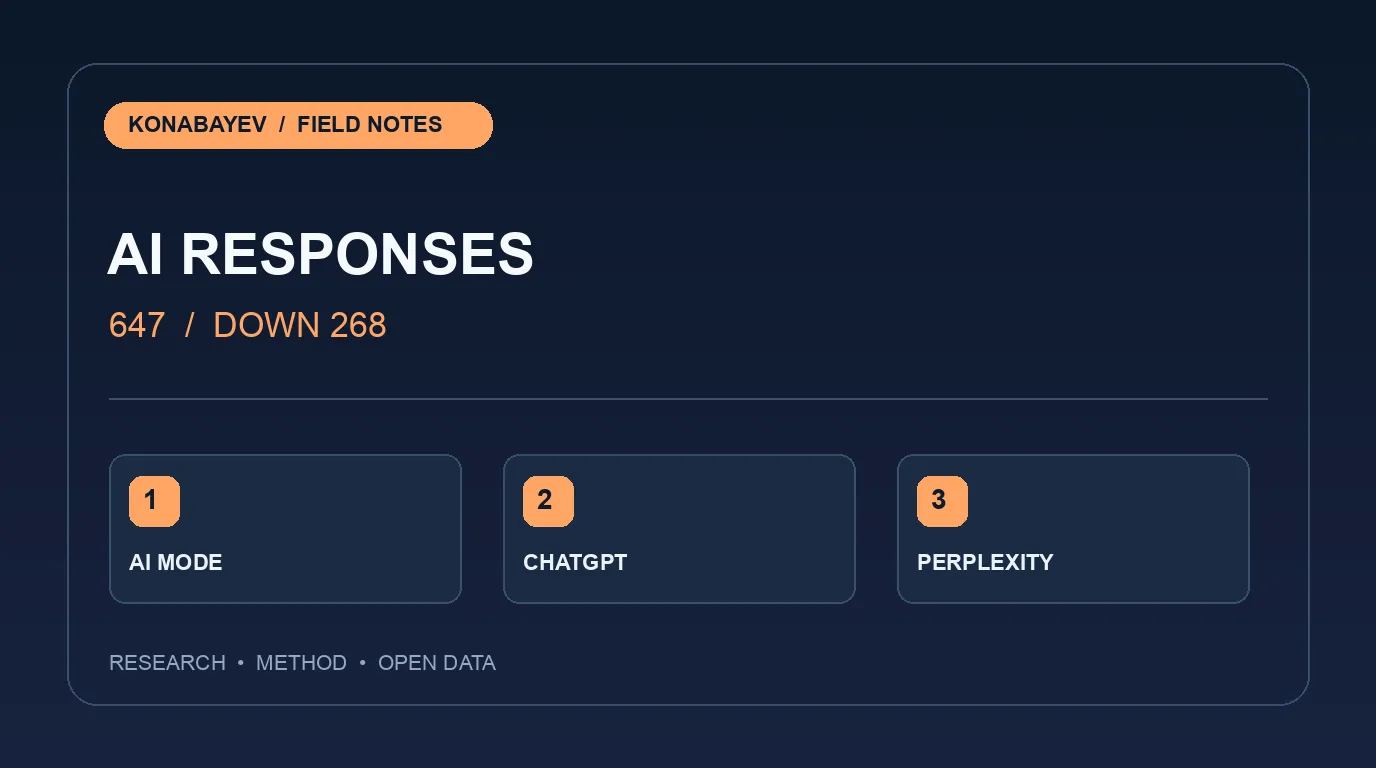
| Ahrefs AI responses | 647, down 268 in its displayed last-month comparison | That 268 people stopped visiting |
| Citation coverage | No fixed prompt-panel result available | That a modeled total is a citation coverage rate |
| Qualified actions | No aligned 28-day comparison available | A revenue trend from an unmeasured row |
The fifth row is not measured for a comparable 28-day change. Separately, a recent seven-day PostHog snapshot had two main CTA clicks, one affiliate click and zero email signups; it is too small and differently dated to fill that row. The citation-coverage row is also a structural placeholder until a fixed prompt panel is actually observed. A blank cell is better than a number that only looks complete.
Definitions before the chart
For each metric, specify period_start, period_end, source and unit. GSC clicks count Google Search result clicks. GA4 AI Assistant is a session classification, which depends on recognizable source information. Ahrefs responses are a third-party indexed-visibility metric whose exact lost prompts and citations were not in the owner-provided overview. A tracked citation requires a saved answer from a declared prompt panel. A qualified action needs an actual event definition, such as an inquiry submitted or an affiliate click; do not silently substitute pageviews.
The example shows why this discipline matters. The Ahrefs decline and GA4 AI-session decline point in the same direction, but Perplexity (+26) and AI Overviews (+14) rose, while AI Mode (−144), ChatGPT (−99) and Gemini (−64) fell; Copilot was nearly flat (−1). The platform case study owns the full table. GSC clicks rose overall while the rest of the editorial portfolio weakened; the concentration case study owns that calculation.
A one-page monthly workflow
- Freeze the previous completed calendar window. Use equal day counts and preserve the property time zone.
- Export GSC page and query rows, GA4 channel and landing-page rows, and your answer observations. Label any third-party modeled estimate with its own date controls.
- Fill the five metric rows. Add only two diagnostic breakdowns: top landing pages and assistant source. If a metric is missing, write “not measured.”
- Write one decision sentence: “Which page, question or outcome changed enough to warrant action?” If the answer depends on unavailable prompt-level data, the action is to obtain that data, not to rewrite the whole site.
- Recheck the same cohort after a change. Keep an untouched comparison where possible and avoid declaring a win from impressions alone.
The field schema is designed for a monthly stakeholder note, not an analytics replacement. A larger dashboard may be justified once a team has reliable conversions and many landing pages; a small site gains more from correct definitions and a readable decision record.
Use our AI citation template to build the fourth row and the GSC–GA4 worksheet if the first two sources appear inconsistent. The Ahrefs response case study explains the actual example in depth.
For an alert rather than a monthly update, follow the AI visibility diagnostic checklist. The five rows provide context; they do not by themselves identify a causal page or platform change.
What a decision-ready monthly note looks like
Write the observed movement, its scope and the next test in separate sentences. For example: “Our equal-window GSC Web clicks moved 380 → 390, while clicks outside the leading review moved 196 → 147. GA4 AI Assistant sessions moved 123 → 78 in those same windows. We will inspect the declining non-review pages and the assistant source landing pages before changing content.” That is a decision note, not a claim that an Ahrefs count caused a session change. Google’s Search Console performance documentation provides the click definition.
A report should also make blank rows conspicuous. In the example CSV, citation coverage has no fixed prompt-panel sample and qualified actions have no aligned 28-day comparison. An executive can still act: commission a prompt sample, validate the conversion event and investigate the pages responsible for the rest-of-site decline. Filling those blanks with unrelated seven-day counts would create a false trend. The GA4 traffic acquisition guide is the definition reference for sessions, but property-specific channel rules still need to be documented locally.
FAQ: the five-metric report
Why leave citation and outcome rows blank?
Because a comparable, dated measurement was unavailable in this case. An Ahrefs domain overview is not the same as a saved answer from a fixed prompt panel, and a recent seven-day CTA snapshot is not a matched 28-day qualified-action trend. State “not measured” and the collection step. That preserves a complete reporting structure without manufacturing completeness in the evidence. Use the citation log template when answer-level observations become available.
Can Ahrefs AI responses stand in for referral traffic?
No. The 647 Ahrefs responses are a modeled visibility count in the screenshot’s last-month view; GA4 AI Assistant sessions are attributed browser sessions in specific equal calendar windows. Their simultaneous declines are a reason to investigate, not proof that each response produced a visit or that the tool windows align. Report each with source, unit and dates, and keep the platform breakdown attached when describing the modeled movement.
Which business action belongs in the fifth row?
Choose an event that matters to the site’s actual funnel, such as a qualified inquiry or verified affiliate click, with a stable definition and matching time window. A pageview is not interchangeable with a lead. The site’s available seven-day snapshot was too small and differently dated for the 28-day example, so the fifth row stays blank. When enough data exists, segment the action by landing page and source before attributing value to a new article.
Last verified: September 2026. The CSV intentionally distinguishes observed values from unmeasured placeholders.
Ready to grow your business?
Get a marketing strategy tailored to your goals and budget.
Start a ProjectGoogle Preferred Sources
See more of my research in Google
Add Konabayev.com as a preferred source to find more fresh marketing and AI research in Google Search.