AI Visibility Dropped: A Diagnostic Checklist
Direct answer
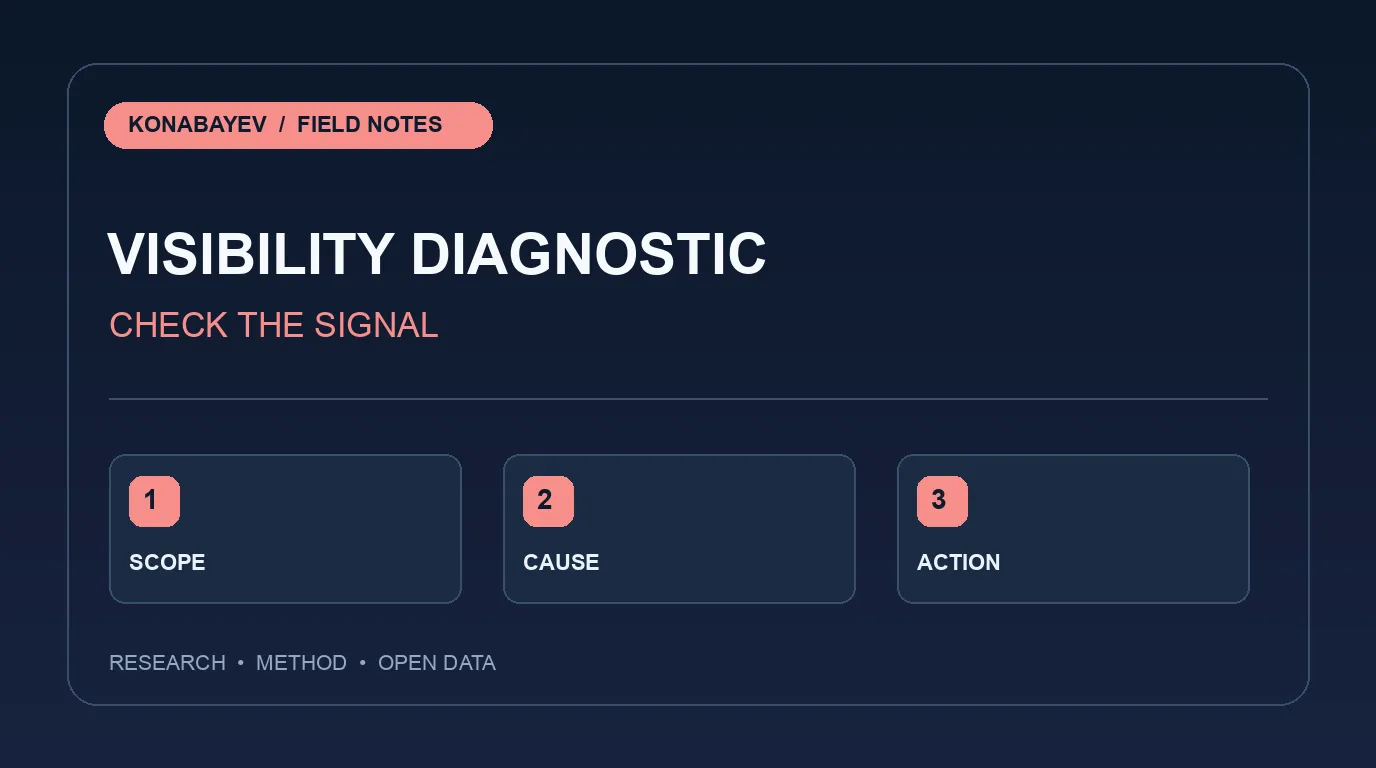
Before rewriting after an AI visibility drop, verify the tool’s unit, then check affected prompts, pages, search demand, referrals, technical access, cited competitors and qualified actions in that order. A modeled response is not automatically a citation, session or lead. This checklist is a procedure; our single-site Ahrefs case study owns the dated platform numbers.
| Alert | First check | Premature conclusion to avoid |
|---|---|---|
| Modeled AI responses fall | Platform, prompt sample, exact comparison settings | “The whole site lost AI traffic” |
| GSC clicks fall | Affected URLs, queries, country and equal windows | “The whole site was deindexed” |
| GA4 assistant sessions fall | Session source, landing page, channel definition | “Citations fell by the same amount” |
Start with the lost unit
When an AI visibility dashboard turns red, identify what the tool counted before changing content. An “AI response” can be a modeled appearance in a monitored answer set; it is not necessarily a cited URL, a referral click or a lead. Save the comparison settings, platform, country, scope and dates. Export the lost prompt and citation rows if the account exposes them. If it does not, record that limitation and avoid assigning a page-level cause from a domain total.
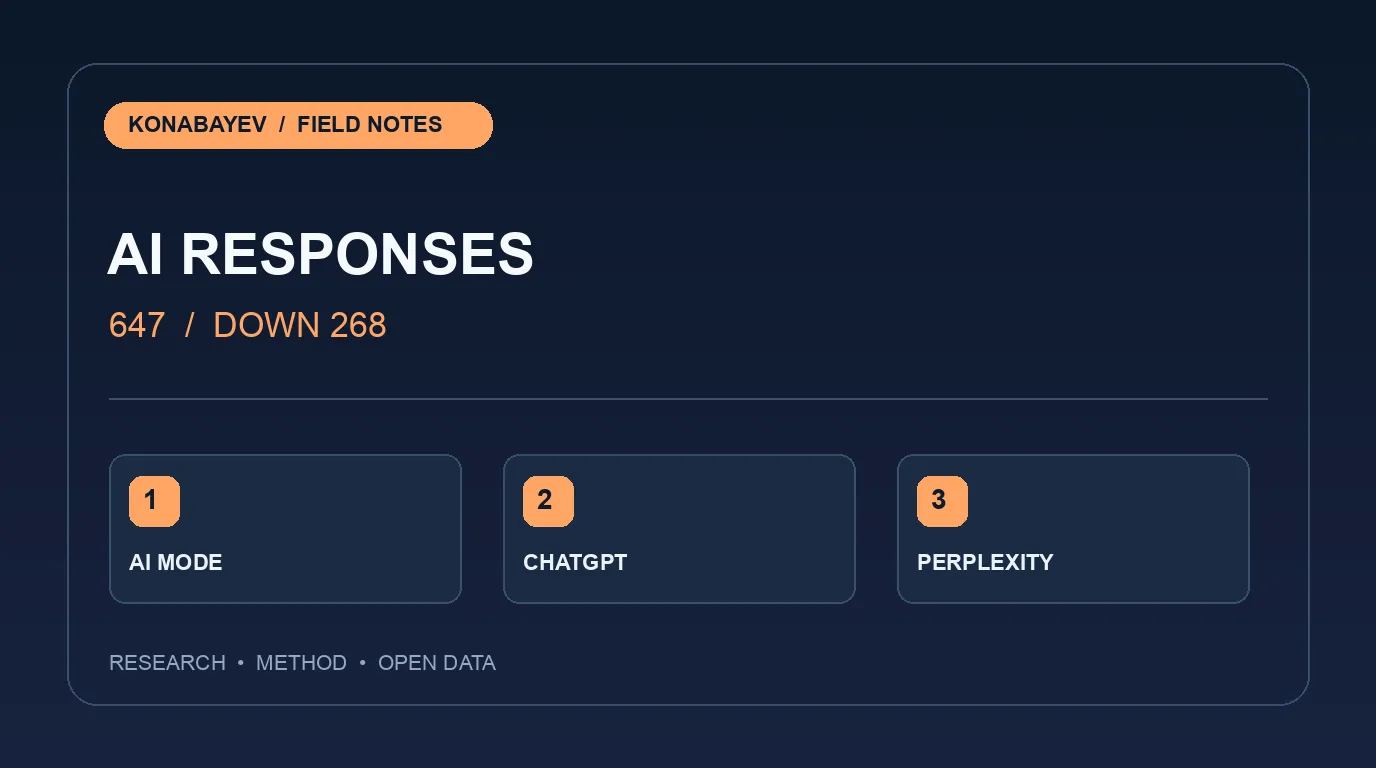
On konabayev.com, Ahrefs Site Explorer displayed 647 responses, down 268 in its last-month view observed September 28, 2026; Copilot was nearly flat at 59 (−1) while platforms moved in different directions. Separately dated GA4 and GSC comparisons also diverged. These are compatible observations, not proof that one caused another. The full case study lists every platform and window.
The decision tree
1. Is the unit or reporting window different? Compare like dates and targets. A modeled response trend is not directly reconciled to a session total. If the exact Ahrefs calendar window is unavailable, keep it as a separate comparison.
2. Did the loss occur on known prompts or pages? If you have prompt-level data, group by question, cited URL and competing domain. Separate a disappeared prompt from a prompt that remains but cites a different page. If you have only the overview, do not jump to a rewrite list.
3. Did search demand or ranking change? For affected pages, compare GSC clicks, impressions, queries and average position in equal complete windows. Segment a single winner from all other pages. Our click concentration example shows why a site total can hide that split.
4. Did measured assistant referrals change? Inspect GA4 session source, landing page and key events; check PostHog referring domain for the same pages. A direct or missing referrer is unclassified, not automatically an AI visit. The AI referral measurement guide gives the host-level QA method.
5. Is there a technical obstacle on the affected URL? Check live response, canonical, robots policy, render, internal entry point and Search Console URL Inspection. Do not treat a domain-level index rate as proof that the page in question disappeared. In our dated URL Inspection cohort, the currently nonindexed pages had the same two clicks in both measured windows; that specific comparison did not explain the observed click decline.
6. Is there a stronger competing answer? Open the actual cited pages for the affected prompt. Compare factual currency, directness, evidence, scope and commercial fit. Add original evidence or repair an outdated claim only when the comparison identifies a real gap. Keep the change bounded enough to evaluate.
7. Did a qualified action move? A visibility recovery that produces no relevant sessions or leads may still matter for awareness, but it is not yet a business recovery. State the conversion event and attribution window before evaluating it.
The five-line incident record
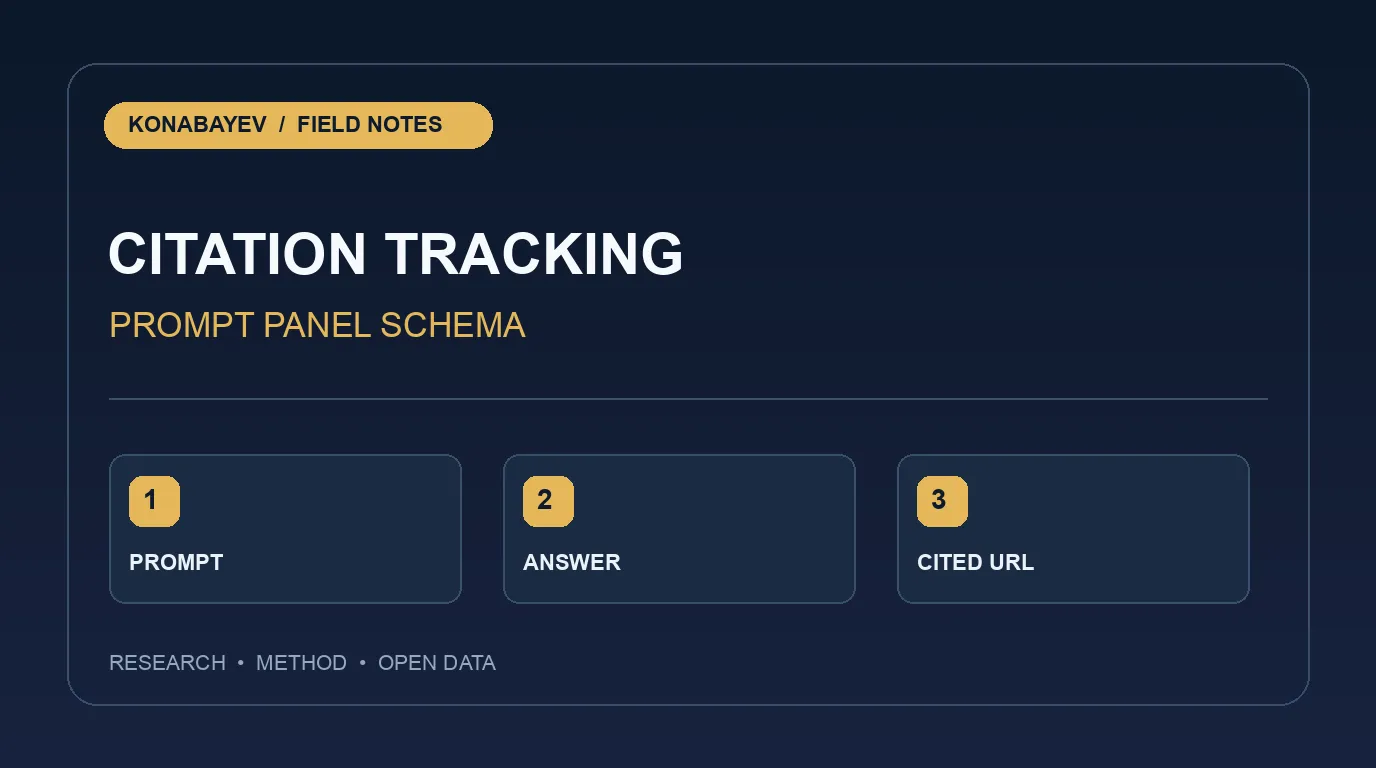
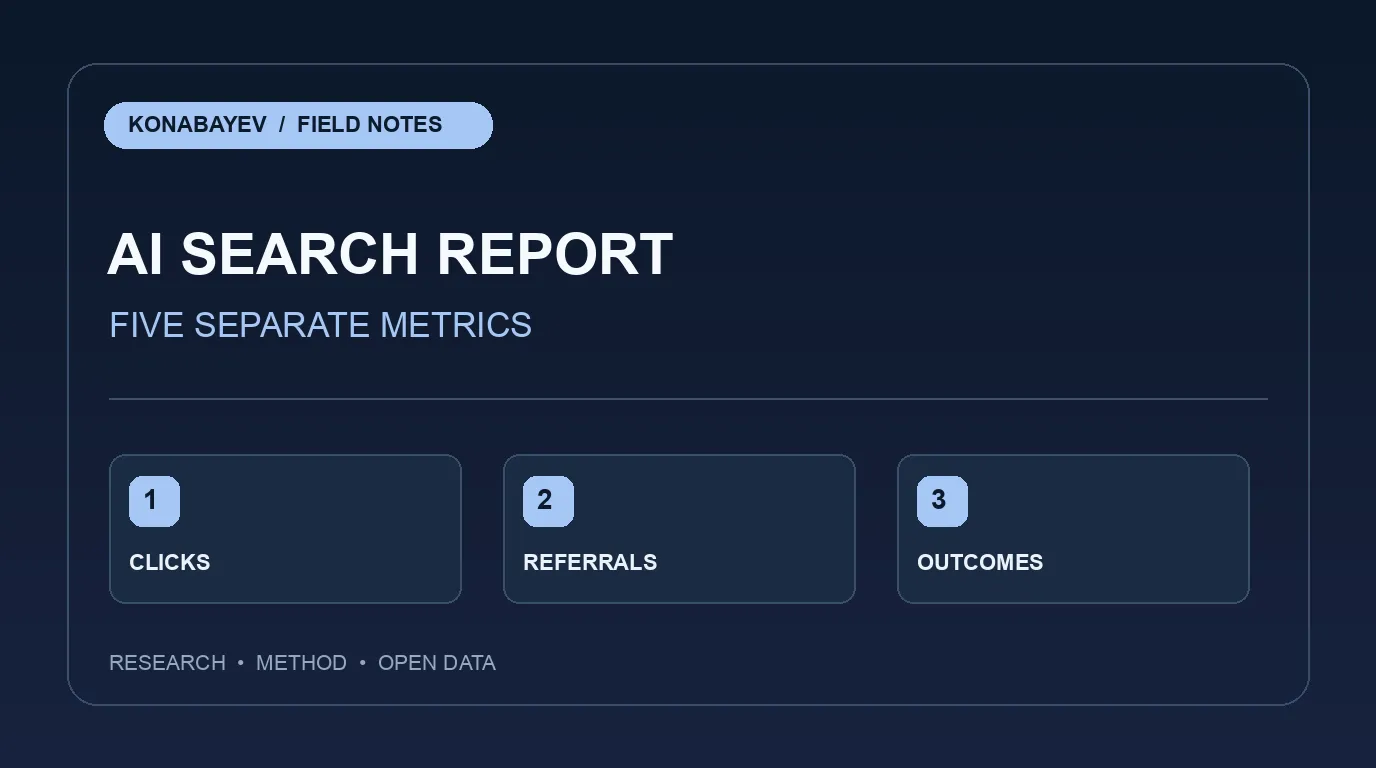
For each investigation, write: symptom and unit; affected platforms/pages; equal-window owned traffic; leading hypothesis with contrary evidence; next test and stop date. This prevents a dashboard alert from becoming a site-wide content rewrite. The five-metric report template provides the monthly baseline, while the citation tracking schema lets you collect the answer-level evidence that a domain overview lacks.
If the exact lost citations remain unavailable, the defensible conclusion is bounded: “modeled response visibility declined in this tool, and attributed assistant sessions also declined.” It is not a diagnosis of which page, crawler or competitor caused the change.
FAQ: diagnosing an AI visibility alert
What is the first check after an alert?
Confirm the unit and comparison settings. Record the platform, property, market, date filter and exact change shown by the tool. Check whether its index, prompt set or dashboard definition changed before reading the movement as site behavior. Then compare with owned outcomes in equal completed windows. In our case, the Ahrefs overview’s exact lost prompts and calendar boundaries were unavailable, so the first conclusion is limited to a modeled response decline, not a known lost-citation list.
When should a page be rewritten?
After you identify a page and query or answer cluster with a real gap that the page can fix. Check factual currency, crawlability, intent, source evidence and qualified actions. A broad response decline with no lost URL export is too weak to justify rewriting every article. Google’s Search Console performance report guidance provides a page-and-query view of search clicks, while the citation log template can collect answer-level evidence for a fixed prompt sample.
Can an Ahrefs overview reveal which competitor replaced us?
Not from the overview shown here. It has platform totals and page counts, but no exact before-and-after prompt, cited URL or competing source list. Inspect actual saved answers for a small relevant prompt panel and record the date and market. If the historical answer was never captured, do not invent a replacement story. The single-site Ahrefs case study publishes the platform arithmetic and the uncertainty around the absent prompt detail.
Last verified: September 2026. This is a triage process, not a claim that the site’s lost AI citations have been identified.
Ready to grow your business?
Get a marketing strategy tailored to your goals and budget.
Start a ProjectGoogle Preferred Sources
See more of my research in Google
Add Konabayev.com as a preferred source to find more fresh marketing and AI research in Google Search.