Ahrefs AI Responses: A 29% Modeled Drop on One Site
Direct answer
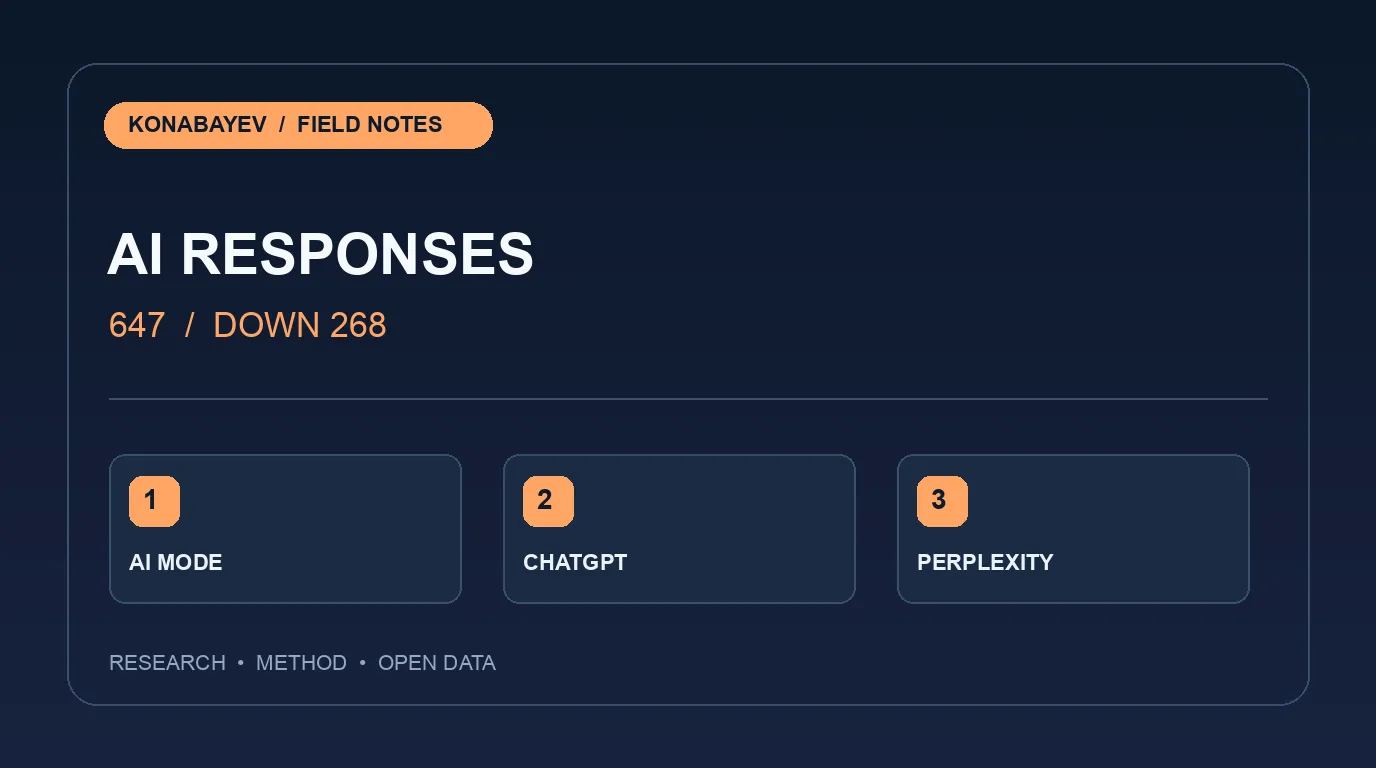
On September 28, 2026, Ahrefs Site Explorer displayed 647 modeled AI responses for konabayev.com, down 268 from an implied 915 (29%) in its last-month comparison. Google AI Mode, ChatGPT and Gemini fell; Perplexity and Google AI Overviews rose; Copilot was nearly unchanged at 59 (−1). Our GA4 AI Assistant sessions also fell in a separately dated comparison. We cannot identify the lost prompts or prove a single cause from the Ahrefs overview.
This is one website’s September 2026 case study. It is useful as a diagnostic example, not a market benchmark for how often AI systems cite sites. Download the six-platform CSV for the displayed Ahrefs counts and deltas.
The response loss was not uniform
| Platform in Ahrefs | Current responses | Change vs Ahrefs prior period | Implied prior count |
|---|---|---|---|
| Google AI Mode | 155 | −144 | 299 |
| ChatGPT | 35 | −99 | 134 |
| Gemini | 76 | −64 | 140 |
| Perplexity | 199 | +26 | 173 |
| Copilot | 59 | −1 | 60 |
| Google AI Overviews | 123 | +14 | 109 |
| All platforms | 647 | −268 | 915 |
The previous counts are arithmetic (current − displayed change), not a separate historical export. The six platform rows, including Copilot, sum to Ahrefs’ displayed all-platform total. Ahrefs also displayed 48 pages, down six in its AI responses panel. That page count is not a traffic measure.
The largest absolute losses were AI Mode (144) and ChatGPT (99). That gives the investigation a place to start, but it does not tell us which prompts changed, whether a citation moved to a competitor, or whether the index sampled different answers. A rewrite chosen from this aggregate alone would be guesswork.
What the owned traffic systems showed
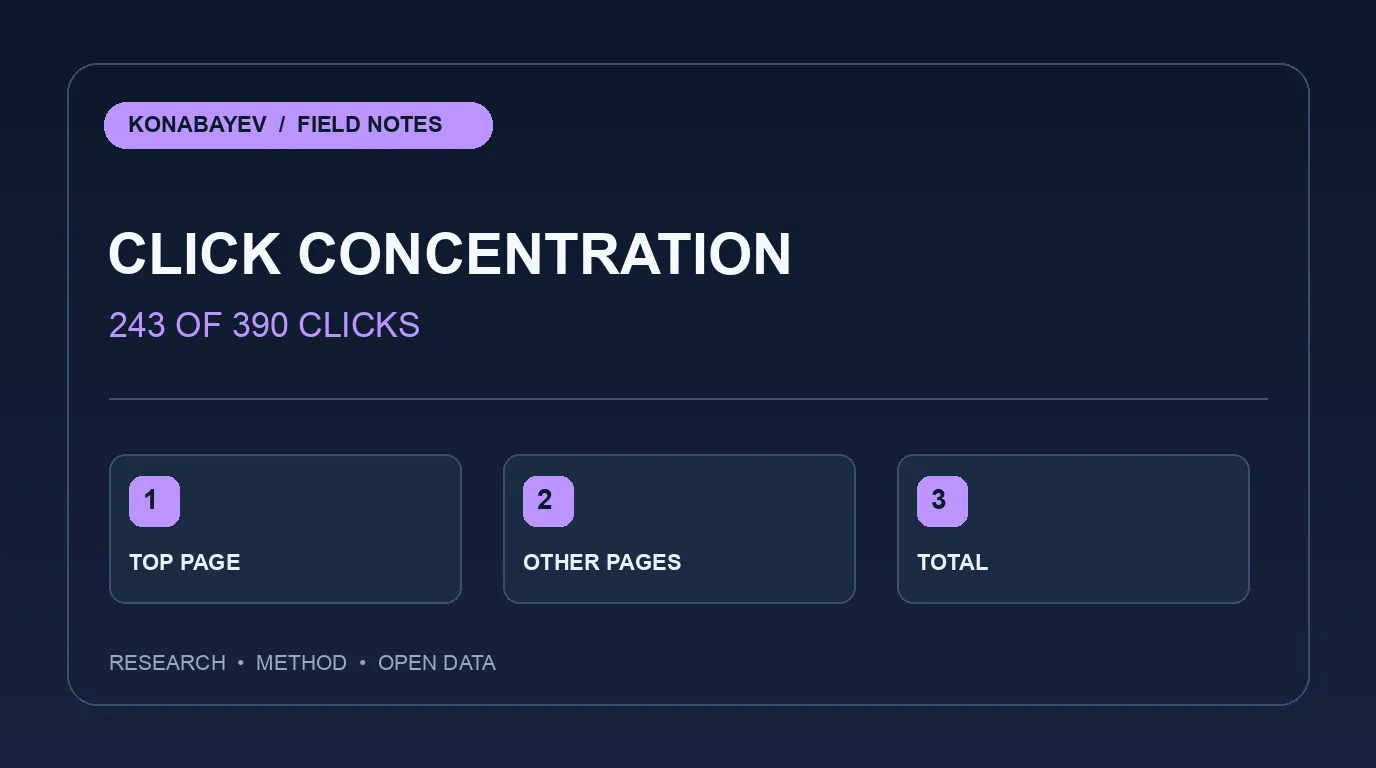
For the equal, complete 28-day windows August 1–28 and August 29–September 25, 2026, Google Search Console recorded 380 → 390 total clicks. One review accounted for 243 of 390 current clicks (62.3%), masking a decline across other pages. The click concentration case study contains the full page split and stress-test worksheet. GSC Search clicks are not assistant referral sessions, and the site export does not isolate clicks from Google AI features inside Search.
In GA4, total sessions for those windows were 4,226 → 4,197 (roughly flat). GA4’s AI Assistant channel recorded 123 → 78 sessions (down 45, or 36.6%). Organic Search recorded 519 → 548. A later complete 28-day comparison, August 4–31 versus September 1–28, showed AI Assistant 121 → 73 (down 48) and Organic Search 552 → 505 (down 47). These are separate rolling windows with different trend directions for Organic Search; do not merge their endpoints.
PostHog browser sessions across the original two windows were 2,967 → 2,725 (down 8.2%), while GA4 total sessions were roughly flat. The totals diverge materially because the tools capture and define sessions differently. These site totals do not independently establish a PostHog AI-referral decline; the GA4 AI Assistant channel is the aligned source-specific observation here.
| Signal | What it can establish | What it cannot establish |
|---|---|---|
| Ahrefs AI responses | Modeled appearances in its tracked answers | Actual sessions, leads or every live answer |
| GSC clicks | Clicks from Google Search surfaces | ChatGPT or Perplexity referral clicks |
| GA4 AI Assistant sessions | Sessions classified into that channel | Every citation or direct visit influenced by AI |
| PostHog referrers | Observed referring hosts on captured events | Attribution when the referrer is absent |
| GSC URL Inspection | Google’s reported status for checked URLs | Why a model did or did not cite a page |
Did indexing break across the site?
A follow-up URL Inspection run checked all 162 English blog URLs without API errors. The 54 URLs nonindexed at that inspection accounted for two GSC clicks in each of the equal August 1–28 and August 29–September 25 windows; seven URLs that lost indexed status also had two clicks in each. Those seven are within the 54, not a separate source of clicks. That comparison does not support these cohorts as the source of the measured 49-click decline outside the leading review. It does not rule out unrealized demand on those pages or effects on modeled AI responses. See the 162-URL indexation cohort for the dated statuses, transition file and method.
This distinction matters because the default reaction to a falling AI response counter is often to edit many articles at once. If the affected pages and prompts are unknown, mass edits introduce noise and can worsen already weak differentiation. First locate lost citations or affected pages, then test a content hypothesis on a small set.
What we investigate next
The overview does not expose the lost prompts or citation URLs. We need those rows, if the account provides them, before choosing pages to edit. For each affected question we would then compare the cited alternatives, GSC demand, source-level referrals and qualified actions. The AI visibility diagnostic checklist owns the full procedure; the GA4 and PostHog workflow covers referral classification.
Method and limits
The Ahrefs counts come from the owner-provided Site Explorer overview observed September 28, 2026, with “Changes: Last month.” The screenshot did not expose lost prompts, citation URLs, per-country breakdowns or exact comparable calendar dates. GSC, GA4 and PostHog figures come from the site’s authorized aggregate reporting and use the dates stated above. No personal visitor data is included in the downloadable CSV.
If you cite this case, describe it as Konabayev.com, one site, Ahrefs Site Explorer overview observed September 28, 2026, 647 modeled responses in its displayed last-month view (−268); exact tool-window dates and lost prompts unavailable. Attribute the tool counts to Ahrefs and use the public six-platform CSV for arithmetic. This does not establish that a specific algorithm, crawl policy or competitor caused the drop. For broader research, see our AI search statistics evidence review.
FAQ: interpreting the decline
Did 268 fewer responses mean 268 lost visits?
No. The Ahrefs figure is a count in a third-party AI visibility index. A response can include a link without producing a click, and a reader can visit without preserving an assistant referrer. The GA4 AI Assistant session comparison is a separate, dated measurement. It moved in the same broad direction here, but it cannot be subtracted from the Ahrefs number or used to reconstruct the missing prompts. Google’s Traffic acquisition report documentation explains the session unit behind the GA4 side of that comparison.
Did the nonindexed blog URLs cause the response decline?
The evidence does not establish that. The September URL Inspection snapshot found 54 currently nonindexed English blog URLs, but the exact Ahrefs lost citation URLs were not exposed. The current nonindexed cohort contributed two GSC Web clicks in each of two equal prior windows. That rules out those URLs as the observed click-loss cohort in that particular comparison; it does not prove that index status was stable during the windows or that those pages have no future value. See the 162-URL cohort for method and counts.
Why did Perplexity rise when other platforms fell?
The overview shows different platform movements, but not their causes. Each answer system can have its own retrieval, prompt set and update cycle. Ahrefs’ displayed comparison also lacked the underlying prompt and URL list in this view. The practical response is to inspect a fixed set of relevant prompts per platform and compare cited URLs over time, then check whether those pages receive qualified visits. Our citation log template specifies that observation record without pretending the missing historical answers exist.
Last verified: September 2026. The counts describe the owner-provided Ahrefs view observed on September 28, not an ongoing live measure.
Ready to grow your business?
Get a marketing strategy tailored to your goals and budget.
Start a ProjectGoogle Preferred Sources
See more of my research in Google
Add Konabayev.com as a preferred source to find more fresh marketing and AI research in Google Search.