Which Marketing Experts Do AI Models Recommend? 796-Answer Study
On the night of November 10–11, 2026, I asked five AI models 32 versions of the same question: “Who are the best [kind of marketing expert] [in a city]? Name specific people, not agencies.” Each question ran five times per model. In 160 model-and-question pairs, no model gave the same non-empty list of names in all five runs. Global questions got long, overlapping lists of well-known people. Local questions got short lists or none: answers about Almaty named nobody from the reviewed name list in 122 of 150 cases.
This is original data. The question it answers is narrow: when a buyer asks an AI model to recommend a person, who gets named, how stable is that list, and does it change by city and language? It does not measure who is actually the best at anything.
Cite This Study
- Canonical URL: https://konabayev.com/blog/ai-recommended-marketers-study-2026/
- Names and counts: CSV
- Run-to-run consistency per model and question: CSV
- Overlap between models per question: CSV
- Answers that named nobody, by model and city: CSV
- Everything in one file: JSON
- Chart: SVG
- Suggested attribution: “Konabayev (2026), Which Marketing Experts Do AI Models Recommend?”, with a link to this page.
Key Findings
- No list repeated. In 0 of 160 model-and-question pairs did all five runs return the same non-empty set of names. Another 27 pairs were “identical” only because all five answers named nobody.
- Most names come and go. In the 95 pairs where every run named someone, the average overlap between two runs (Jaccard similarity) was 0.39. Only 15% of the names a model gave for a question appeared in all five of its runs.
- Global questions converge; local ones do not. Answers to global questions named nobody from the reviewed list in 1 of 199 cases. For London it was 8 of 148, Berlin 34 of 150, Dubai 61 of 149 and Almaty 122 of 150.
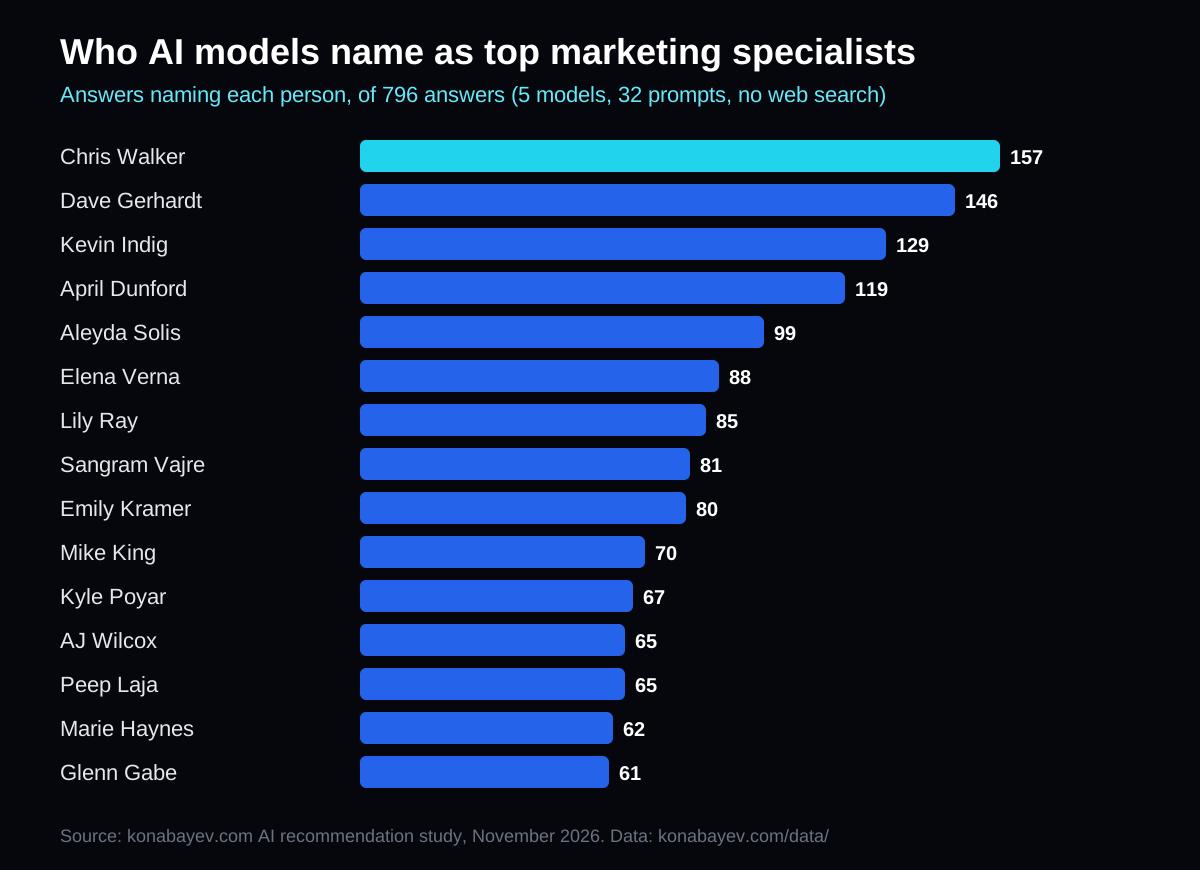
- A small group of names dominates. Chris Walker was named in 157 of 796 answers, Dave Gerhardt in 146, Kevin Indig in 129, April Dunford in 119 and Aleyda Solis in 99.
- Models agree more on SEO than on fractional CMOs. For the global SEO question, 13 people were named by all five models. For the global fractional CMO question, 3 were.
- Language changes the list. The Russian-language SEO question brought up Russian-speaking specialists. Sergey Koksharov was named in 22 of its 25 answers, Dmitry Sevalnev in 21 and Mikhail Shakin in 19. Across all English-language questions, each of them appeared in five answers or fewer.
- For Almaty, most models named nobody. Grok named nobody from the reviewed list in 30 of 30 Almaty answers, DeepSeek in 29, GLM in 27 and Claude in 23; most of these answers explicitly declined to name people without verification. Gemini named nobody from the list in 13. It usually did answer, but with local names that mostly appeared only once, so they are not on the list.
How the Study Worked
Questions. One template, filled in for six specialisms and five locations, plus two Russian-language questions: 32 questions in all. The wording was fixed before any answer was read.
- Template: “Who are the best {role}{location}? Name specific people, not agencies.”
- Roles: B2B marketing consultants; SEO consultants; generative engine optimization (GEO) consultants; demand generation consultants for B2B SaaS; fractional CMOs for B2B tech companies; LinkedIn marketing experts for B2B companies.
- Locations: no location (global), London, Dubai, Berlin, Almaty (Kazakhstan).
- Russian: «Кто лучшие B2B-маркетологи? Назови конкретных людей, а не агентства.» and the same question for SEO specialists.
Models. Claude Opus 5.5, DeepSeek V4.1 Flash, Gemini 3.8 Flash High, GLM-5.3 and Grok 4.7. Each question went to all five at once, five separate times. That gives 800 planned answers; 796 arrived. GLM missed three and Grok missed one.
Collection. Answers were collected through my own multi-model tool, which sends one question to several models in parallel. It was used instead of the consumer chat apps. This matters, and is the main limitation of the study:
- Each model received the question inside the same instruction, in full: “You are one independent model in a council. Give your best complete answer to the question. Check the reasoning, assumptions, constraints, risks, alternatives, edge cases, and success criteria yourself. The complete question and evidence are supplied below. Answer from this input directly; do not use tools or inspect files. Do not refer to other models or ask follow-up questions. The moderator receives your complete answer. Preserve the reasoning and any material uncertainty or dissent.” Then came the question. So models were told not to use tools, and no answer contained a URL. These are answers from the models’ own knowledge, not from ChatGPT-style search.
- The instruction asks the model to check its assumptions and risks, and says the “question and evidence” are supplied, although no evidence was attached. Both probably make refusals more likely than in a normal chat app.
- Some models ran through my own subscriptions, which can carry account settings. Gemini answered all 150 of its English-language questions in Russian, and Grok 132 of 149. Claude, DeepSeek and GLM answered in English. This may have shifted which names those two models reached for.
- Time window: one session of about four hours, November 10, 2026, 21:17 to November 11, 01:08, Almaty time (UTC+5). Two runs where only one model answered were repeated at the end of this window.
- A sixth model, Composer 2.5, became available partway through collection. It is excluded so that every model answered the same set of questions.
Counting names. A script pulled out everything that looked like a personal name: bold text, table cells and list items of two to four capitalised words. I then reviewed the list by hand. I removed phrases that are not people (“Fractional CMO”, “Dark Social”, “Astana Hub”) and merged spellings of the same person (Aleyda Solís and Aleyda Solis; Эйприл Данфорд and April Dunford; Michael King and Mike King). Only names found in at least two answers made the reviewed list, which has 523 entries. Each answer was then matched against it. Seventeen entries matched no answer from the five study models, because the extractor also read the excluded sixth model’s answers.
What is published. 506 reviewed names were matched at least once. 176 of them came from only one model. Only names given by at least two models are in the public files, 330 in total. One model repeating a name is not a signal across models. Many single-model local names also could not be checked against a real person in that role (see limitations).
Lists Change From Run to Run
Ask the same model the same question five times and you get overlapping but different lists.
Consistency is measured with Jaccard similarity: names in both lists divided by names in either list. 1.0 means identical; 0 means no name in common. Over the 95 model-and-question pairs where all five runs named someone:
| Model | Pairs where every run named someone | Average Jaccard between two runs | Share of names in all five runs |
|---|---|---|---|
| Claude Opus 5.5 | 18 | 0.52 | 27% |
| Grok 4.7 | 14 | 0.40 | 14% |
| DeepSeek V4.1 Flash | 17 | 0.37 | 14% |
| GLM-5.3 | 20 | 0.36 | 14% |
| Gemini 3.8 Flash High | 26 | 0.33 | 10% |
Claude was the most stable but still never repeated a full list. Gemini named someone most often and changed its list the most. On average a model gave 5 to 9 reviewed names per answer: Gemini 5.1, DeepSeek 5.7, Grok 7.9, Claude 8.4, GLM 8.8.
This matches what SparkToro and Gumshoe reported from consumer AI tools across 2,961 prompts: fewer than 1 in 100 runs returned the same list. That study and this one used different questions and different tools, but they reach the same conclusion. Being named once is not a position you hold.
Global Questions Converge, Local Questions Do Not
The more specific the place, the more often models name nobody. Outside the global questions, they also agree less.
| Location | Answers | Answers naming nobody from the reviewed list | Average Jaccard between runs (pairs where every run named someone) |
|---|---|---|---|
| Global (incl. Russian) | 199 | 1 | 0.47 (39 pairs) |
| London | 148 | 8 | 0.34 (26 pairs) |
| Berlin | 150 | 34 | 0.37 (17 pairs) |
| Dubai | 149 | 61 | 0.32 (10 pairs) |
| Almaty | 150 | 122 | 0.24 (3 pairs) |
Run-to-run agreement is highest for global questions; among the cities the order is less clean (Berlin is slightly above London). Agreement between models falls more clearly. For the global questions, between 3 and 13 people were named by all five models at least once. For every Dubai and Almaty question, and every Berlin question except SEO, no single person was named by all five.
Each city got its own names. Berlin answers favoured German SEO and SaaS people: Malte Landwehr (32 answers, five models), Marcus Tober (25), Marcus Tandler (17) and Kai Spriestersbach (15). Dubai answers repeatedly named Alex Malouf (13 answers, four models) and Hisham Wyne (12, three models). London answers mostly reused the global names.
Almaty: Refusal or Guesswork
For Almaty, most models chose to name nobody rather than guess, and the names the one model that did answer gave could only be partly checked.
Claude, DeepSeek, GLM and Grok typically explained that there is no public ranking of Almaty consultants and that naming people without verifiable cases would be making them up. A keyword check for such statements found them in 30 of 30 GLM answers and 22 of 30 for each of the other three. The keyword check is crude; I read a sample to confirm what it catches. When these four models did name someone from the reviewed list for Almaty, it was mostly someone also named for other places: global LinkedIn and B2B names such as Justin Welsh, Jasmin Alić and AJ Wilcox, or Russian-speaking SEO and marketing names such as Dmitry Sevalnev and Igor Mann. Each appeared in three Almaty answers or fewer.
Gemini behaved differently. It named more than 50 different people across its 30 Almaty answers, most of them only once. In the answers I read, many came with specific job titles and employers attached. I tried to check a sample with web search:
- Some names belong to real professionals in roughly the stated field.
- Some match people in unrelated jobs.
- Many returned nothing.
The search tool then became unavailable, so the check is incomplete. An empty search is not proof a person does not exist: the same search method also missed a marketer I know personally to exist. So I do not claim these names were invented, and I do not publish them. For buyers, the practical point is the same either way: a model’s list of local experts that changes every run and cannot be checked is not a shortlist.
Disclosure: I am a B2B marketer based in Almaty. My name did not appear in any of the 796 answers, nor in Composer’s.
Who Gets Named
The most-named people share a visible pattern: years of public material on one clearly labelled topic. That is my reading of the list, not something this data measures.
Top 15 by answers naming them (of 796):
| Person | Answers | Models | Questions |
|---|---|---|---|
| Chris Walker | 157 | 5 | 14 |
| Dave Gerhardt | 146 | 5 | 16 |
| Kevin Indig | 129 | 5 | 12 |
| April Dunford | 119 | 5 | 12 |
| Aleyda Solis | 99 | 5 | 9 |
| Elena Verna | 88 | 5 | 9 |
| Lily Ray | 85 | 5 | 7 |
| Sangram Vajre | 81 | 5 | 10 |
| Emily Kramer | 80 | 4 | 9 |
| Mike King | 70 | 5 | 5 |
| Kyle Poyar | 67 | 5 | 9 |
| AJ Wilcox | 65 | 5 | 9 |
| Peep Laja | 65 | 5 | 7 |
| Marie Haynes | 62 | 5 | 5 |
| Glenn Gabe | 61 | 5 | 4 |
A model naming someone is not a verdict on their skill. A likely explanation, not tested here, is how often and how consistently a person appears in the text the model learned from. The names at the top share a pattern: a long-running podcast, newsletter, book or conference talk on one clearly labelled topic, quoted by others. That fits outside research on AI visibility. In Ahrefs’ analysis of 75,000 brands (December 2025), branded web mentions correlated with AI visibility at 0.66–0.71 and YouTube mentions at about 0.74, while link and content volume had little impact. Those figures are about brands, not people, so treat the parallel as a hint.
Some names appear because the model reached for them under a related label. Chris Walker and Dave Gerhardt, best known for US B2B SaaS work, were named for London, Dubai, Berlin and even Almaty questions. One plausible reading is that when a model lacks local knowledge, it falls back on the global names it knows.
What This Means If You Want to Be Named
- Pick one label and use it everywhere. The people named across many questions are tied to a phrase a buyer would type: “B2B demand generation”, “positioning”, “technical SEO”.
- Publish under your own name where models read. In Semrush’s study of 89,000 LinkedIn URLs cited by AI search, ChatGPT Search and Google AI Mode cited individual creators 59% of the time. That is about citations with search on, not the no-search answers measured here. For how often AI search sends visits at all, see the AI search statistics.
- Assume no-search answers lag. These models answered from training data. Work published this month will not show up in a no-search answer until a later model version.
- Local visibility is mostly empty space. Models named nobody from the reviewed list in 41% of Dubai answers and 81% of Almaty answers. Clear public material tying a person to a city and a specialism is rare, so even a small amount may stand out. That is an inference from this data, not a tested result.
- Measure repeatedly, not once. One screenshot of a model naming you proves little. Lists change across runs, so track a fixed set of questions over many runs. The AI citation tracking template gives a schema for that panel, and the GEO guide covers what to publish. For the research behind these tactics, see GEO statistics 2026.
Limitations
- Not consumer chat. No web search, and a shared instruction that asks for careful reasoning. Consumer ChatGPT, Gemini or Grok with search on may name different people and refuse less.
- Five models and one moment. One four-hour session in November 2026. Model updates change answers.
- Answer language. Gemini and Grok mostly answered the English questions in Russian, probably because of account settings on my subscriptions.
- Name matching is mechanical. Names written differently from the reviewed spellings, or inflected in Russian grammar, may be missed. “Named nobody” means nobody from the reviewed list, not literally no name. Gemini’s Almaty answers often contained single-use names that are not on the list.
- People are not verified. The reviewed list records what the models wrote. Being on it does not confirm that a person exists, holds the role described or is good at it.
- The author is not neutral. I am a marketer who would like to be named. The question set, method and raw counts are published so others can check the work.
FAQ
Do AI assistants give the same recommendations to everyone?
No. In this study the same model, asked the same question five times, never returned the same non-empty list. In the 95 model-and-question pairs where every run named someone, two runs shared on average about 39% of their combined names.
Which marketers do AI models recommend most often?
Across 796 answers, the most named were Chris Walker, Dave Gerhardt, Kevin Indig, April Dunford and Aleyda Solis. They were named by all five models across many questions.
Can AI models recommend local marketing consultants?
Not reliably in this test. For Almaty, four of five models named nobody from the reviewed list in most answers. The fifth named many people who could only be partly checked. Dubai and Berlin answers were thinner and less consistent than global ones.
Does this study measure who is the best marketer?
No. It measures who models name when asked, and how stable that is. Being named most likely reflects visibility in model training data, not quality of work.
Can I reuse the data?
Yes. The CSV and JSON files above are free to reuse with attribution and a link to this page.
I am named in the data. Can I ask for a correction?
Yes. The files record what models wrote, not my judgment of anyone. If your name is misspelled, merged with someone else, or you would rather not be listed, write to info@konabayev.com and I will correct or remove it.
Last verified: November 2026. Answers collected November 10–11, 2026; outside sources read November 9–10, 2026.
Google Preferred Sources
See more of my research in Google
Add Konabayev.com as a preferred source to find more fresh marketing and AI research in Google Search.
Have a relevant product or documented use case? View sponsorship formats and editorial requirements.