162 Blog URLs in GSC: Indexation and Click Contribution
The finding in one paragraph
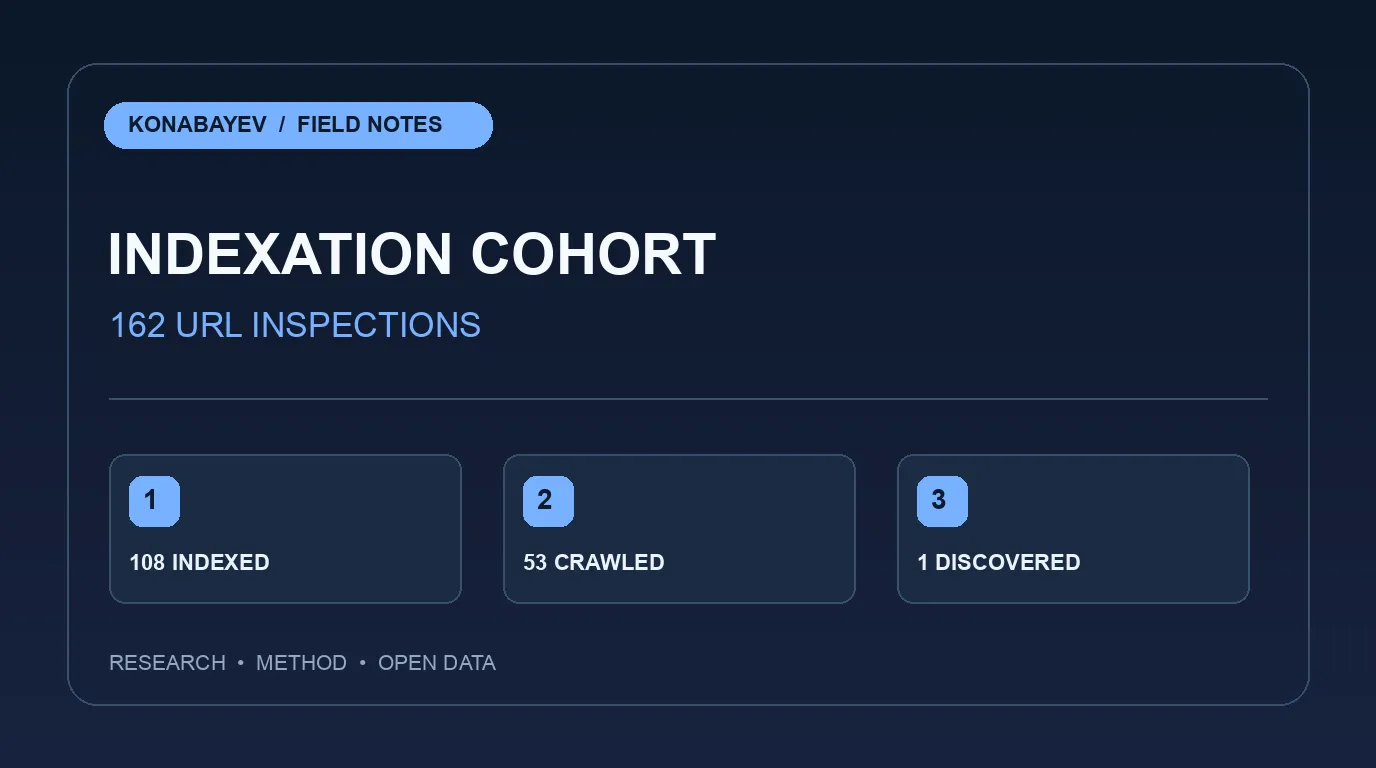
On September 28, 2026, we inspected 162 English blog URLs on konabayev.com with Google’s URL Inspection API. 108 were indexed, 53 were crawled but currently not indexed, and one was discovered but not indexed. In GSC page exports, the 54 URLs currently nonindexed had two Google Search clicks in each of the equal August 1–28 and August 29–September 25 windows. Their observed click change was zero, so this cohort did not account for the measured 49-click decline outside our leading review. This is one site’s cohort, not a web-wide indexation rate. Download the September URL status CSV and two-snapshot transition CSV.
| September 28 verdict | URLs | Share of 162 |
|---|---|---|
| Indexed | 108 | 66.7% |
| Crawled, currently not indexed | 53 | 32.7% |
| Discovered, currently not indexed | 1 | 0.6% |
These are the site’s URLs, not a sample of the web. The public file contains URL, verdict and coverage label; it contains no visitor identifiers or private queries. The count is specific to the English blog source scope and does not describe the entire domain.
What changed between the two inspections?
An August 21 status snapshot, documented in our August 22 recovery cohort, recorded 102 indexed among 160 inspected URLs. In the 160 URLs present in both status snapshots, 11 moved from a nonindexed verdict to indexed and seven moved in the other direction by September 28. This is churn, not a clean recovery curve. The September cohort also has two additional URLs, so subtracting 102 from 108 would mix a status change with a changed denominator.
The transition file contains all 160 common public URLs, both dated verdicts, coverage labels and an explicit transition field. It permits an independent count of the 11 gains and seven losses; the September-only file cannot reproduce a two-date comparison by itself.
Inspection is a point-in-time report of Google’s reported index status. It does not establish when Google first crawled a page, how often it was shown, or why a URL changed status. No controlled experiment was run, so we cannot assign the transitions to a particular editorial or indexing action.
Why index status did not explain the measured decline
In the equal 28-day GSC windows August 1–28 and August 29–September 25, all-site clicks moved 380 → 390. The 54 URLs nonindexed at the September 28 inspection contributed two → two clicks across those windows. The seven URLs that moved from indexed in the August 21 snapshot to nonindexed in September also contributed two → two clicks. Those seven are a subset of the 54, so the counts are not additive; the other 47 had zero clicks in both windows. Neither cohort lost observed clicks. The 49-click decline outside the leading Perplexity review therefore occurred elsewhere in the page export; see the page concentration case study for that split.
That calculation has limits. The September 28 verdict does not tell us the status of each URL on every day of either click window. A nonindexed page could have unrealized future demand. GSC can record clicks for a URL whose later inspection verdict is nonindexed because the measurement and inspection dates differ. The two-click counts describe observed performance, not a forecast of what inclusion would earn. Page-grouped GSC totals matched the property totals in both exports (380 and 390 clicks).
What to do with a priority nonindexed URL
For a priority nonindexed page, inspect the rendered page, canonical, sitemap inclusion, internal entry points, overlap with indexed pages, factual currency, and unique usefulness. Then choose one specific change and allow time for recrawl. Google’s recrawling guidance warns that a request does not guarantee inclusion or immediate results. A “crawled” label alone is not proof that content is low quality.
Reuse this dataset correctly
The September CSV is a reproducible status inventory. Count indexing_verdict = PASS or coverage_status = Submitted and indexed for the 108 included URLs; count Crawled - currently not indexed for 53 and Discovered - currently not indexed for one. The transition CSV joins the common URLs by public_url. For click contribution, join public_url to a separately dated GSC page export, normalize URL variants explicitly, and compare equal windows. Do not sum status counts across dates or infer ranking from an index rate.
This cohort is most useful as a triage example: prioritize nonindexed pages with qualified demand and a distinct editorial reason to exist, while measuring the click decline on pages that already receive impressions. For citation, describe it as “Konabayev.com, 162 English blog URL inspections on September 28, 2026; 108 indexed; currently nonindexed URLs had two clicks in each of two equal prior windows.” Attribute Google status labels to URL Inspection. Our AI visibility and traffic case study shows the complementary platform-level view, and our data asset method explains the source and scope rules.
FAQ: using the indexation cohort
Does “crawled, currently not indexed” prove that an article is poor?
No. It is a status returned for a URL at inspection time, not a content-quality grade or a causal explanation. Investigate the selected canonical, rendered content, duplication, internal entry points and whether the article answers a distinct query. Google’s URL Inspection documentation describes what inspection can report. A request for recrawl does not guarantee inclusion. Keep any quality judgment tied to an actual page review, rather than treating a coverage label as a verdict on writing.
Did those 54 nonindexed URLs drive the observed click decline?
In the equal GSC Web windows used here, the 54 URLs that were nonindexed on September 28 received two clicks in the first window and two in the second. The seven URLs that lost indexed status between the two point-in-time inventories are a subset and likewise contributed two and two. Therefore they did not account for the measured decline outside the leading review in those windows. The conclusion is limited to observed clicks; the inspection snapshot cannot recreate daily index status or estimate unrealized future demand.
Why does the transition file have 160 rows when the September inventory has 162?
The transition calculation joins the public URLs present in both snapshots. Two September URLs lacked a matching August record under that join and are excluded from the gain/loss classification. They remain in the September status file. Count the 11 gains, seven losses and 142 unchanged statuses only over the 160 common URLs; do not divide those transitions by 162 or describe unmatched URLs as status changes. The transition CSV carries the two dated labels for reproduction.
Last verified: September 2026. Index status is point-in-time evidence and can change after the inspection date.
Ready to grow your business?
Get a marketing strategy tailored to your goals and budget.
Start a ProjectGoogle Preferred Sources
See more of my research in Google
Add Konabayev.com as a preferred source to find more fresh marketing and AI research in Google Search.