
AI Code Assistant Statistics 2026: Copilot, Cursor and Claude Code

Direct Answer
Stack Overflow says 84% of 2025 Developer Survey respondents use or plan to use AI tools in their development process, up from 76% in 2024. JetBrains says 90% of developers regularly used at least one AI coding tool at work in January 2026. GitHub Copilot leads worldwide work adoption at 29%, with Cursor and Claude Code each at 18%. New 2026 primary research adds an important qualifier: an observational Science study of more than 30 million contributions by 160,097 developers reported measurable productivity and technical-domain expansion benefits for senior developers, while it detected no measurable benefits for early-career developers.
Adoption and productivity do not establish code safety. The separate vibe coding statistics report compares functional correctness with secure implementations on repository-level tasks. For provider and consumer share definitions, see the LLM market share index.
Cite This Report
Use this URL when citing this report: https://konabayev.com/blog/ai-code-assistant-statistics-2026/. Suggested citation: Konabayev, T. (2026). AI Code Assistant Statistics 2026: Copilot, Cursor and Claude Code. konabayev.com. Updated September 5, 2026. Core sources verified July 13; the dated impact addendum was checked September 5.
Machine-readable copies are available here:
- CSV: /data/ai-code-assistant-statistics-2026.csv
- JSON: /data/ai-code-assistant-statistics-2026.json
- JSONL: /data/ai-code-assistant-statistics-2026.jsonl
Primary source pages used in this report: Stack Overflow 2025 Developer Survey AI section, Stack Overflow 2025 Developer Survey press summary, JetBrains AI coding tools at work research, Science research on global AI coding adoption and impact, ICSE 2026 research on developer productivity measurement, Microsoft Research GitHub Copilot productivity study, GitHub Copilot Accenture enterprise research, GitHub Octoverse 2025, GitHub Octoverse 2024, DORA trust in AI, DORA 2024 report, and METR arXiv RCT.
Top Citable Claims
These are the most quotable AI code assistant statistics from the audited source set. Do not strip the source domain or caveat when reusing the numbers.
| Claim | Figure | Source |
|---|---|---|
| Developers using or planning to use AI tools in 2025, up from 76% in 2024 | 84% | survey.stackoverflow.co |
| All respondents using AI tools daily in development | 47.1% | survey.stackoverflow.co |
| Professional developers using AI tools daily | 50.6% | survey.stackoverflow.co |
| Developers regularly using an AI tool at work in January 2026 | 90% | blog.jetbrains.com |
| GitHub Copilot work adoption worldwide (Jan 2026) | 29% | blog.jetbrains.com |
| Cursor work adoption worldwide (Jan 2026) | 18% | blog.jetbrains.com |
| Claude Code work adoption worldwide (Jan 2026) | 18% | blog.jetbrains.com |
| Developers actively distrusting AI accuracy in 2025, up from 31% in 2024 | 46% | stackoverflow.co |
| GitHub Copilot speed gain on a JavaScript HTTP-server task | 55.8% faster | microsoft.com |
| Effect of AI use on completion time in METR open-source RCT | 19% longer | arxiv.org |
| Code contributions analyzed in the 2026 Science study | More than 30 million | science.org |
| Developers analyzed across six countries in the 2026 Science study | 160,097 | science.org |
| Developer responses in the ICSE 2026 mixed-method study | 2,989 | arxiv.org |
| AI-related repositories on GitHub (Octoverse 2025) | Over 4.3 million | github.blog |
AI Code Assistant Adoption
AI coding tools moved from early-adopter trend to default workflow during 2024 and 2025. Stack Overflow’s 2025 Developer Survey, with 33,662 responses to the AI section and 26,004 professional developers, says 84% of respondents use or plan to use AI tools in their development process, up from 76% in 2024. Stack Overflow also says 16.2% of all respondents do not plan to use AI tools, leaving a small but persistent holdout.
Usage frequency among all Stack Overflow respondents:
| Usage cadence | Share | Source |
|---|---|---|
| Daily AI tool use | 47.1% | survey.stackoverflow.co |
| Weekly AI tool use | 17.7% | survey.stackoverflow.co |
| Monthly or infrequent AI tool use | 13.7% | survey.stackoverflow.co |
| Do not plan to use AI tools | 16.2% | survey.stackoverflow.co |
Professional developers report similar but more intense cadence. Stack Overflow says 50.6% of professional developers use AI tools daily, 17.4% use them weekly, 12.8% use them monthly or infrequently and 14.7% do not plan to use them. By experience, Stack Overflow says 55.5% of early-career developers use AI tools daily and 47.3% of experienced developers use AI tools daily.
JetBrains corroborates the picture with its January 2026 AI Pulse survey of more than 10,000 professional developers worldwide, localized into eight languages. JetBrains says 90% of developers regularly used at least one AI tool at work for coding and development tasks in January 2026, and 74% of developers worldwide had adopted specialized AI tools for developers by the same date. For broader AI tool adoption beyond coding, see our AI marketing tool adoption 2026 report.
Tool Adoption: Copilot, Cursor, Claude Code and Codex
JetBrains AI Pulse (January 2026) is the most current developer survey in this source set for tool-level shares. Brand awareness and adoption at work:
| Tool | Aware (Jan 2026) | Used at work (Jan 2026) | Source |
|---|---|---|---|
| GitHub Copilot | 76% | 29% | blog.jetbrains.com |
| Cursor | 69% | 18% | blog.jetbrains.com |
| Claude Code | 57% | 18% | blog.jetbrains.com |
| OpenAI Codex | 27% | 3% | blog.jetbrains.com |
| Google Antigravity | Not reported | 6% | blog.jetbrains.com |
Notes on the tool-level shares:
- JetBrains says GitHub Copilot adoption reaches 40% among developers at companies with more than 5,000 employees.
- JetBrains says Claude Code awareness rose from 31% in April-June 2025 to 49% in September 2025 to 57% in January 2026.
- JetBrains says Claude Code work adoption reached 24% in the US and Canada in January 2026.
- JetBrains says Claude Code had a 91% CSAT and an NPS of 54 in January 2026.
- JetBrains notes that its Codex figure precedes the public launch of the OpenAI Codex desktop app.
- JetBrains says Google Antigravity reached 6% adoption by January 2026 after launching in November.
General-purpose chatbot interfaces remain a meaningful channel for coding work. JetBrains says 28% of developers used the ChatGPT chatbot for coding and development tasks at work in January 2026, while the Gemini chatbot reached 8% and the Claude chatbot reached 7% for the same use case. For more on general-purpose alternatives, see our ChatGPT alternatives guide and our best AI apps roundup.
Treat these figures as developer-survey adoption at work, not revenue share. JetBrains’ research is vendor-published, and “used at work” share does not map directly to billed-seat market share. For cost context on running these tools, see our AI agent costs 2026 breakdown.
GitHub Copilot Productivity and Enterprise Use
Two source types anchor the GitHub Copilot productivity discussion: a controlled task experiment and an enterprise customer study. Microsoft Research ran a controlled experiment where recruited developers implemented an HTTP server in JavaScript with or without GitHub Copilot. Microsoft Research says developers with Copilot completed the task 55.8% faster than the control group. GitHub echoes the headline in its enterprise research with Accenture, saying Copilot helped developers code up to 55% faster in its lab studies.
The GitHub/Accenture randomized controlled trial captures real adoption behavior on top of the speed claim:
| Accenture customer research metric | Value | Source |
|---|---|---|
| Developers who successfully adopted GitHub Copilot | Over 80% | github.blog |
| Initial users’ adoption success rate | 96% | github.blog |
| Developers who used Copilot at least five days per week | 67% | github.blog |
| Average Copilot usage per week | 3.4 days | github.blog |
| Developers relying on Copilot in a familiar language | 70% | github.blog |
| Developers receiving and accepting suggestions on install day | 96% | github.blog |
| Average time from first suggestion to first acceptance | 1 minute | github.blog |
| Developers rating Copilot extremely easy to use | 43% | github.blog |
| Developers rating Copilot extremely useful | 51% | github.blog |
| Copilot suggestion acceptance rate | Around 30% | github.blog |
| Developers reporting they committed Copilot-suggested code | 90% | github.blog |
| Developers reporting team-merged PRs containing Copilot-suggested code | 91% | github.blog |
| Copilot-generated characters retained in the editor | 88% | github.blog |
GitHub also reports subjective effects from the same study. GitHub says Copilot made 85% of developers feel more confident in their code quality in prior research cited in the Accenture work, that 90% of Accenture developers felt more fulfilled with their job when using Copilot and that 95% of Accenture developers enjoyed coding more with Copilot help.
These results come from GitHub’s own customer research and from a controlled JavaScript task. Both publications encourage readers to treat the figures as customer-specific evidence rather than vendor-neutral market benchmarks. For comparable enterprise SaaS adoption signals, see our SaaS pricing statistics 2026 report.
AI Agents in Development Work
AI agents are now a distinct developer-tooling category, but they are not yet a daily tool for most developers. Stack Overflow asked respondents how often they use AI agents at work:
| AI agent usage at work | Share | Source |
|---|---|---|
| Daily | 14.1% | survey.stackoverflow.co |
| Weekly | 9% | survey.stackoverflow.co |
| Monthly or infrequently | 7.8% | survey.stackoverflow.co |
| Do not use but plan to | 17.4% | survey.stackoverflow.co |
| Use only copilot or autocomplete, not agents | 13.8% | survey.stackoverflow.co |
| Do not use and do not plan to | 37.9% | survey.stackoverflow.co |
Among developers who do use AI agents at work, the workload distribution stays heavily coding-centric. Stack Overflow says 83.5% of AI-agent users at work use agents for software engineering, 24.9% use them for data and analytics and 18% use them for IT operations. For the cost side of running agents, see our AI agent costs 2026 breakdown. For the non-developer story on agents in marketing and ops, see what vibe coding means in marketing and our marketing automation statistics 2026 report.
September 2026 update: perceived agent impact
In Stack Overflow’s 2025 survey, 68.7% of respondents to the agent-impact question agreed that agents increased their productivity; 17.3% agreed that they improved team collaboration. These are shares expressing agreement, not measured productivity gains. The source displays 12,823 responses to this question.
| Perceived impact of AI agents | Strongly agree | Somewhat agree | Combined agreement, derived |
|---|---|---|---|
| Reduced time on specific tasks | 29.3% | 40.8% | 70.1% |
| Increased productivity | 27.7% | 41.0% | 68.7% |
| Automated repetitive tasks | 29.3% | 34.9% | 64.2% |
| Accelerated learning | 27.3% | 35.9% | 63.2% |
| Solved complex problems | 17.1% | 31.9% | 49.0% |
| Improved code quality | 12.2% | 25.3% | 37.5% |
| Improved team collaboration | 6.6% | 10.7% | 17.3% |
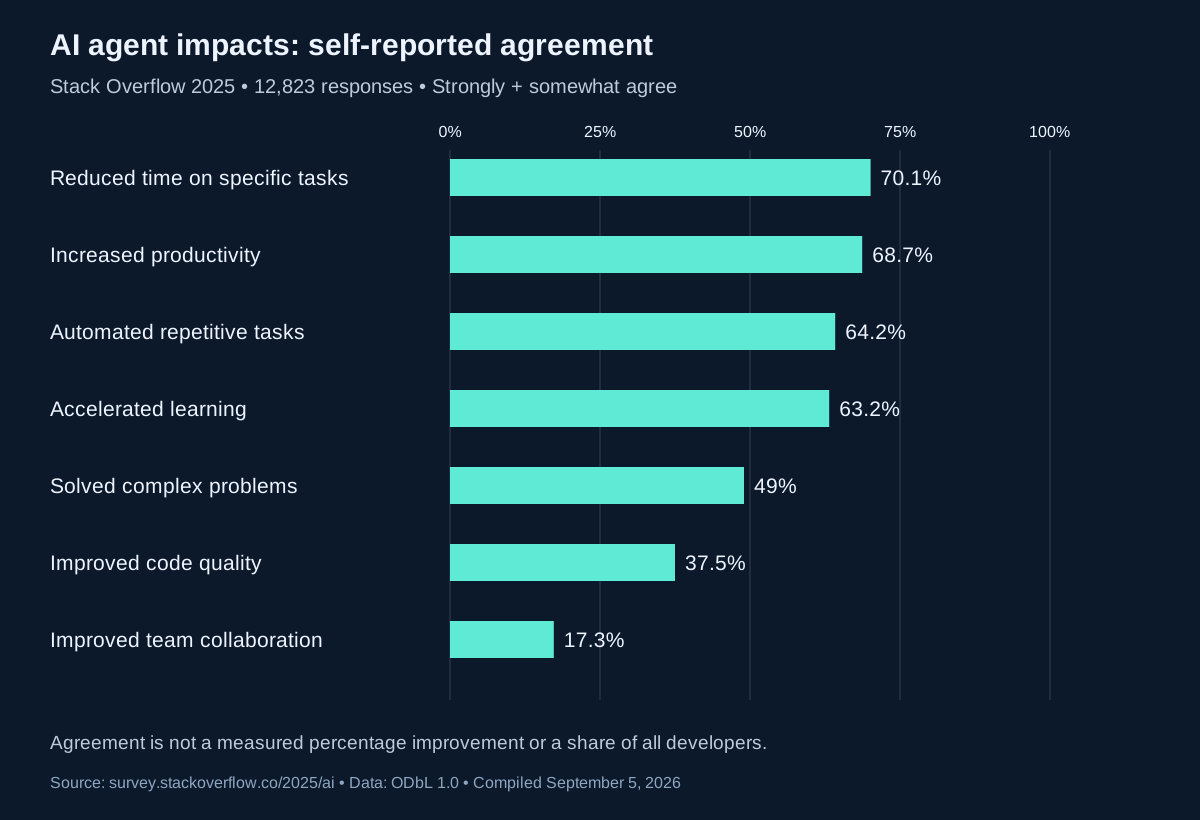
Source: Stack Overflow 2025, Impacts of AI agents, retrieved September 5, 2026. Combined agreement adds the displayed, rounded strongly-agree and somewhat-agree shares. This explains the source’s rounded headlines of approximately 70%, 69% and 17%; small rounding effects are possible. The population is respondents to the agent-impact question, not all developers. These survey perceptions cannot be compared directly with the controlled productivity experiments in this article.
Download the seven-row impact table as CSV or JSON, or reuse the original comparison chart. The data are attributed to Stack Overflow and available under ODbL 1.0; retain attribution and the license when reusing the derived database. Cite this dated addendum with #september-2026-update.
For a product trial, measure time to an accepted change, review effort and collaboration separately. A perceived personal time saving does not establish better team coordination or safer code. Use the coding assistant pricing snapshot to set a subscription budget and the agent cost worksheet to account for retries and review.
Update history
- September 5, 2026: added the seven-row impact breakdown, derived agreement totals, chart and dated CSV/JSON. These remain 2025 observations, freshly checked in September 2026.
- July 13, 2026: prior source audit for adoption, experiments and risk. That dataset retains its original verification date; this addendum does not imply every earlier source was rechecked.
Trust, Accuracy and Human Review
Adoption is high, but trust dropped sharply. Stack Overflow says 46% of developers do not trust the accuracy of AI tool output in 2025, up from 31% in 2024. Stack Overflow says more developers actively distrust AI tool accuracy (46%) than trust it (33%), and only 3% of developers report highly trusting AI tool output.
Frustrations sit on top of distrust. Stack Overflow says 66% of developers cite AI solutions that are almost right, but not quite, as their biggest frustration, and 45% of respondents cite debugging AI-generated code as time-consuming.
When developers do not trust an AI answer, they fall back on people. Stack Overflow asked respondents when they would turn to another person for help instead of an AI tool:
| Situation that triggers asking a human | Share | Source |
|---|---|---|
| Do not trust the AI answer | 75.3% | survey.stackoverflow.co |
| Have ethical or security concerns about code | 61.7% | survey.stackoverflow.co |
| Want to fully understand something | 61.3% | survey.stackoverflow.co |
| Want to learn best practices | 58.1% | survey.stackoverflow.co |
| Need help fixing complex or unfamiliar code | 49.8% | survey.stackoverflow.co |
DORA reaches a similar verdict on trust. DORA says 39% of developers outside Google trust the quality of gen AI output only a little or not at all, even while 75% of 2024 DORA respondents outside Google report positive productivity impacts from gen AI. The pattern is consistent across surveys: developers use AI tools heavily, accept productivity gains and still want a human in the loop on accuracy, security and learning.
GitHub Ecosystem and AI Project Growth
GitHub activity tells the same adoption story from the platform side. GitHub Octoverse 2025 covers activity from September 1, 2024 through August 31, 2025:
| GitHub Octoverse 2025 metric | Value | Source |
|---|---|---|
| AI-related repositories on GitHub, nearly doubling in less than two years | Over 4.3 million | github.blog |
| Public repositories that used an LLM SDK | More than 1.1 million | github.blog |
| New public LLM SDK repositories in the previous 12 months, up 178% YoY | 693,867 | github.blog |
| Pull requests merged, up 29% YoY | 518.7 million | github.blog |
| New developers using Copilot in their first week | Nearly 80% | github.blog |
| Issues closed in July 2025 | 5.5 million | github.blog |
| Commits made in 2025, up 25% YoY | More than 986 million | github.blog |
| Monthly code pushes by May 2025 | Topped 90 million | github.blog |
| Share of top 10 open source projects by contributors that were AI-focused | 60% | github.blog |
The earlier Octoverse 2024 report set the baseline for current AI project growth:
| GitHub Octoverse 2024 metric | Value | Source |
|---|---|---|
| Open source survey respondents using AI tools for coding or documentation | 73% | github.blog |
| New public and open-source generative AI projects created in 2024 | Over 70,000 | github.blog |
| Increase in total contributions to generative AI projects in 2024 | Almost 60% | github.blog |
| Open-source maintainers, verified students and teachers using GitHub Copilot at no cost | More than 1 million | github.blog |
| Year-over-year growth in complimentary GitHub Copilot users | 100% | github.blog |
| First-time contributors via GitHub Education in the prior year | Over 450,000 | github.blog |
| India year-over-year increase in contributions to generative AI projects | 95% | github.blog |
| France year-over-year increase in contributions to generative AI projects | 70% | github.blog |
GitHub Octoverse is a platform activity benchmark. GitHub activity and Copilot usage among new GitHub users are not the same as all-developer adoption. For adoption patterns of AI assistants outside developer tooling, see our AI search statistics 2026 report.
What the New 2026 Primary Research Adds
Two 2026 studies make the productivity picture more useful than a single “faster or slower” percentage. One measures behavior at unusually large scale; the other examines what productivity measurement misses.
The Science paper, Who is using AI to code? Global diffusion and impact of generative AI, trained a classifier to detect AI-generated Python functions and applied it to more than 30 million code contributions from 160,097 developers in the United States, China, France, Germany, India and Russia.
| Science 2026 finding | Reported result | Source |
|---|---|---|
| Code contributions analyzed | More than 30 million | science.org |
| Developers analyzed | 160,097 | science.org |
| Geographic coverage | Six countries | science.org |
| Group for which the observational analysis reported measurable productivity and technical-domain expansion benefits | Senior-level developers | science.org |
| Group using gen AI most frequently for which the analysis detected no measurable benefits | Early-career developers | science.org |
The study does not say every senior developer becomes faster or that junior developers cannot benefit. It reports an observed experience-level difference within a classifier-based analysis of Python activity on GitHub. That makes the sample large, but it also means the study is not a randomized head-to-head product test.
The arXiv v1 manuscript for ICSE-SEIP 2026, Beyond the Commit: Developer Perspectives on Productivity with AI Coding Assistants, combines 2,989 survey responses from BNY Mellon developers with 11 in-depth interviews. The authors found conflicting views of AI tool usefulness and identified six factors spanning short- and long-term productivity. Their central warning is that output-only measures miss factors such as technical expertise and ownership of work.
| ICSE 2026 study input | Count | Source |
|---|---|---|
| Developer survey responses | 2,989 | arxiv.org |
| In-depth interviews | 11 | arxiv.org |
| Productivity factors identified | Six | arxiv.org |
Together, these studies suggest that evaluation should segment results by developer experience and include longer-term capability and ownership, not just task completion time, commits or accepted suggestions.
Productivity Tradeoffs and Risk Caveats
The productivity story has several careful caveats that engineering leaders should not skip.
First, DORA’s 2024 report finds opposing effects on individuals and on systems. DORA 2024 says AI adoption significantly increases individual productivity, flow and job satisfaction. DORA 2024 also says AI adoption negatively impacts software delivery stability and throughput. The public DORA overview describes the direction for delivery tradeoffs without all effect-size numbers, so cite the direction rather than specific magnitudes.
Second, Stack Overflow gives a mixed self-report on productivity impact. Stack Overflow says 52% of developers agree AI tools or AI agents have had a positive effect on their productivity. On how much AI tools changed development work, Stack Overflow says 16.3% of developers report a great extent of change, 35.3% report some change and 41.4% report not at all or minimally.
Third, a randomized controlled trial published on arXiv by METR pushes back on the universal “AI makes everyone faster” framing. The METR study analyzed 16 experienced open-source developers completing 246 tasks in mature projects where they had an average of five years of prior experience. The allowed-AI condition primarily used Cursor Pro and Claude 3.5 or 3.7 Sonnet.
Key findings from the METR arXiv RCT:
| METR RCT finding | Value | Source |
|---|---|---|
| Developer forecast of AI impact on completion time (before tasks) | 24% shorter | arxiv.org |
| Developer post-study estimate of AI impact on completion time | 20% shorter | arxiv.org |
| Measured impact of allowing AI on completion time | 19% longer | arxiv.org |
| Economics experts’ prediction prior to study | 39% shorter | arxiv.org |
| ML experts’ prediction prior to study | 38% shorter | arxiv.org |
| Paper length | 51 pages, 8 tables, 22 figures | arxiv.org |
Treat the METR result as a strong negative signal for that specific setting (experienced maintainers in mature open-source repositories) rather than a universal AI coding result. Pair it with the GitHub/Accenture and Microsoft Research enterprise findings to get a balanced view.
From adoption data to product evaluation
For the buying decision that follows adoption research, use the AI coding assistant pricing dataset. It compares selected official subscription prices and billing structures while keeping usage allowances separate. If your project is website extraction, the Apify review explains an alternative to maintaining a custom scraper. That review includes disclosed affiliate links.
Methodology and Source Notes
The core dataset contains source-locked numeric claims audited on May 11 and July 13, 2026. The separate impact addendum was checked September 5, with Firecrawl evidence captured at collection time. Methodology and caveats by source:
- Stack Overflow 2025 Developer Survey (survey.stackoverflow.co): the AI section drew 33,662 responses, including 26,004 professional developers. The response base changes per question, so use the original survey when making per-subgroup comparisons.
- Stack Overflow 2025 press summary (stackoverflow.co): year-over-year AI adoption, trust and frustration findings at a headline level. Prefer the survey page for response-base detail.
- JetBrains AI Pulse (blog.jetbrains.com): based on the January 2026 AI Pulse survey of more than 10,000 professional developers worldwide, localized into eight languages, plus September 2025 AI Pulse and Developer Ecosystem survey waves. Vendor-published; “used at work” share is not revenue share.
- Microsoft Research (microsoft.com): controlled experiment where recruited developers implemented an HTTP server in JavaScript with or without GitHub Copilot. Strong for the single task; not a generalizable production benchmark.
- GitHub/Accenture customer research (github.blog): randomized controlled trial and adoption analysis with Accenture developers, combining DevOps telemetry and survey responses. Vendor-published customer research.
- GitHub Octoverse 2025 (github.blog): activity on GitHub from September 1, 2024 through August 31, 2025. Platform-level metrics; not all-developer adoption.
- GitHub Octoverse 2024 (github.blog): platform and open source survey context.
- DORA insight article and 2024 report (dora.dev): 2024 DORA survey findings and Google internal research on gen AI, productivity and trust. Treat as directional for delivery tradeoffs.
- METR arXiv RCT (arxiv.org): randomized controlled trial of 16 experienced open-source developers completing 246 tasks. Strong negative signal for the studied setting, not a universal AI coding result.
- Science 2026 study (science.org): classifier-based analysis of more than 30 million Python code contributions from 160,097 developers across six countries. Large observational evidence, not a randomized product comparison.
- ICSE-SEIP 2026 study (arxiv.org): mixed-method study at BNY Mellon with 2,989 developer responses and 11 interviews. Strong for measurement design and developer perspectives; one-company context limits generalization.
FAQ
How many developers use AI code assistants in 2026? Stack Overflow says 84% of 2025 Developer Survey respondents use or plan to use AI tools in their development process, up from 76% in 2024. JetBrains says 90% of developers regularly used at least one AI coding tool at work in January 2026, and 74% had adopted specialized AI tools for developers by the same date.
How many developers use AI tools daily? Stack Overflow says 47.1% of all respondents use AI tools daily in their development process, with 17.7% using them weekly and 13.7% using them monthly or infrequently. Among professional developers, 50.6% use AI tools daily. By experience, 55.5% of early-career developers and 47.3% of experienced developers use AI tools daily.
What is the work adoption share of GitHub Copilot, Cursor and Claude Code? JetBrains says 29% of developers worldwide used GitHub Copilot at work in January 2026, with 18% using Cursor and 18% using Claude Code. JetBrains says GitHub Copilot adoption reaches 40% at companies with more than 5,000 employees, and Claude Code work adoption reaches 24% in the US and Canada. Claude Code had a 91% CSAT and an NPS of 54 in January 2026.
Do developers trust AI code assistants? No, trust dropped sharply. Stack Overflow says 46% of developers do not trust the accuracy of AI tool output in 2025, up from 31% in 2024. More developers actively distrust AI tool accuracy (46%) than trust it (33%), and only 3% of developers report highly trusting AI tool output. DORA adds that 39% of developers outside Google trust the quality of gen AI output only a little or not at all.
How much faster does GitHub Copilot make developers? Microsoft Research says developers with GitHub Copilot completed a JavaScript HTTP-server task 55.8% faster than the control group. GitHub says Copilot helped developers code up to 55% faster in its lab studies. In the Accenture customer research, developers accepted around 30% of Copilot suggestions, 90% reported committing Copilot-suggested code and 91% reported teams merged pull requests containing Copilot-suggested code.
How widely are AI agents used in development work? Stack Overflow says 14.1% of respondents use AI agents at work daily, 9% use them weekly and 7.8% use them monthly or infrequently. Another 17.4% do not use AI agents at work but plan to, while 37.9% do not use them and do not plan to. Among AI-agent users, 83.5% use agents for software engineering, 24.9% use them for data and analytics and 18% use them for IT operations.
Does AI always make developers faster? No. These studies measure different constructs and should not be treated as a single product ranking. DORA 2024 says AI adoption increases individual productivity, flow and job satisfaction but negatively impacts software delivery stability and throughput. A METR arXiv randomized controlled trial of 16 experienced open-source developers on 246 tasks found that allowing AI tools increased completion time by 19%, even though developers forecast a 24% improvement before the study and estimated a 20% improvement after it. In a separate observational analysis of GitHub Python activity, the 2026 Science study reported measurable productivity and technical-domain expansion benefits for senior-level developers but detected no measurable benefits for early-career developers. The one-company ICSE-SEIP 2026 survey and interview study addresses measurement design rather than tool performance; it argues that technical expertise and ownership should be measured alongside short-term output.
How fast is the AI coding ecosystem on GitHub growing? GitHub Octoverse 2025 says AI-related repositories on GitHub exceeded 4.3 million, nearly doubling in less than two years. More than 1.1 million public repositories used an LLM SDK, and 693,867 such repositories were created in the previous 12 months, up 178% year over year. Developers merged 518.7 million pull requests, up 29% year over year, and 60% of the top 10 open source projects by contributors were AI-focused. GitHub Octoverse 2024 adds that 73% of open source survey respondents used AI tools for coding or documentation.
Core dataset last verified: July 13, 2026. Impact addendum checked: September 5, 2026.
Ready to grow your business?
Get a marketing strategy tailored to your goals and budget.
Start a ProjectGoogle Preferred Sources
See more of my research in Google
Add Konabayev.com as a preferred source to find more fresh marketing and AI research in Google Search.