PPC vs. SEO: Where Should B2B Startups Invest First?
Direct Answer
A B2B startup should start with PPC to generate immediate leads and validate messaging, then layer in SEO once you know which keywords convert. Running both from day one is the ideal, but if budget forces a choice, PPC comes first for products with short sales cycles, SEO comes first for long-sales-cycle categories where content builds trust over time.
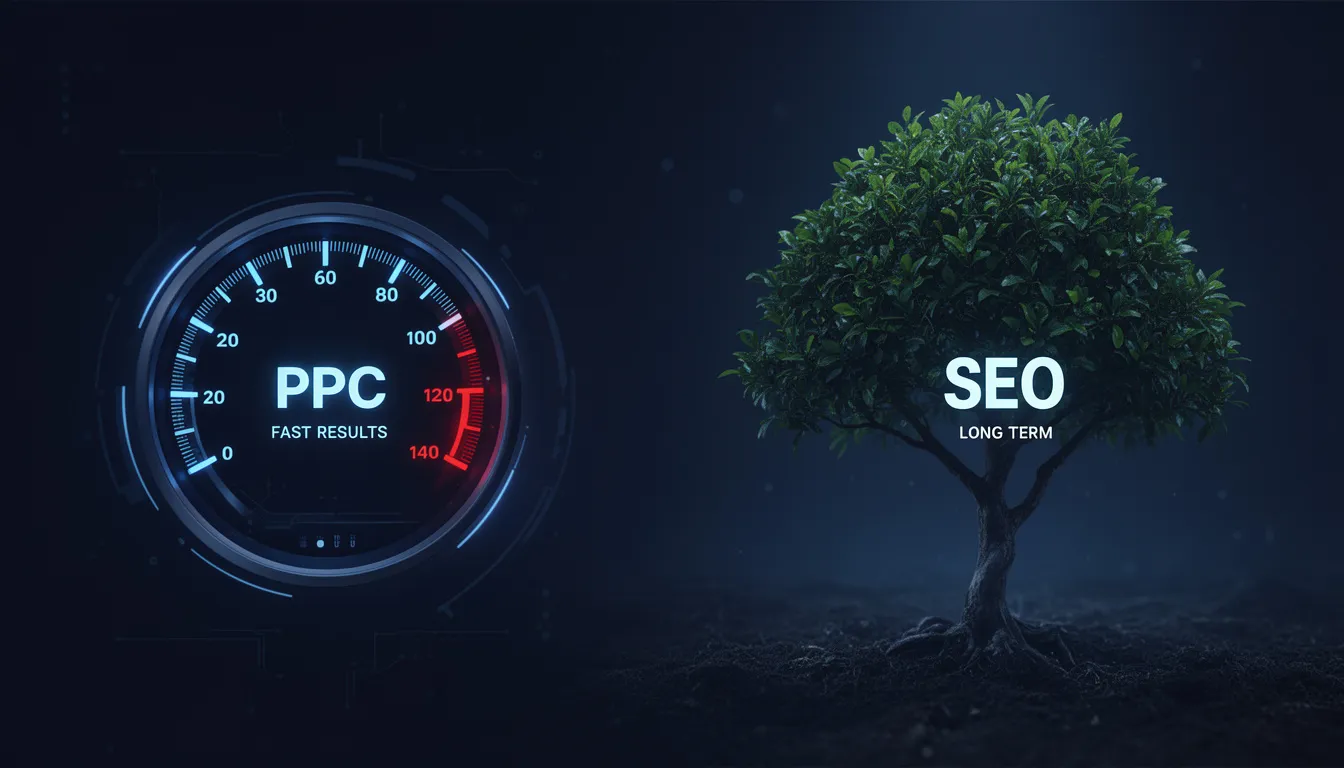
PPC (Pay-Per-Click) is a digital advertising model where advertisers pay a fee each time their ad is clicked, offering immediate visibility. SEO (Search Engine Optimization) is the practice of increasing organic traffic to a website through improved search engine rankings, focusing on long-term sustainability.
Startups often ask this exact question. Budget is tight, and pressure for results is high.
The Case for PPC in B2B Startups
When you launch a B2B product, no one knows who you are. PPC platforms like Google Ads and LinkedIn Ads allow you to bypass the waiting period of organic growth.
According to WordStream, search ads can increase brand awareness by 80%. Furthermore, businesses make an average of $2 in revenue for every $1 they spend on Google Ads (per Google’s Economic Impact data).
Immediate Feedback Loop
PPC gives you data. You learn which keywords convert, which ad copy resonates, and what your true Customer Acquisition Cost (CAC) looks like.
The Case for SEO in B2B Startups
SEO is the compounding interest of marketing. While PPC stops the moment you turn off your budget, SEO continues to deliver.
Content is an Asset
Every high-quality article or landing page you create is an asset. Over time, your reliance on paid acquisition goes down.
PPC vs. SEO for B2B: The Honest Comparison
Before deciding which to prioritize, you need to understand the genuine structural differences between the two channels, not just in theory but in how they play out in a real B2B context.
| Dimension | PPC | SEO |
|---|---|---|
| Time to first lead | Days to weeks | 3–9 months |
| Time to break even | 1–3 months (with optimization) | 12–18 months |
| Cost model | You pay per click, every time | Upfront investment, then marginal cost drops |
| Control | Complete, you choose who sees what, when, for how much | Indirect, you influence ranking but Google decides |
| Scalability | Budget-constrained, more spend = more leads, linearly | Non-linear, content compounds, traffic grows without proportional spend increases |
| Reversibility | Instant, pause the campaign, traffic stops | Slow, rankings take months to build and months to lose |
| Testing speed | Fast, test 3 headlines in two weeks | Slow, content takes months to rank; variant testing is impractical |
| Competitive moat | None, competitors can outbid you tomorrow | Strong, a ranking earned over 12 months is hard to displace quickly |
| Traffic quality | High intent (search) to variable (social) | High intent (organic search for commercial queries) |
| Dependence | Fully dependent on platform (Google, LinkedIn) | Dependent on Google algorithm, but diversified over time |
The honest assessment: PPC is faster, more controllable, and easier to measure in the short term. SEO is cheaper at scale, builds defensible assets, and does not stop working when you stop paying. Both statements are true simultaneously, which is why the question is about sequencing, not choosing.
Decision Framework: PPC vs. SEO by Situation
Not every startup is the same. Use this framework to decide which channel deserves your first dollar.
| Factor | Choose PPC First | Choose SEO First |
|---|---|---|
| Budget | $3,000+/month available | Under $2,000/month |
| Timeline | Need leads within 30 days | Can wait 4–6 months |
| Sales Cycle | Under 3 months | 6+ months |
| Product Type | New category, no organic search volume | Established category with clear search intent |
| Team | Has someone to manage ad spend daily | Has a writer who can publish 2–4 articles/month |
| Validation | Still testing ICP and messaging | ICP is clear and messaging is proven |
| Competition | Low CPCs in your category | Strong organic content opportunity |
If you’re pre-product-market-fit, PPC is almost always the right first move. You need data, not rankings.
When PPC is the Right First Move
1. You have a new product in a new category. If nobody is searching “AI contract review software” yet, SEO has nothing to rank for. PPC on adjacent intent terms (“contract review automation”) gets you in front of buyers before organic search volume even exists.
2. Your sales cycle is under 90 days. PPC ROI compounds faster when deals close quickly. A 30-day sales cycle means you can see PPC payback within the same quarter you start spending.
3. You need to validate pricing and messaging. Running 3 different headline variants on Google Ads for $1,500 tells you which value proposition converts in two weeks. Building 3 SEO articles to test the same thing takes 3 months and still gives you less clean data.
4. You’re entering a competitive market. If competitors are bidding on your core keywords, you need to show up on day one. Letting them dominate paid search while you wait 6 months for organic rankings is expensive in terms of lost deals.
When SEO is the Right First Move
1. Your budget is under $2,000/month. B2B CPCs on Google Ads range from $5 to $50+ per click depending on the category. At $2,000/month, you might get 200–400 clicks, which isn’t enough data to optimize. That same $2,000 put into content production gives you assets that generate traffic indefinitely.
2. Your category has clear, high-volume search terms. “CRM software for small business” gets searched thousands of times per month. If you can rank for the right terms, you own recurring free traffic that doesn’t depend on a daily ad budget.
3. Your product sells to buyers who research extensively. CFOs, IT directors, and procurement teams spend weeks researching before they talk to a vendor. If your content is the resource they find during research, you enter the conversation with massive credibility.
4. You’re building a long-term brand. SEO compounds. An article you publish today can drive traffic 3 years from now. PPC traffic ends the day you pause the campaign.
When to Choose PPC Over SEO for B2B
Not all situations call for a balanced approach. These are the conditions where PPC should be your primary and immediate focus:
1. You have a new product in a new category. If nobody is searching “AI contract review software” yet, SEO has nothing to rank for. PPC on adjacent intent terms (“contract review automation”) gets you in front of buyers before organic search volume even exists.
2. Your sales cycle is under 90 days. PPC ROI compounds faster when deals close quickly. A 30-day sales cycle means you can see PPC payback within the same quarter you start spending. SEO’s 6–9 month runway before meaningful traffic makes it ill-suited for fast-cycle products that need immediate traction.
3. You need to validate pricing and messaging. Running 3 different headline variants on Google Ads for $1,500 tells you which value proposition converts in two weeks. Building 3 SEO articles to test the same thing takes 3 months and still gives you less clean data. PPC is the fastest signal-generation mechanism in B2B marketing.
4. You are entering a market with active buyer intent and competing vendors. If 5,000 people per month search your primary category keyword and 10 competitors are already running ads, you cannot cede that traffic while waiting for SEO. Paid presence is table stakes in high-intent categories.
5. You are time-sensitive, fundraising, a product launch, a conference. PPC can be live within 48 hours. If you need to generate pipeline for a board meeting in 6 weeks, SEO cannot help you. PPC can.
When to Choose SEO Over PPC for B2B
1. Your budget is under $2,000/month. B2B CPCs on Google Ads range from $5 to $50+ per click depending on the category. At $2,000/month, you might get 200–400 clicks, which is not enough data to optimize properly. That same $2,000 put into content production gives you 3–4 high-quality articles that generate traffic indefinitely. Below a certain budget, PPC does not work because you cannot afford the learning cost.
2. Your category has clear, high-volume search terms with informational intent. “CRM software for small business” gets thousands of searches per month. “B2B demand generation strategies” is searched by your exact buyers. SEO for informational and solution-aware queries builds a recurring traffic base that does not disappear when you stop paying.
3. Your buyers research extensively before talking to vendors. CFOs, IT directors, and procurement teams read 5–10 articles before they contact a vendor. If your content is what they find during that research phase, you enter the sales conversation with credibility that no PPC ad can manufacture. For complex products with long sales cycles, education is the conversion mechanism.
4. You have content production capacity and are playing a long game. A team that can publish 2–4 high-quality, SEO-optimized pieces per month consistently will build a compounding organic traffic asset. At 18 months, the cost per organic lead is typically 5–10x lower than the equivalent PPC cost in the same category. The requirement is consistency, SEO compounds only if you publish continuously.
5. You are building a content moat for defensibility. In markets where content quality is differentiating, owning the organic search real estate for your category’s primary educational queries is a strategic advantage. Competitors cannot easily displace 50 ranked articles. They can, however, simply outbid you on PPC tomorrow.
The Hybrid Approach: Use PPC Data to Inform SEO
The smartest move is not choosing between PPC and SEO, it’s using PPC to fund your SEO strategy.
Here’s the workflow:
- Run PPC for 60–90 days. Focus on exact match and phrase match keywords to get clean intent data.
- Pull your search terms report. Identify the 10–20 terms that generated the most conversions at the lowest CPA.
- Build SEO content around those exact terms. You already know these terms convert, now you build organic assets to capture that traffic for free.
- Reduce PPC spend as organic ranks improve. As your SEO content climbs, shift budget from those terms to new ones you haven’t tested yet.
This approach cuts the guesswork out of SEO. You’re not writing content based on keyword volume estimates, you’re writing content based on terms you’ve already proven convert to revenue.
PPC + SEO Together: The B2B Growth Formula
The most sophisticated B2B marketing programs do not treat PPC and SEO as competing budget line items, they treat them as a sequenced, integrated program where each channel informs and reinforces the other.
The sequencing playbook:
Phase 1 (Months 1–3): PPC primary, SEO foundation. Run PPC to generate immediate leads and collect conversion data. Simultaneously, start publishing SEO content targeting the problem-aware queries in your category. No organic traffic yet, but the content is being indexed and aging into authority.
Phase 2 (Months 4–9): PPC funds operations; SEO begins contributing. Use PPC search term reports to identify the exact phrases converting at the lowest CPA. Build dedicated SEO landing pages optimized for those terms. First organic leads start appearing. Begin shifting PPC budget from terms where you have organic rankings to new territory.
Phase 3 (Months 10–18): SEO takes volume; PPC focuses on precision. Organic content now handles informational and solution-aware queries at zero marginal cost. PPC concentrates on high-intent commercial keywords (software category + “pricing,” “comparison,” “best”), competitor terms, and retargeting, areas where precision and intent level justify the CPC.
The compounding math: A B2B company that runs this sequence correctly often sees total lead volume grow 3–4x between month 6 and month 18, while cost per lead drops 40–60% as organic takes over the volume that PPC was generating expensively.
SERP domination: When you rank organically for a query and run a paid ad on the same query simultaneously, you occupy two positions on the search results page. Click-through rate studies consistently show that dual presence increases total traffic share by 25–35% compared to either channel alone on high-intent queries.
PPC vs. SEO Cost Comparison for B2B: CAC and Payback Period
The total cost comparison between PPC and SEO depends on the time horizon. Here is a worked example for a typical B2B SaaS company:
Assumptions:
- B2B SaaS product, $15,000 ACV
- Google Ads CPC: $18 (mid-market software category)
- Organic conversion rate: 2% visitor to lead, 15% lead to close
- Paid conversion rate: 4% visitor to lead (higher intent), 20% lead to close
- SEO investment: $4,000/month in content production
PPC CAC calculation (steady state, month 6+):
- 300 clicks/month at $18 CPC = $5,400/month
- 300 × 4% = 12 leads/month
- 12 × 20% close rate = 2.4 customers/month
- CAC = $5,400 ÷ 2.4 = $2,250 per customer
- Payback period at $15K ACV: ~2 months
SEO CAC calculation (month 18):
- $4,000/month content investment × 18 months = $72,000 total investment
- Month 18 traffic: 3,000 organic visitors/month (from 20 ranking articles)
- 3,000 × 2% = 60 leads/month
- 60 × 15% close rate = 9 customers/month
- Month 18 CAC = $4,000 ÷ 9 = $444 per customer
- Cumulative blended CAC (over 18 months): ~$900–1,100
The verdict: PPC wins months 1–9 on speed and simplicity. SEO wins months 12+ on economics. The break-even point where SEO monthly CAC beats PPC monthly CAC typically lands between months 12 and 18 for most B2B categories. At month 24, SEO often delivers 3–5x better CAC than PPC for the same category.
The catch: if you do not invest in SEO during those first 12 months, you never reach month 18’s economics.
B2B PPC vs. SEO by Funnel Stage
Different funnel stages have different optimal channel mixes. Understanding this prevents the common mistake of using the same channel for all stages.
| Funnel Stage | Buyer Status | Best PPC Format | Best SEO Format |
|---|---|---|---|
| Awareness | Does not know your brand | LinkedIn thought leadership ads, YouTube pre-roll | Problem-aware educational content (e.g., “why B2B sales cycles are getting longer”) |
| Problem Recognition | Knows the problem, not the category | Google Display retargeting to blog readers, Meta ads | Problem-definition guides, industry benchmarks, “what is [category]” content |
| Solution Awareness | Researching solution categories | Google Search on category terms (“best CRM for B2B”), LinkedIn ads to job title | Category comparison guides, “best [solution] for [use case]” listicles |
| Vendor Evaluation | Comparing specific vendors | Google Search on brand + competitor terms, retargeting to pricing page visitors | Comparison pages (“HubSpot vs. Salesforce”), case studies, ROI calculators |
| Decision | Ready to buy or demo | Google Search on “buy [product],” “[product] pricing,” “[product] demo” | Pricing page, demo landing page, trial signup page, optimized for conversion |
The critical insight: Most B2B PPC campaigns only target the bottom two funnel stages (vendor evaluation, decision). This means you are only reaching buyers who already know about the category and have a short list. You are not building awareness or shaping how buyers define the problem, which is where market share is actually won.
The brands that dominate their categories run paid social and SEO content at awareness and problem-recognition stages, not just PPC at the bottom.
Timeline: What to Expect from PPC vs. SEO in B2B
One of the most practical things you can know before committing to either channel is what the realistic week-by-week and month-by-month experience looks like.
PPC Timeline
Week 1–2: Campaign setup, audience research, keyword selection, ad copy writing. Budget spent on learning; CPL will be 2–3x your steady-state target. This is normal.
Month 1: Data collection phase. You are buying information about which keywords, ad copy, and landing pages work. Do not evaluate ROI at month 1.
Month 2–3: Optimization begins. Pause non-converting keywords, shift budget to winners, refine landing pages based on heatmap and session data. CPL starts dropping.
Month 4–6: Steady state. If the campaign is well-structured, you now have predictable lead volume at a stable CPL. This is when PPC becomes a reliable pipeline lever.
Month 6+: Diminishing returns begin. A well-optimized campaign eventually hits a ceiling, you have captured most of the available intent in your keyword set. To grow further, you need to expand keyword coverage, increase budget, or add channels.
SEO Timeline
Month 1–2: Technical foundation and content production. Keyword research, site audit, first articles published. Zero organic leads, this is expected.
Month 3–4: First articles start getting impressions in Google Search Console. Low click volume. Long-tail keywords may deliver a trickle of traffic.
Month 5–6: Articles targeting lower-competition keywords begin ranking on page 1–2. First meaningful organic traffic appears. 1–5 organic leads/month.
Month 7–9: Compounding begins. Articles rank higher as they accumulate age and backlinks. Traffic grows non-linearly. 10–30 organic leads/month for a consistent program.
Month 12: A B2B company publishing 4–6 high-quality pieces per month consistently typically sees 50–100+ organic leads/month with a strong topical authority in their category.
Month 18–24: SEO has become a significant pipeline channel. The content library is self-reinforcing, older articles link to newer ones, authority compounds across the domain, and new content ranks faster because the site has established topical authority.
Real Cost Comparison: $5,000/Month PPC vs. 6 Months of SEO Work
This is a common trade-off a startup with a $5,000/month marketing budget faces.
PPC: $5,000/month for 6 months = $30,000 total
- Month 1: Learning phase, CPL is high ($400–800 per lead)
- Month 2–3: Optimization, CPL drops to $150–300
- Month 4–6: Steady state, 15–30 qualified leads/month
- After month 6: Stop spending, leads stop immediately
- Total leads generated: ~100–150 qualified leads
SEO: $5,000/month for 6 months = $30,000 total
- Months 1–3: Content production, zero organic traffic from new articles
- Month 4: First articles begin ranking for long-tail terms
- Month 5–6: Traffic starts building, 5–15 organic leads/month
- After month 6: Traffic continues growing without additional spend
- Month 12: Same $0/month in SEO spend generates 40–80 leads/month from compounding content
The verdict: PPC wins on speed. SEO wins on total cost-per-lead over 12+ months. For a startup that needs to show traction this quarter, PPC is the right call. For a startup playing a 2-year game, SEO is the better investment.
PPC vs. SEO Cost Comparison: 12-Month and 24-Month Models
The theoretical comparisons above become more actionable when you model actual dollar amounts over real timelines. Here are three worked scenarios for B2B startups at different budget levels.
Scenario 1: Bootstrap Startup, $3,000/Month Total Marketing Budget
PPC-only path (12 months):
- $3,000/month Google Ads spend
- Average B2B CPC: $12 (mid-market SaaS)
- Monthly clicks: 250
- Conversion rate (click to lead): 3.5%
- Monthly leads: ~9
- 12-month total spend: $36,000
- 12-month total leads: ~108
- Cost per lead: ~$333
SEO-only path (12 months):
- $3,000/month allocated to content production (writer + strategist)
- Content output: 4 articles/month at $750 each
- Month 1-4: minimal organic traffic from new content
- Month 5-8: 500-1,500 organic visitors/month as articles rank
- Month 9-12: 2,000-4,000 organic visitors/month (compounding)
- Organic conversion rate: 2%
- 12-month total spend: $36,000
- 12-month total leads: ~120-180 (back-loaded in months 8-12)
- Cost per lead at month 12: ~$75 (monthly spend / monthly leads)
Hybrid path (12 months):
- $1,500/month PPC + $1,500/month SEO
- PPC generates 4-5 leads/month from day one (validates messaging)
- SEO content starts contributing leads at month 6
- 12-month total leads: ~130-160
- Month 12 blended CPL: ~$115
The insight: At $3,000/month, the hybrid path generates comparable total leads to PPC-only but with a critical advantage, when you stop spending on PPC, the SEO traffic continues. At month 18, the hybrid path is generating 30-50 organic leads/month at zero marginal cost while the PPC-only path generates zero leads if paused.
Scenario 2: Funded Startup, $10,000/Month Marketing Budget
24-month PPC-only path:
- $10,000/month Google Ads + LinkedIn Ads
- Google: $7,000/month, LinkedIn: $3,000/month
- Google leads: ~20/month (at $350 CPL after optimization)
- LinkedIn leads: ~12/month (at $250 CPL, lower intent)
- Monthly total: ~32 leads
- 24-month spend: $240,000
- 24-month leads: ~768
- Average CPL: $312
24-month SEO-primary path:
- $4,000/month content + $2,000/month link building + $4,000/month PPC (first 12 months only)
- Months 1-6: PPC carries pipeline, SEO builds foundation
- Months 7-12: Organic traffic starts matching PPC volume
- Months 13-18: PPC reduced to $2,000/month (brand + competitor terms only), SEO carries volume
- Months 19-24: PPC at $1,000/month maintenance, organic generates 80+ leads/month
- 24-month spend: ~$192,000 (lower than PPC-only due to reduced ad spend in year 2)
- 24-month leads: ~1,200+ (significantly more due to compounding)
- Average CPL by month 24: ~$75
The math is clear: Over 24 months, the SEO-primary path with initial PPC support generates 50-60% more leads at 20% lower total spend compared to PPC-only. The break-even point where cumulative SEO leads exceed cumulative PPC leads typically occurs between months 14 and 18.
Scenario 3: Enterprise B2B, $50,000/Month Marketing Budget
At $50,000/month, the question changes from “PPC or SEO?” to “what is the optimal channel allocation across the full funnel?”
Recommended allocation at $50K/month:
| Channel | Monthly Budget | Role | Expected Monthly Leads (Month 12+) |
|---|---|---|---|
| Google Search (non-brand) | $15,000 | Bottom-funnel capture | 35-50 |
| Google Search (brand + competitor) | $5,000 | Defense + conquest | 10-15 |
| LinkedIn Ads | $8,000 | ABM + awareness | 15-20 |
| SEO content production | $8,000 | Organic pipeline growth | 40-80 (at month 12+) |
| Link building + digital PR | $4,000 | SEO authority acceleration | Supports organic leads |
| Meta retargeting | $3,000 | Re-engagement | 8-12 |
| YouTube / video | $4,000 | Mid-funnel education | 5-10 |
| Analytics + attribution | $3,000 | Measurement infrastructure | Supports all channels |
At this budget level, the combined approach generates 120-200+ leads/month by month 12, with organic growing each month while paid remains stable.
ROI Timeline: When Each Channel Pays for Itself
One of the most practical planning questions is: when does each channel reach positive ROI? Here is the realistic timeline by channel for B2B.
PPC ROI Timeline
| Milestone | Typical Timeline | What Happens |
|---|---|---|
| First lead | Week 1-2 | Campaign live, first conversions appear |
| Positive unit economics | Month 2-3 | CPA optimization brings cost per lead below target |
| Steady-state ROI | Month 4-6 | Campaign delivers predictable leads at stable cost |
| Diminishing returns | Month 8-12 | Keyword coverage maxed, CPA starts rising without expansion |
| Plateau | Month 12+ | Growth requires budget increase or new channels |
PPC payback calculation: If your average deal value is $15,000 and your close rate from PPC leads is 15%, each PPC lead is worth $2,250 in expected revenue. At a CPL of $300, the payback ratio is 7.5:1. This is healthy, but it only holds while you are spending. Stop spending, stop earning.
SEO ROI Timeline
| Milestone | Typical Timeline | What Happens |
|---|---|---|
| First organic impressions | Month 2-3 | Google starts showing your pages in SERPs |
| First organic leads | Month 4-6 | Low-competition keywords drive initial traffic + conversions |
| Break-even point | Month 12-18 | Cumulative organic leads exceed cumulative investment |
| Compounding returns | Month 18-24 | Monthly organic lead volume exceeds what PPC was generating |
| Asset maturity | Month 24+ | Content library generates leads at near-zero marginal cost |
SEO payback calculation: A $5,000/month SEO investment over 18 months = $90,000 total. If by month 18 the program generates 60 organic leads/month worth $2,250 each (same math as above), monthly revenue from organic = $135,000 in pipeline. The program pays for its entire 18-month investment in a single month of mature performance.
Budget Allocation Framework by Startup Stage
Different stages demand different channel mixes. Here is a stage-specific allocation framework.
Pre-Revenue / Pre-Product-Market-Fit
Budget range: $1,000-$3,000/month Allocation: 90% PPC / 10% SEO
At this stage, you need data, not traffic. Run small-scale Google Ads campaigns on exact-match keywords to test which value propositions convert. The 10% SEO allocation goes to publishing 1-2 foundational articles that will become your homepage and core category pages, not for traffic, but for credibility when PPC visitors evaluate your brand.
Primary goal: Validate messaging and identify your highest-converting keyword themes.
Early Revenue / PMF Confirmed
Budget range: $3,000-$10,000/month Allocation: 60% PPC / 40% SEO
You know what works. Now build both channels. PPC maintains lead flow while SEO content starts targeting the keyword themes your PPC data proved are valuable. Begin publishing 3-4 SEO articles per month targeting proven keyword clusters.
Primary goal: Build scalable pipeline while laying the organic foundation.
Growth Stage / Series A-B
Budget range: $10,000-$50,000/month Allocation: 40% PPC / 40% SEO / 20% Other (social, retargeting, ABM)
Organic traffic is growing. PPC budget focuses increasingly on competitive terms, brand defense, and new keyword testing rather than volume terms where organic now ranks. Add LinkedIn for ABM or Meta for retargeting.
Primary goal: Diversify lead sources and reduce dependency on any single channel.
Scale Stage / Post-Series B
Budget range: $50,000+/month Allocation: 30% PPC / 30% SEO / 20% Brand / 20% Demand Gen (events, partnerships, ABM)
SEO is now a major pipeline contributor. PPC is surgical, targeting high-intent keywords, competitor terms, and new market segments. Brand investment (sponsorships, thought leadership, PR) begins to reduce overall acquisition costs by increasing brand-driven search volume.
Primary goal: Own your category in organic search while using paid strategically for new market entry and competitive defense.
PPC vs. SEO Benchmarks by B2B Industry
Performance varies significantly by industry. Here are realistic benchmarks for common B2B categories.
SaaS / Software
| Metric | PPC (Google Search) | SEO (Organic) |
|---|---|---|
| Average CPC | $8-$25 | N/A |
| Conversion rate (to lead) | 3-5% | 2-3% |
| CPL | $200-$500 | $50-$150 (at maturity) |
| Typical close rate | 15-25% | 12-20% |
| Average deal size | $5,000-$50,000 ACV | Same |
| Time to first lead | 1-2 weeks | 4-6 months |
| ROI timeline | 2-4 months | 12-18 months |
Professional Services (Consulting, Agencies)
| Metric | PPC (Google Search) | SEO (Organic) |
|---|---|---|
| Average CPC | $15-$50 | N/A |
| Conversion rate (to lead) | 2-4% | 1.5-3% |
| CPL | $400-$1,200 | $100-$300 (at maturity) |
| Typical close rate | 20-35% | 15-25% |
| Average deal size | $10,000-$100,000 | Same |
| Time to first lead | 1-3 weeks | 5-8 months |
| ROI timeline | 3-6 months | 15-24 months |
Manufacturing / Industrial B2B
| Metric | PPC (Google Search) | SEO (Organic) |
|---|---|---|
| Average CPC | $3-$12 | N/A |
| Conversion rate (to lead) | 2-3.5% | 1-2% |
| CPL | $150-$400 | $40-$120 (at maturity) |
| Typical close rate | 10-20% | 8-15% |
| Average deal size | $25,000-$500,000 | Same |
| Time to first lead | 1-2 weeks | 3-6 months |
| ROI timeline | 3-6 months | 12-18 months |
Financial Services / FinTech
| Metric | PPC (Google Search) | SEO (Organic) |
|---|---|---|
| Average CPC | $20-$80 | N/A |
| Conversion rate (to lead) | 2-4% | 1.5-2.5% |
| CPL | $500-$2,000 | $150-$500 (at maturity) |
| Typical close rate | 10-20% | 8-15% |
| Average deal size | $15,000-$200,000 | Same |
| Time to first lead | 1-2 weeks | 6-9 months |
| ROI timeline | 4-8 months | 18-24 months |
Key pattern across industries: PPC CPL is consistently 3-5x higher than mature SEO CPL in every B2B vertical. The trade-off is always speed vs. economics. Industries with higher deal sizes can absorb higher PPC costs more easily, which is why enterprise software and financial services run large PPC budgets profitably despite high CPCs.
When to Prioritize PPC Over SEO: The Decision Matrix
Use this scoring system to determine your optimal channel priority. Score each factor 1-5 based on your situation, then add up the totals.
| Factor | Score 1 (→ SEO) | Score 5 (→ PPC) |
|---|---|---|
| Time to revenue needed | 12+ months acceptable | Need leads this month |
| Budget available | Under $2K/month | $10K+/month |
| Sales cycle length | 6+ months | Under 90 days |
| Search volume exists | High-volume keywords exist | New category, little search |
| Content production capacity | Strong writer/team available | No content resources |
| Competitive landscape (organic) | Low competition in SERPs | Established players dominate |
| Competitive landscape (paid) | High CPCs, crowded auctions | Moderate CPCs, room to compete |
| Product-market fit | Confirmed PMF, clear ICP | Still validating |
| Existing organic traffic | Some organic traffic base | Zero organic presence |
| Internal expertise | SEO knowledge on team | PPC expertise available |
Scoring guide:
- 10-25 points: Prioritize SEO (with minimal PPC for validation)
- 26-35 points: Hybrid approach (40-60 split either direction)
- 36-50 points: Prioritize PPC (with foundational SEO content)
Common Mistakes When Choosing Between PPC and SEO
Mistake 1: Treating PPC and SEO as Mutually Exclusive
The most damaging mistake is framing this as an either/or decision. Even when budget forces a primary channel choice, the other channel should receive at least 10-20% allocation. PPC without any organic presence lacks credibility (searchers check organic results even after clicking an ad). SEO without any PPC data means you are guessing about which keywords convert.
Mistake 2: Evaluating SEO on PPC Timelines
Declaring “SEO doesn’t work” after 3 months is like declaring a savings account doesn’t work after one quarter. SEO is a compounding investment. Evaluating it on a 90-day timeframe guarantees disappointment. The correct evaluation window for SEO is 12-18 months from the start of consistent content publication.
Mistake 3: Over-Investing in PPC Without Building Organic Assets
Companies that run $20,000/month in PPC for two years without investing in SEO end up with $480,000 spent and zero organic traffic. When they finally reduce PPC budget (due to rising CPCs, budget cuts, or diminishing returns), pipeline drops to zero. The companies that thrive are the ones that use years 1-2 of PPC spend to fund simultaneous SEO investment, so that by year 3, organic carries the majority of volume.
Mistake 4: Ignoring Channel-Specific Conversion Rate Differences
PPC and SEO leads convert at different rates. PPC leads are typically higher intent (they searched for a specific solution) but less brand-aware. SEO leads have consumed more of your content and are often more brand-aware but may be earlier in their journey. Applying a single conversion rate to both channels in your planning model leads to inaccurate CAC calculations.
Mistake 5: Not Tracking Assisted Conversions
Many organic leads first discovered your brand through a PPC ad (or vice versa). Last-click attribution makes PPC look better than SEO in the short term because it captures the final touchpoint. Multi-touch attribution reveals that SEO content often assisted the conversion even when PPC gets the last click. Set up multi-touch attribution before making channel investment decisions.
Related Reading
- PPC Consultant: Role, Pricing, When to Hire
- SEO Consulting: Costs, Services, and Value
- Best SEO Tools in 2026 by Use Case and Budget
- Performance Marketing: Channels and Metrics
- Google Ads Consultant: Cost and When to Hire
Frequently Asked Questions
1. How long does SEO take to show results for B2B? Typically, SEO takes 3 to 6 months to start showing meaningful organic traffic growth. Competitive categories can take 9–12 months before you see significant volume from new content. In very low-competition niches (like “ppc vs seo b2b”), you can rank in 6–12 weeks with a single well-structured article. In categories like “best CRM software,” expect 9–18 months before ranking for head terms.
2. Is LinkedIn Ads or Google Ads better for B2B? Google Ads captures intent (people searching for a solution), while LinkedIn Ads captures persona (targeting specific job titles). Both are highly effective. For most B2B startups, Google Ads delivers better short-term ROI because search intent is already there. LinkedIn Ads works better for brand awareness and top-of-funnel when you’re targeting a specific persona at accounts you’ve pre-selected.
3. Can I do SEO without a big budget? Yes. Focusing on long-tail keywords and high-quality, founder-led content can yield strong results with minimal financial investment. The real cost is time, expect to publish consistently for 6+ months before seeing meaningful organic traffic. A founder writing one well-researched article per week, targeting low-competition keywords in their category, can build 20–30 ranking articles in 6 months for the cost of their time.
4. What is a good ROI for B2B PPC? A good B2B PPC campaign should aim for a Return on Ad Spend (ROAS) of at least 3:1 or 4:1. More practically, track Cost Per Qualified Lead and Cost Per Opportunity. A CPL under 10–15% of your average contract value is generally healthy. For a product with $15K ACV, a CPL under $1,500–$2,250 is within normal range.
5. Should I stop PPC once my SEO ranks well? Not entirely. PPC and SEO work best together, allowing you to dominate both the paid and organic sections of the SERP. Once SEO covers your high-volume informational terms, redirect PPC budget to competitor terms, high-intent commercial queries (“pricing,” “demo,” “best [category]”), and retargeting. PPC becomes more surgical as SEO takes over volume.
6. What is the minimum budget to run B2B PPC effectively? $3,000/month is a realistic floor for Google Ads in most B2B categories. Below that, you do not have enough data to optimize properly within a reasonable timeframe. LinkedIn Ads requires more, $5,000/month minimum to get statistically meaningful results given higher CPCs ($12–$25 per click vs. $5–$18 for Google Search in comparable B2B categories).
7. How do I know if my SEO is working? Track three metrics in sequence: organic impressions in Google Search Console (is Google showing your pages?), organic clicks (are searchers visiting?), and organic leads (are visitors converting?). Impressions grow first (months 2–4), clicks follow (months 4–7), leads come last (months 6–12). If impressions are growing but clicks are not, your titles and meta descriptions are not compelling enough to earn the click.
8. At what point should a B2B company shift budget from PPC to SEO? When your PPC campaigns have identified 10–20 high-converting keywords with stable CPL data, those are your first SEO content targets. Start building organic content for those proven terms while continuing to run PPC on them. As articles rank and organic traffic grows for specific terms, reduce PPC spend on those terms and redirect budget to new keywords you have not yet tested organically. The transition is gradual, not a single switch.
Conclusion
The PPC versus SEO debate is a false dichotomy, B2B startups need both, but the sequencing matters. Start with PPC to generate immediate leads, validate your messaging, and learn which keywords convert, then reinvest those insights into an SEO foundation that compounds over time. The startups that win are the ones that use PPC data to accelerate their organic strategy rather than treating these as competing budget line items. If you need help building an integrated PPC and SEO strategy for your B2B startup, let’s connect.
According to Ahrefs, 96.55% of all pages get zero organic traffic from Google.
Semrush data shows that the average first-page result on Google contains 1,447 words.
Last verified: March 2026
Ready to grow your business?
Get a marketing strategy tailored to your goals and budget.
Start a Project