Sales Funnel: Stages, Examples, and Templates
Direct Answer: Sales Funnel at a Glance
A sales funnel is the structured process your sales team uses to move prospects from initial contact to closed deal. Unlike a marketing funnel (which focuses on generating and nurturing awareness), a sales funnel starts where marketing hands off a qualified lead and tracks every interaction through qualification, proposal, negotiation, and close. The typical B2B sales funnel has 5-7 stages, converts at 2-5% from lead to customer, and takes 30-90 days to complete. To build one that works: define your stages, set entry and exit criteria for each stage, assign conversion benchmarks, build your tech stack around a CRM, and measure obsessively.
Most businesses confuse the sales funnel with the marketing funnel. They are different things. The marketing funnel generates demand and qualified leads. The sales funnel picks up from there, it is the system your sales team uses to convert those leads into revenue. This distinction matters because optimizing the wrong funnel means misallocating budget, mismanaging your pipeline, and wondering why revenue forecasts are consistently wrong.
This guide covers the sales funnel from the sales team’s perspective: pipeline stages, deal management, forecasting, and the specific tactics that move prospects from “interested” to “signed.”
What Is a Sales Funnel
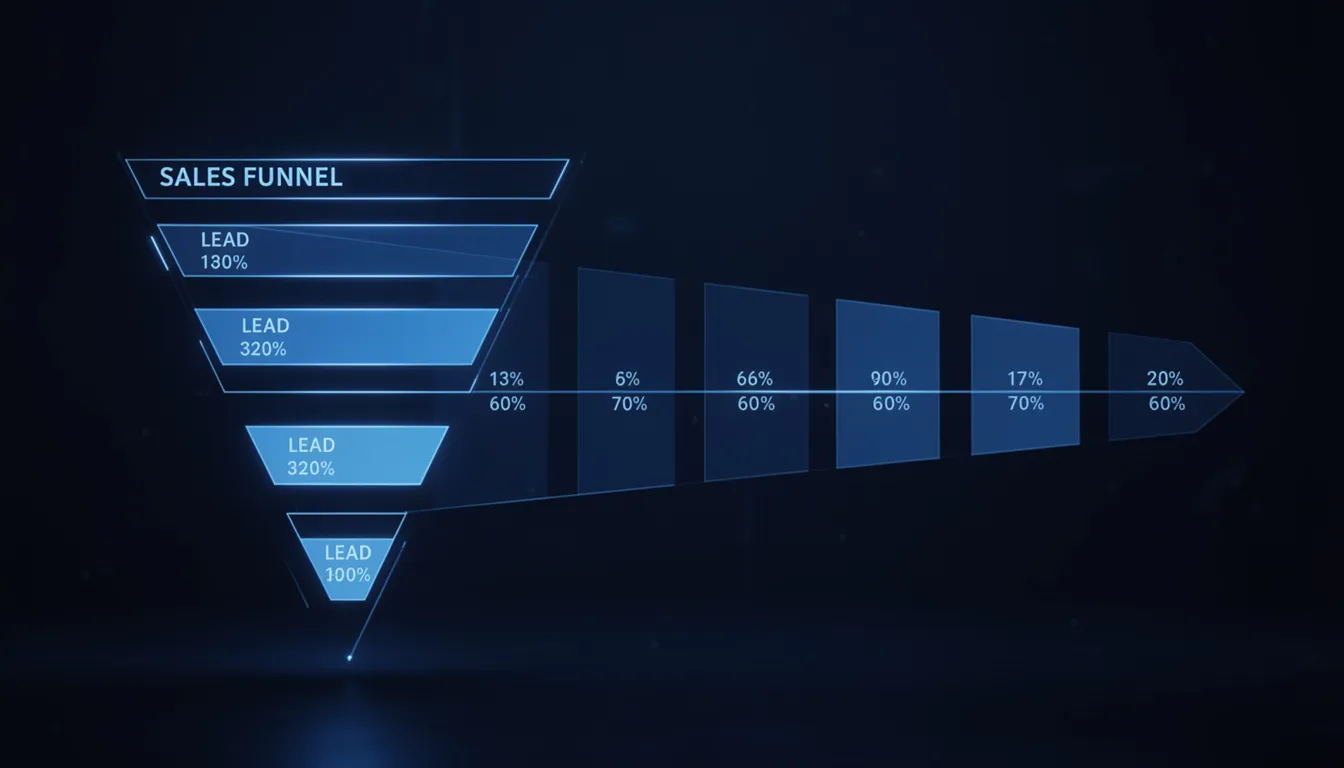
A sales funnel is a visual and operational model that represents every step a prospect takes from first sales contact to becoming a paying customer. It’s called a funnel because each stage has fewer prospects than the one before it, people drop off at every step, and that’s normal.
The sales funnel answers three critical questions:
- Where are deals right now? Pipeline visibility tells you how much revenue is in play at each stage.
- Where are deals getting stuck? Stage-by-stage conversion rates reveal exactly where your process breaks down.
- How much revenue will close this quarter? Weighted pipeline gives you a forecast based on historical stage-to-close rates.
Sales Funnel vs Marketing Funnel: The Real Difference
This is where most guides get confused, and it matters for this site specifically since we already have a detailed marketing funnel guide. Here’s the actual distinction:
| Dimension | Marketing Funnel | Sales Funnel |
|---|---|---|
| Owned by | Marketing team | Sales team |
| Starts with | Stranger who doesn’t know you | Lead who has shown intent or been qualified |
| Goal | Generate qualified leads (MQLs/SQLs) | Close deals and generate revenue |
| Stages | Awareness → Consideration → Decision | Prospecting → Qualification → Proposal → Negotiation → Close |
| Key metrics | Traffic, MQLs, CPL, engagement | Pipeline value, win rate, deal velocity, average deal size |
| Timeframe | Weeks to months (building awareness) | Days to months (closing deals) |
| Primary tools | CMS, ad platforms, email marketing | CRM, sales engagement, CPQ |
| Content used | Blog posts, guides, webinars | Sales decks, proposals, case studies, ROI calculators |
| Interaction type | One-to-many (content, ads) | One-to-one (calls, demos, meetings) |
The handoff point between marketing and sales is where most organizations lose deals. Marketing says they sent qualified leads. Sales says the leads were garbage. The solution is a Service Level Agreement (SLA) between the two teams that defines exactly what “qualified” means, specific criteria like company size, budget authority, timeline, and demonstrated intent.
Why Your Business Needs a Defined Sales Funnel
Without a formal sales funnel, your sales process depends entirely on individual reps’ intuition. That creates three problems:
Inconsistent performance. Your best rep closes at 35% while your worst closes at 8%. Without a funnel, you can’t diagnose why or replicate what works.
Unreliable forecasting. If you can’t see how many deals are at each stage and what the historical conversion rate is for each stage, your revenue forecast is a guess.
Invisible bottlenecks. Maybe 60% of your prospects drop off after the demo. Without stage-by-stage tracking, you’d never know, you’d just see low overall conversion and blame the leads.
Sales Funnel Stages: The Complete Breakdown
Every business will customize their funnel stages, but the core structure follows a universal pattern. Here are the stages most B2B sales organizations use, with specific tactics for each.
Stage 1: Prospecting (Top of Funnel, TOFU)
What happens: Sales reps identify and reach out to potential buyers. This includes outbound prospecting (cold email, cold calls, LinkedIn outreach, social selling) and processing inbound leads from marketing.
Entry criteria: Prospect matches your Ideal Customer Profile (ICP).
Exit criteria: Prospect responds positively and agrees to a discovery conversation.
Tactics that work at this stage:
- Multi-channel sequences. The best prospecting combines email, phone, LinkedIn, and sometimes video. Research shows that sequences using 3+ channels achieve significantly higher engagement rates than single-channel outreach, up to 287% higher purchase rates according to Omnisend data.
- Personalization at scale. Reference the prospect’s specific company, recent news, tech stack, or published content. “I saw your company just raised a Series B” beats “I hope this email finds you well.”
- Trigger-based outreach. Reach out when something changes, new funding, leadership change, job posting that signals a need, technology adoption signals from tools like BuiltWith or Slintel.
- Referral mining. Ask existing customers for introductions. Referred prospects convert at 3-5x the rate of cold prospects.
Benchmark conversion rate: 5-15% of outbound prospects agree to a conversation. 25-40% of inbound leads move to the next stage.
| Prospecting Channel | Average Response Rate | Best Use Case |
|---|---|---|
| Cold email (personalized) | 5-12% | Scale outreach to ICP accounts |
| Cold calling | 2-3% connect rate | High-value accounts, decision-makers |
| LinkedIn outreach | 15-25% acceptance | Relationship building, social proof |
| Referral introductions | 40-60% | Highest-quality pipeline |
| Inbound (form fills) | 25-40% qualify | Intent-driven leads |
Stage 2: Qualification (TOFU/MOFU)
What happens: The sales rep determines whether the prospect is a genuine opportunity worth pursuing. This is the single most important stage for pipeline quality.
Entry criteria: Prospect has agreed to engage (accepted a meeting, responded to outreach).
Exit criteria: Prospect meets defined qualification criteria and agrees to move forward with evaluation.
Qualification frameworks:
BANT (Budget, Authority, Need, Timeline) The classic framework. Still useful but increasingly outdated because modern B2B purchases often don’t have pre-set budgets, budgets get created when the pain is acute enough.
| BANT Element | Key Questions | Red Flag |
|---|---|---|
| Budget | What’s your allocated budget? How have you funded similar projects? | ”We have no budget for this” (but still worth exploring if need is strong) |
| Authority | Who else is involved in this decision? What’s the approval process? | Can’t identify decision-maker or refuses to involve them |
| Need | What problem are you trying to solve? What happens if you don’t solve it? | No clear pain point or urgency |
| Timeline | When do you need this resolved? What’s driving that date? | ”Sometime next year, maybe” |
MEDDIC (Metrics, Economic Buyer, Decision Criteria, Decision Process, Identify Pain, Champion) More thorough than BANT. Used by enterprise sales teams where deal sizes are $50K+.
- Metrics: What measurable outcome does the buyer need? (“Reduce churn by 15%”)
- Economic Buyer: Who has the final budget authority? (Not the same as your contact)
- Decision Criteria: What specific criteria will they evaluate vendors on?
- Decision Process: What are the actual steps to get a contract signed?
- Identify Pain: What’s the core business pain driving this initiative?
- Champion: Who inside the organization will advocate for your solution?
GPCTBA/C&I (Goals, Plans, Challenges, Timeline, Budget, Authority, Consequences & Implications) HubSpot’s framework. The “Consequences & Implications” addition is valuable, it forces the prospect to articulate what happens if they don’t solve the problem (which builds urgency) and what success looks like (which sets expectations).
Benchmark conversion rate: 40-60% of prospects that enter qualification should move forward. If it’s higher than 60%, your criteria may be too loose. If it’s lower than 40%, your prospecting may be targeting the wrong profiles.
Stage 3: Discovery / Needs Analysis (MOFU)
What happens: Deep-dive conversations to understand the prospect’s specific situation, requirements, stakeholders, evaluation process, and success criteria. This is where you build the business case.
Entry criteria: Prospect is qualified and has agreed to a detailed evaluation.
Exit criteria: You have a complete understanding of requirements and the prospect agrees to see a proposal or demo.
Tactics for effective discovery:
- Ask about the status quo. “Walk me through how your team handles [process] today.” This reveals pain points the prospect might not have articulated yet.
- Quantify the cost of inaction. “How much time does your team spend on [manual process] each week? At what average hourly cost?” This builds the ROI case you’ll use later.
- Map the buying committee. In B2B, the average deal involves 6-10 stakeholders according to Gartner. Ask: “Besides yourself, who else needs to weigh in on this decision? Who might block it?”
- Understand the evaluation process. “Have you looked at other solutions? What would need to be true for you to choose us? What’s your internal timeline for making a decision?”
- Document everything. Send a follow-up email summarizing what you learned, the requirements discussed, and agreed next steps. This creates accountability and a shared understanding.
Discovery meeting structure (60 minutes):
| Time Block | Activity | Purpose |
|---|---|---|
| 0-5 min | Agenda setting and introductions | Align on meeting goals |
| 5-20 min | Current state and pain points | Understand the problem deeply |
| 20-35 min | Desired future state and requirements | Define what success looks like |
| 35-45 min | Stakeholder mapping and decision process | Understand how they’ll buy |
| 45-55 min | Initial solution alignment | Connect their needs to your capabilities |
| 55-60 min | Next steps and commitments | Lock in the next action |
Benchmark conversion rate: 60-75% of qualified opportunities move from discovery to proposal/demo.
Stage 4: Proposal / Demo (MOFU/BOFU)
What happens: You present your solution tailored to the prospect’s specific requirements and provide a formal proposal with pricing.
Entry criteria: Discovery is complete, requirements are documented, and the prospect has agreed to evaluate a proposal.
Exit criteria: Prospect has reviewed the proposal and enters negotiation or provides feedback.
Demo best practices:
- Never do a generic demo. Every demo should address the specific pain points and use cases discovered in Stage 3. If you’re showing features the prospect didn’t ask about, you’re wasting their time.
- Lead with the outcome, not the feature. Instead of “This is our reporting dashboard,” say “You mentioned your VP of Sales needs pipeline visibility without asking reps for updates, here’s how that works.”
- Include the economic buyer. If the decision-maker isn’t in the demo, you’ll need to repeat it or have your champion relay it (poorly). Push to include them.
- End with a clear next step. “Based on what you’ve seen, does this address the requirements we discussed? What would you need to see to move forward?”
Proposal structure that closes:
- Executive summary, 1 paragraph restating their problem and the proposed outcome
- Recommended solution, Specific to their requirements, not generic product description
- Implementation plan, Timeline, milestones, resource requirements from both sides
- Investment, Pricing with clear options (good/better/best) and ROI projection
- Case study, One relevant example from a similar company/industry
- Terms and next steps, Clear path to signing
Benchmark conversion rate: 50-70% of proposals should move to negotiation. If fewer than 50% advance, your proposals may be misaligned with what was discussed in discovery.
Stage 5: Negotiation (BOFU)
What happens: The prospect and your team discuss terms, pricing, contract details, and handle final objections. This is where deals are won or lost on execution.
Entry criteria: Prospect has reviewed the proposal and wants to move forward with modifications.
Exit criteria: Both parties agree on terms and the deal moves to contract signing.
Common negotiation scenarios and responses:
| Objection | What It Really Means | Effective Response |
|---|---|---|
| ”The price is too high” | They haven’t seen enough value, or they’re comparing to a cheaper alternative | Reframe around ROI: “Based on the metrics we discussed, this should save your team 200 hours/month. At your team’s average cost, that’s $X/year in savings against a $Y investment." |
| "We need to think about it” | There’s an unaddressed concern or a missing stakeholder | ”Of course. What specific areas do you want to think through? I want to make sure you have everything you need." |
| "Can you match competitor pricing?” | They want a discount and are using competition as use | ”I’d rather make sure we’re comparing apples to apples. What specific capabilities are included in that quote?" |
| "Legal needs to review” | Normal procurement process, but can stall if not managed | ”Absolutely. Can you introduce me to your legal contact so we can address questions proactively and keep the timeline on track?" |
| "We need to get CFO approval” | You didn’t map the buying committee properly in discovery | ”Happy to prepare a one-page executive summary focused on the financial impact. Would it help if I joined that conversation?” |
Negotiation principles:
- Never negotiate on price alone. If they need a lower price, trade something: longer contract term, reduced scope, different payment terms, case study rights.
- Create urgency without being pushy. “Our implementation team has capacity starting April 1. If we finalize by March 25, we can hit your Q2 launch target.”
- Get mutual commitments. Every concession you make should come with a corresponding commitment: “If I can get approval for that discount, can we finalize the contract this week?”
Benchmark conversion rate: 70-85% of deals in negotiation should close. If your negotiation-to-close rate is below 70%, prospects may be entering negotiation prematurely.
Stage 6: Close (BOFU)
What happens: The deal is signed, payment terms are finalized, and the customer transitions to onboarding/implementation.
Entry criteria: Terms are agreed upon and contract is in the signature process.
Exit criteria: Contract is signed and payment is processed or scheduled.
Closing tactics that work:
- The assumptive close. “I’ll send the contract over today. Shall I include your legal team on the email?” Works when verbal agreement is strong.
- The timeline close. “You mentioned needing to launch by Q2. Working backward from your implementation timeline, we’d need to finalize by [date] to hit that target.”
- The summary close. Restate everything agreed upon: problem, solution, pricing, timeline. “Does this match your understanding? If so, I’ll prepare the final agreement.”
Post-close checklist:
- Signed contract filed in CRM
- Deal marked as Closed Won with accurate revenue and close date
- Handoff meeting scheduled between sales, customer success, and the customer
- Implementation kickoff date confirmed
- Win/loss notes documented (what worked, what almost killed the deal)
- Internal celebration (seriously, recognizing wins matters for team morale)
Stage 7: Post-Sale (Retention and Expansion)
Many sales funnels stop at “Close,” which is a mistake. The most profitable revenue comes from existing customers through upsells, cross-sells, and renewals.
Key post-sale activities for the sales team:
- 90-day check-in. Are they using the product? Are they seeing results? This prevents churn before it starts.
- Quarterly business reviews. Show the customer the value they’ve received and identify expansion opportunities.
- Referral requests. After a successful implementation, ask for introductions. “Is there anyone in your network facing similar challenges?”
- Expansion selling. Once value is proven, introduce additional products or higher tiers. Expansion revenue costs 5-7x less than new customer acquisition.
Sales Funnel Templates
Use these templates as starting points and customize for your specific needs.
Template 1: B2B SaaS (Self-Serve + Sales-Assisted)
This template works for SaaS companies with an average contract value (ACV) of $5K-$50K/year where some customers self-serve and others need sales involvement.
| Stage | Definition | Exit Criteria | Target Conversion | Avg Time in Stage |
|---|---|---|---|---|
| Lead | Signed up for free trial or requested demo | Responds to outreach | 30% → Qualified | 3-5 days |
| Qualified | Meets ICP, has identified need | Agrees to discovery call | 50% → Discovery | 2-3 days |
| Discovery | Needs mapped, stakeholders identified | Agrees to see proposal | 65% → Proposal | 5-7 days |
| Proposal | Custom proposal delivered | Verbal commitment | 55% → Negotiation | 5-10 days |
| Negotiation | Terms being finalized | Contract sent | 80% → Close | 3-7 days |
| Closed Won | Contract signed | , | , | , |
Overall lead-to-close rate: ~4.3% Average sales cycle: 18-32 days
Template 2: E-Commerce (Direct-to-Consumer)
E-commerce funnels are shorter and higher velocity. “Sales” here means the website experience and post-visit follow-up.
| Stage | Definition | Exit Criteria | Target Conversion | Avg Time in Stage |
|---|---|---|---|---|
| Visitor | Lands on product page | Adds to cart | 8-12% → Cart | Minutes |
| Cart | Product in cart | Begins checkout | 55-65% → Checkout | Minutes to hours |
| Checkout | Enters payment information | Completes purchase | 65-75% → Purchase | Minutes |
| Purchase | Order confirmed | , | , | , |
| Repeat | Returns for second purchase | , | 20-30% repeat rate | 30-90 days |
Overall visitor-to-purchase rate: 2.5-4.5% Cart abandonment recovery: Email sequences can recover 5-15% of abandoned carts.
Template 3: Professional Services (Consulting, Agency)
Longer sales cycles, relationship-driven, often involves proposals and SOWs (Statements of Work).
| Stage | Definition | Exit Criteria | Target Conversion | Avg Time in Stage |
|---|---|---|---|---|
| Inquiry | Prospect fills out contact form or is referred | Initial conversation held | 60% → Consultation | 1-3 days |
| Consultation | Free consultation or audit delivered | Scope agreed upon | 50% → Proposal | 7-14 days |
| Proposal | SOW/proposal delivered with pricing | Client provides feedback | 45% → Negotiation | 7-21 days |
| Negotiation | Terms, scope, and pricing being finalized | Verbal agreement | 75% → Close | 3-14 days |
| Closed Won | Contract/SOW signed, retainer paid | , | , | , |
Overall inquiry-to-close rate: ~10% Average sales cycle: 21-52 days
How to Build a Sales Funnel Step-by-Step
Follow this process from start to finish.
Step 1: Define Your Ideal Customer Profile (ICP)
Before building funnel stages, define who belongs in it. An ICP isn’t a vague persona, it’s a specific, data-driven description of your best customers.
ICP definition framework:
| Attribute | Example (B2B SaaS) | How to Research |
|---|---|---|
| Company size | 50-500 employees | Analyze your best customers’ company sizes |
| Industry | SaaS, fintech, e-commerce | Look at which industries have highest win rates |
| Revenue | $5M-$100M ARR | Check databases like Crunchbase, ZoomInfo |
| Tech stack | Uses Salesforce, HubSpot, or Marketo | Tools like BuiltWith, Slintel, HG Insights |
| Pain point | Manual lead routing, slow response times | Customer interviews, sales call recordings |
| Buying signal | Hiring SDRs, launching new product | Job postings, press releases, funding news |
| Budget range | $15K-$75K annually | Historical deal data |
Step 2: Map Your Current Sales Process
Before designing the ideal funnel, document what actually happens today. Shadow your sales reps through 10-15 deals (both won and lost) and answer:
- What triggers a rep to start working a lead?
- What questions do they ask first?
- At what point do they send a proposal?
- How many meetings typically happen before a close?
- Where do deals get stuck or die?
This reveals your actual funnel, which may be very different from what you think it is.
Step 3: Define Funnel Stages with Entry and Exit Criteria
Each stage needs a clear definition of what it means for a deal to be “in” that stage and what needs to happen to move it forward. Without these criteria, reps will categorize deals inconsistently, making your pipeline data unreliable.
Rules for stage definitions:
- Entry criteria must be verifiable. “Prospect seems interested” is not a stage. “Prospect confirmed budget exists and has agreed to a demo” is.
- Exit criteria must require action. Moving to the next stage should require the prospect to do something (attend a meeting, provide information, give verbal commitment), not just the rep doing something.
- Keep it to 5-7 stages. More than 7 creates administrative overhead without improving visibility. Fewer than 5 doesn’t give you enough granularity to diagnose problems.
Step 4: Set Conversion Rate Benchmarks
Use your historical data (or industry benchmarks if you’re starting from zero) to set expected conversion rates for each stage transition. These benchmarks serve two purposes:
- Forecasting. If you have 100 deals in Discovery and your Discovery-to-Proposal rate is 65%, you can expect about 65 proposals.
- Diagnosis. If your Proposal-to-Negotiation rate suddenly drops from 55% to 30%, something changed, maybe a competitor launched a new feature, or your pricing increased.
Industry benchmark conversion rates (B2B):
| Stage Transition | Bottom 25% | Median | Top 25% |
|---|---|---|---|
| Lead → Qualified | 10% | 25% | 40% |
| Qualified → Discovery | 30% | 50% | 65% |
| Discovery → Proposal | 45% | 65% | 80% |
| Proposal → Negotiation | 35% | 55% | 70% |
| Negotiation → Close | 55% | 75% | 85% |
| Overall Lead → Close | 0.3% | 3.5% | 10% |
Step 5: Build Your Lead Scoring Model
Not all leads deserve equal sales attention. A lead scoring model assigns points based on fit (demographic/firmographic) and behavior (engagement/intent) to prioritize which leads enter the sales funnel.
Scoring model example:
| Signal | Points | Category |
|---|---|---|
| Matches ICP company size | +20 | Fit |
| Decision-maker title | +15 | Fit |
| Target industry | +10 | Fit |
| Requested demo | +25 | Behavior |
| Visited pricing page 3+ times | +20 | Behavior |
| Downloaded case study | +15 | Behavior |
| Opened 5+ emails | +10 | Behavior |
| Unsubscribed from emails | -30 | Behavior |
| Company too small | -20 | Fit |
| Competitor email domain | -50 | Fit |
Threshold: Leads scoring 50+ enter the sales funnel. Below 50, they stay in marketing nurture.
Step 6: Design Stage-Specific Sales Playbooks
Each funnel stage should have a documented playbook that includes:
- Talk tracks and question frameworks for that stage
- Email templates for follow-ups and advancement
- Required deliverables (e.g., discovery summary, proposal, ROI calculator)
- Common objections at that stage and how to handle them
- Time limits, how long a deal can stay in a stage before triggering a review
Step 7: Implement Your CRM and Tech Stack
Your CRM is the system of record for the sales funnel. Without it, everything above is just theory.
CRM setup essentials:
- Create pipeline stages matching your funnel definition
- Set required fields at each stage (forces data discipline)
- Configure deal aging alerts (deals stuck too long get flagged)
- Build dashboards for pipeline by stage, conversion rates, and velocity
- Set up automation for task creation, follow-up reminders, and stage movement notifications
Step 8: Measure, Iterate, and Optimize
A sales funnel is never “done.” Review it monthly:
- Which stage has the biggest drop-off? Why?
- Are deals taking longer in certain stages? What changed?
- Which lead sources produce the highest lead-to-close conversion?
- Which reps have the best conversion rates at each stage, and what are they doing differently?
- Is the overall close rate trending up or down?
Sales Funnel Metrics: What to Measure
These benchmarks help you measure performance against industry standards.
Primary Metrics
| Metric | Formula | Why It Matters | Benchmark (B2B SaaS) |
|---|---|---|---|
| Win Rate | Closed Won / Total Opportunities | Overall sales effectiveness | 15-25% |
| Average Deal Size | Total Revenue / Deals Closed | Revenue per customer | Varies by segment |
| Sales Cycle Length | Average days from lead to close | Forecasting and resource planning | 30-90 days |
| Pipeline Value | Sum of all open deal values | Revenue potential | 3-5x quota |
| Pipeline Velocity | (Deals × Win Rate × Avg Deal Size) / Cycle Length | Revenue generation speed | , |
| Pipeline Coverage | Pipeline Value / Revenue Target | Forecast confidence | 3x-4x minimum |
Stage-Level Metrics
| Metric | What It Reveals |
|---|---|
| Stage conversion rate | Where prospects drop off |
| Average time in stage | Where deals get stuck |
| Stage skip rate | Whether reps are following the process |
| Stage regression rate | How often deals move backward (bad sign) |
| Activities per stage | Effort required to advance deals |
Pipeline Velocity Formula
Pipeline velocity is the single most useful sales metric. It tells you how much revenue your pipeline generates per day:
Pipeline Velocity = (Number of Opportunities × Win Rate × Average Deal Size) / Sales Cycle Length
Example:
- 80 opportunities in pipeline
- 20% win rate
- $25,000 average deal size
- 60-day sales cycle
Velocity = (80 × 0.20 × $25,000) / 60 = $6,667/day
To increase velocity, you can: get more opportunities (volume), improve win rate (effectiveness), increase deal size (value), or shorten the sales cycle (speed). Most teams try to increase volume first, but improving win rate or shortening the cycle is usually more impactful and costs less.
Sales Funnel Tools
These are the most effective options available, ranked by practical value.
CRM Platforms (The Foundation)
| Tool | Best For | Starting Price | Key Strength |
|---|---|---|---|
| Salesforce | Enterprise, complex processes | $25/user/mo | Customizability, ecosystem |
| HubSpot CRM | SMB, marketing-sales alignment | Free (paid from $20/user/mo) | Ease of use, marketing integration |
| Pipedrive | Sales-focused teams | $14/user/mo | Visual pipeline management |
| Close | Inside sales, call-heavy | $29/user/mo | Built-in calling, email |
| Freshsales | SMB, AI-powered scoring | $9/user/mo | AI deal insights, affordable |
Sales Engagement Platforms
| Tool | Best For | What It Does |
|---|---|---|
| Outreach | Enterprise outbound | Multi-channel sequences, analytics, AI coaching |
| Salesloft | Mid-market to enterprise | Cadence management, call recording, deal intelligence |
| Apollo.io | SMB prospecting + engagement | Contact database + sequences in one platform |
| Lemlist | Email-first outbound | Personalized email at scale, deliverability focus |
Analytics and Forecasting
| Tool | Best For | What It Does |
|---|---|---|
| Gong | Conversation intelligence | Records and analyzes sales calls, identifies winning patterns |
| Clari | Revenue forecasting | AI-powered forecast accuracy, pipeline risk alerts |
| InsightSquared | Pipeline analytics | Stage-by-stage conversion reporting, rep performance |
| Tableau / Looker | Custom analytics | Build any dashboard, combine CRM + marketing data |
Proposal and Contract Tools
| Tool | Best For | What It Does |
|---|---|---|
| PandaDoc | Proposal creation + e-sign | Templates, analytics, electronic signatures |
| DocuSign | Enterprise e-signatures | Industry-standard e-sign, CLM |
| Proposify | Agency/services proposals | Beautiful proposals with approval workflows |
| DealHub | CPQ + proposals | Configure-price-quote with guided selling |
Sales Funnel Examples: 3 Real Companies
These real-world examples show how the concepts apply in practice.
Example 1: Slack, Product-Led Sales Funnel
Slack’s funnel is product-led: users sign up for free, experience value, and then the sales team engages companies with high adoption to convert them to paid plans.
Funnel structure:
- Free signup, User creates a workspace (no sales involvement)
- Product adoption, Team reaches 2,000+ messages, signals value realization
- Product-qualified lead (PQL), Usage metrics trigger sales outreach (e.g., 10+ active users on free plan)
- Sales engagement, Rep contacts the admin, offers enterprise trial
- Enterprise demo, Tailored demo showing security, compliance, admin features
- Negotiation, Procurement and IT security review
- Close, Enterprise contract signed
Why it works: By the time sales engages, the prospect is already using the product and experiencing value. The sales conversation shifts from “do you need this?” to “here’s how to get more value from what you’re already using.”
Key metric: Product-qualified leads convert to paid at 3-5x the rate of marketing-qualified leads because they’ve already experienced the product.
Example 2: Salesforce, Enterprise Sales Funnel
Salesforce runs a classic enterprise sales funnel with high-touch selling and multiple stakeholders.
Funnel structure:
- Inbound lead / Outbound prospecting, Marketing generates leads through content, events, and paid; SDRs do outbound to target accounts
- SDR qualification, SDR confirms BANT criteria and books a meeting with an Account Executive
- Discovery, AE conducts deep discovery across multiple meetings, maps 6-10 stakeholders
- Solution design, Salesforce team (AE + Solution Engineer) builds a custom demo and POC
- Proposal and business case, AE builds ROI model, presents to economic buyer
- Procurement, Legal, security, and procurement reviews (this can take weeks)
- Close, Contract signed, handed to implementation team
Why it works: Salesforce invests heavily in the middle of the funnel (discovery and solution design) rather than trying to rush to a proposal. Their Solution Engineers build custom demos that mirror the prospect’s actual use cases, making it hard to choose a competitor who shows a generic demo.
Key metric: Average deal size of $50K-$250K+ with 90-180 day sales cycles. Win rate on deals that reach the proposal stage: ~40%.
Example 3: Shopify, SMB Sales Funnel
Shopify targets small businesses with a hybrid self-serve and sales-assisted funnel.
Funnel structure:
- Free trial signup, 3-day free trial (reduced from 14 days in 2023)
- Onboarding engagement, In-product guides and email sequences help merchants set up their store
- Activation, Merchant adds first product, configures payment, publishes store
- Conversion to paid, Trial ends, merchant converts to paid plan ($39/month and up)
- Expansion, Shopify Plus team identifies high-growth merchants and upsells to enterprise ($2,300+/month)
Why it works: The short trial period (3 days) creates urgency without sacrificing quality, it forces prospects to take action immediately rather than signing up and forgetting. The expansion sales team only contacts merchants showing real growth signals (GMV thresholds, employee count, etc.), making outreach relevant rather than intrusive.
Key metric: Free trial to paid conversion rate: approximately 5-8%. Merchants who complete store setup during the trial convert at 3x the rate of those who don’t.
Common Sales Funnel Mistakes
Here is what matters most in practice.
Mistake 1: No Clear Handoff from Marketing to Sales
The problem: Marketing counts someone as an MQL because they downloaded an ebook. Sales calls them immediately and asks about budget. The prospect is confused and annoyed because they were just doing research.
The fix: Define SQL criteria jointly between sales and marketing. An MQL becomes an SQL only when specific behavioral and fit criteria are met, not just a content download. Implement a lead scoring model and only pass leads that cross the threshold.
Mistake 2: Skipping Discovery
The problem: Reps rush to demo the product before understanding the prospect’s situation. The demo is generic, doesn’t address specific pain points, and the prospect mentally checks out.
The fix: Make discovery a mandatory stage with required documentation. No demo should be scheduled without a completed discovery summary that includes: identified pain points, success criteria, buying committee, and timeline.
Mistake 3: No Stage Exit Criteria
The problem: Reps move deals forward in the CRM based on gut feel. “It feels like they’re in negotiation” leads to an inflated pipeline full of deals that aren’t actually progressing.
The fix: Define verifiable exit criteria for each stage that require the prospect (not just the rep) to take action. “Prospect confirmed budget” is verifiable. “Prospect seems interested” is not.
Mistake 4: Measuring Activities Instead of Outcomes
The problem: Sales managers track calls made, emails sent, and meetings booked, but not conversion rates, deal velocity, or pipeline quality. Reps optimize for activity metrics and generate lots of motion without progress.
The fix: Track both activity metrics and outcome metrics. Activity tells you whether reps are working. Outcomes tell you whether the work is effective. A rep making 50 calls/day with a 1% conversion rate needs coaching, not congratulations.
Mistake 5: Ignoring Post-Sale
The problem: Sales closes the deal and moves on. Customer onboarding is handled by a different team with no overlap. The customer’s initial experience doesn’t match the sales promise, and they churn within 6 months.
The fix: Require a structured handoff meeting between sales, customer success, and the customer. Sales documents everything promised, the customer’s success criteria, and the key stakeholders. Customer success picks up with full context, not a blank slate.
Mistake 6: One Funnel for All Segments
The problem: An enterprise deal with a 6-month cycle and 10 stakeholders gets the same funnel as an SMB deal that should close in 2 weeks with one decision-maker. This means either enterprise deals are rushed or SMB deals are over-complicated.
The fix: Create separate funnels (or at minimum, separate stage definitions) for each segment. Most companies need at least two: one for self-serve/SMB and one for mid-market/enterprise.
Mistake 7: Not Tracking “Closed Lost” Reasons
The problem: When deals don’t close, they’re marked as “Closed Lost” with no explanation. You can’t learn from losses if you don’t document why they happened.
The fix: Require a “Closed Lost” reason from a standardized dropdown (went with competitor, no decision/status quo, budget cut, timing, lost contact, etc.) plus a free-text field for details. Review Closed Lost reasons monthly to identify patterns.
Related Reading
- Marketing Funnel: Build One That Converts
- B2B Lead Generation Strategies That Actually Work in 2026
- Demand Generation: Strategy and Metrics 2026
- Conversion Rate Optimization: CRO for B2B
- Customer Journey Mapping: Improve Conversions
FAQ
Here is what matters most in practice.
1. What is a sales funnel in simple terms?
A sales funnel is the step-by-step process your sales team uses to turn a potential customer into a paying customer. It starts with finding prospects and ends with closing a deal. Each step narrows down the number of people, similar to a physical funnel, because not everyone who enters will buy. Tracking these steps helps you predict revenue, find problems in your process, and improve your close rate.
2. How many stages should a sales funnel have?
Five to seven stages is the sweet spot for most businesses. Fewer than five doesn’t give you enough visibility into where deals get stuck. More than seven creates administrative overhead that slows your sales team down. The specific stages depend on your sales cycle complexity and deal size, but the core flow is always some variation of: Prospect → Qualify → Discover → Propose → Negotiate → Close.
3. What is the difference between a sales funnel and a sales pipeline?
A sales funnel is the conceptual model (stages and conversion rates). A sales pipeline is the operational view, the actual deals in your CRM at each stage right now. Think of the funnel as the blueprint and the pipeline as the construction site. You design the funnel once and optimize it over time. You manage the pipeline daily. When someone says “pipeline review,” they mean looking at specific deals. When someone says “funnel optimization,” they mean improving conversion rates between stages.
4. What is a good sales funnel conversion rate?
For B2B, an overall lead-to-close rate of 2-5% is typical. Top-performing teams hit 8-12%. But overall conversion rate is less useful than stage-by-stage conversion rates, because the overall number hides where the actual problems are. A 3% overall rate could mean excellent qualification but terrible negotiation, or poor qualification but great closing. Break it down by stage to diagnose and fix the real issues.
5. How long should a sales funnel take from start to finish?
It depends on deal complexity and size. B2B SaaS (SMB): 14-30 days. B2B SaaS (mid-market): 30-90 days. Enterprise: 90-180+ days. E-commerce: minutes to hours. Professional services: 21-60 days. If your cycle is significantly longer than these benchmarks for your segment, look for stages where deals sit too long and address the bottleneck.
6. How do I know if my sales funnel is leaking?
Look at stage-by-stage conversion rates over time. A “leak” means a stage where conversion is significantly below benchmark or declining. Common leak points: Lead → Qualified (bad targeting), Discovery → Proposal (weak discovery or poor fit), Proposal → Negotiation (pricing misalignment or unconvincing proposals). If your overall conversion dropped from 4% to 2% in a quarter, compare current stage rates to the previous quarter to find which stage degraded.
7. Do I need a CRM to manage a sales funnel?
Technically, no, you could use a spreadsheet for a very small operation (fewer than 50 deals per quarter). Practically, yes. A CRM tracks deal movement, automates follow-ups, provides reporting, and ensures nothing falls through the cracks. The cost of a CRM ($14-$75/user/month) is trivial compared to the cost of lost deals from disorganized pipeline management. Start with HubSpot (free tier) or Pipedrive ($14/user/month) if budget is tight.
8. How is a sales funnel different from a marketing funnel?
The marketing funnel generates demand and qualified leads (traffic → MQL → SQL). The sales funnel converts those leads into revenue (SQL → Opportunity → Proposal → Close). Marketing owns awareness and nurturing. Sales owns qualification, proposal, negotiation, and close. The overlap is at the “qualified lead” stage, where marketing hands off to sales. Problems arise when the handoff criteria aren’t clearly defined, marketing thinks they’re sending great leads while sales thinks the leads are unqualified.
9. How do I calculate pipeline velocity?
Pipeline Velocity = (Number of Opportunities × Win Rate × Average Deal Size) / Sales Cycle Length. For example: 60 opportunities × 22% win rate × $30,000 ACV / 45-day cycle = $8,800/day in pipeline velocity. Track this monthly. If velocity drops, identify which variable changed: fewer opportunities (lead gen problem), lower win rate (sales execution problem), smaller deals (pricing or targeting problem), or longer cycles (process problem).
10. Can I automate my sales funnel?
Parts of it, yes. You can automate: lead scoring and routing (CRM rules or Clearbit + CRM), follow-up email sequences (Outreach, Salesloft, Apollo), task creation when deals move stages (CRM workflow), alerts when deals are stuck (CRM automation), proposal generation (PandaDoc, Proposify), and meeting scheduling (Calendly, Chili Piper). You cannot effectively automate: discovery conversations, solution design, complex negotiations, or relationship building. The best sales teams automate the administrative parts so reps spend more time on the human parts.
Last verified: March 2026
Ready to grow your business?
Get a marketing strategy tailored to your goals and budget.
Start a Project