SWOT Analysis for Marketing: Strategy Guide
Direct Answer: How to Use SWOT Analysis for Marketing
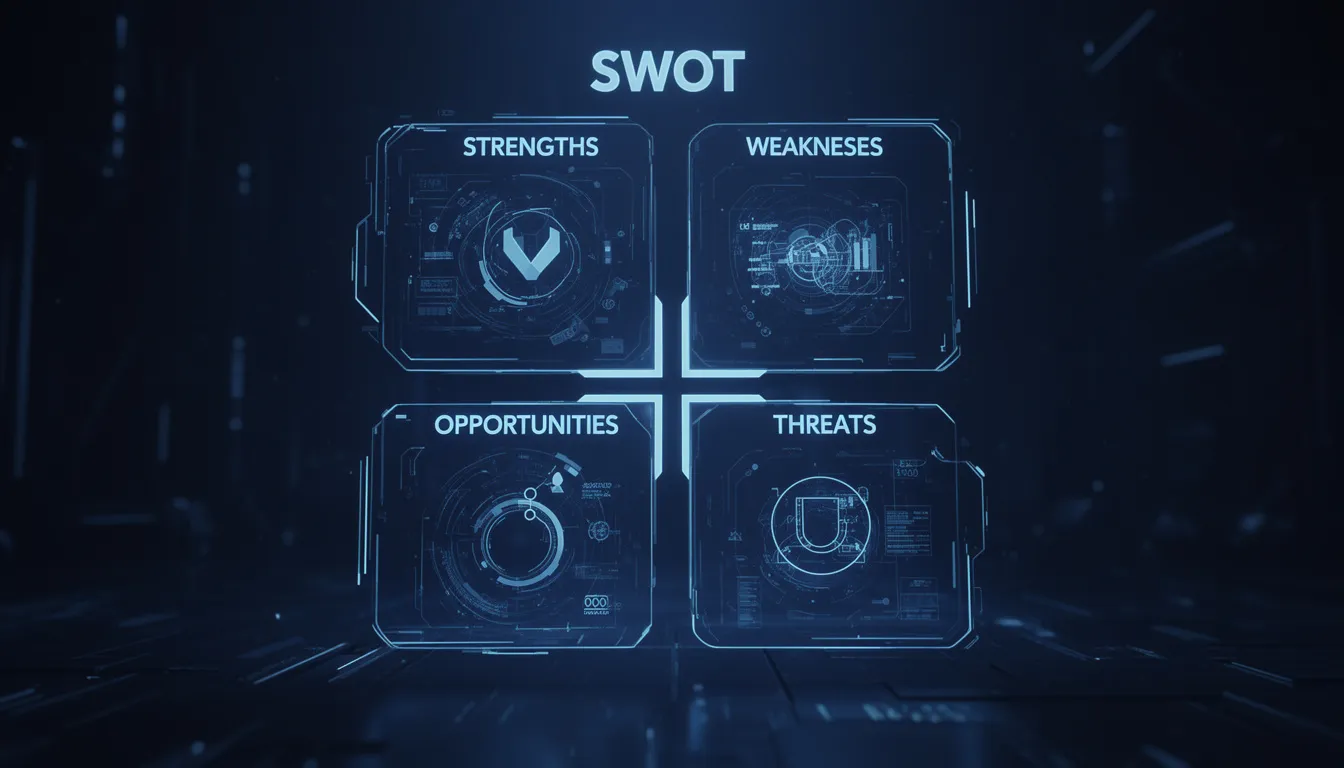
A SWOT analysis for marketing identifies your internal Strengths (what your marketing does well), Weaknesses (where your marketing underperforms), Opportunities (external trends you can capitalize on), and Threats (external forces that could hurt your marketing). The real value is not the grid itself, it is what you do after filling it in. Combine quadrants to create four strategy types: SO strategies (use strengths to capture opportunities), WO strategies (address weaknesses to unlock opportunities), ST strategies (use strengths to defend against threats), and WT strategies (minimize weaknesses and avoid threats). A SWOT analysis that does not produce specific action items is a waste of time.
SWOT analysis is one of the most widely taught and least effectively used strategic frameworks in marketing. According to Harvard Business Review, every MBA program teaches it. Every marketing plan template includes it. And most of the time, teams fill in the four quadrants with vague observations (“strong brand,” “limited budget,” “AI is changing things”), put the slide in a deck, and never reference it again.
That is not a SWOT problem, it is an execution problem. When done correctly, a SWOT analysis forces you to honestly assess where you stand, identify specific opportunities worth pursuing, and create strategies that connect your internal capabilities to external market conditions.
This guide covers how to run a marketing SWOT analysis that produces actionable strategy: the framework with marketing-specific examples, a step-by-step process, three fully worked examples, and how to convert SWOT findings into actual strategy using SO/WO/ST/WT combinations.
What Is SWOT Analysis
SWOT stands for Strengths, Weaknesses, Opportunities, and Threats. It is a strategic planning framework that organizes internal and external factors affecting a business or marketing operation.
| Helpful | Harmful | |
|---|---|---|
| Internal (you control) | Strengths | Weaknesses |
| External (you don’t control) | Opportunities | Threats |
Internal vs External
Internal factors are things your organization controls: your team’s skills, your marketing budget, your brand reputation, your technology stack, your content library, your customer data.
External factors are things outside your control: market trends, competitor actions, regulatory changes, economic conditions, technology shifts, consumer behavior changes.
This distinction matters because it determines your response. You can directly improve internal weaknesses. You can only respond to, adapt to, or plan for external threats.
Why SWOT Still Works in 2026
Critics call SWOT oversimplified. And it is, that is the point. In a marketing landscape drowning in data, AI tools, and complexity, SWOT forces you to distill your situation into the factors that actually matter. It is a thinking framework, not an analytical model. Its value comes from the structured conversation it creates, not from the grid itself.
SWOT works when:
- You are developing an annual marketing plan
- You are entering a new market or launching a new product
- You are evaluating whether to invest in a new channel
- You need to align a team around strategic priorities
- You are conducting a marketing audit
SWOT fails when:
- It is filled in by one person without input from the team
- The findings are too vague to act on
- Nobody creates specific action items from the analysis
- It is done once and never revisited
SWOT Analysis Framework for Marketing
Each quadrant needs marketing-specific analysis. Here are the questions to ask and examples for each.
Strengths: What Does Your Marketing Do Well?
Strengths are internal advantages your marketing has over competitors.
Questions to ask:
- Which marketing channels consistently outperform benchmarks?
- What content or campaigns have generated the most ROI?
- What unique data, skills, or technology does your team have?
- Where is your brand perception strongest?
- What is your competitive advantage in marketing execution?
- Which customer segments are most loyal, and why?
Marketing-specific strength examples:
| Strength | What It Means Strategically |
|---|---|
| High domain authority (DR 65+) | You can rank for competitive keywords that newcomers cannot |
| 50,000+ email subscribers | You have a direct channel that is not dependent on algorithms |
| In-house video production team | You can produce content faster and cheaper than competitors outsourcing |
| Strong brand recognition in your niche | Branded search volume gives you free traffic |
| First-party customer data | You can build custom audiences and personalize campaigns |
| Proven paid media ROI (5:1 ROAS) | You have a scalable, predictable acquisition channel |
| Technical SEO expertise on the team | You can fix site architecture issues competitors hire agencies for |
| Established partner/affiliate network | You have a distribution channel beyond paid and organic |
Weaknesses: Where Does Your Marketing Underperform?
Weaknesses are internal limitations holding your marketing back.
Questions to ask:
- Which channels are underperforming relative to investment?
- What marketing skills does your team lack?
- Where are you losing to competitors?
- What marketing infrastructure gaps exist (tools, data, processes)?
- What is your biggest marketing bottleneck?
- Where is your brand perception weakest?
Marketing-specific weakness examples:
| Weakness | What It Means Strategically |
|---|---|
| No SEO strategy or organic traffic | 100% dependent on paid channels (unsustainable) |
| Small marketing team (1-2 people) | Cannot execute across multiple channels simultaneously |
| Outdated website (slow, poor UX) | Paid traffic converts poorly, SEO suffers |
| No CRM or marketing automation | Cannot nurture leads or segment audiences |
| Weak content production pipeline | Cannot sustain content marketing at competitive volume |
| High customer acquisition cost ($500+ for $50/mo product) | Unit economics do not support scaling |
| No brand differentiation | Competing on price instead of value |
| Poor marketing-sales alignment | MQLs do not convert to SQLs, wasting marketing budget |
Opportunities: What External Trends Can You Capitalize On?
Opportunities are external conditions you can use for marketing advantage.
Questions to ask:
- What market trends favor your product or positioning?
- What new channels or platforms are emerging where competitors are not yet present?
- Are there regulatory or industry changes that create messaging opportunities?
- What customer pain points are growing that your product addresses?
- Are competitor weaknesses creating openings?
- What technology changes enable new marketing approaches?
Marketing-specific opportunity examples:
| Opportunity | How to Capitalize |
|---|---|
| AI-powered search (Perplexity, ChatGPT) growing | Optimize content for AI citation (GEO) |
| Competitor stopped investing in content marketing | Fill the content gap and capture their organic traffic |
| New social platform gaining your target audience | Establish presence before competition saturates it |
| Industry regulation requiring specific disclosures | Create educational content positioning you as the compliant choice |
| Remote work increasing demand for your product category | Expand targeting to new geographic markets |
| Rising CPC making paid too expensive for small competitors | Your higher budget becomes a competitive moat |
| Partner ecosystem expansion (new integrations) | Co-marketing with integration partners for shared audiences |
| Video content consumption increasing 30% YoY | Invest in video strategy where competitors use only text |
Threats: What External Forces Could Hurt Your Marketing?
Threats are external conditions that could negatively impact your marketing performance.
Questions to ask:
- What are competitors doing that threatens your market position?
- What technology changes could disrupt your marketing channels?
- Are there regulatory changes that could limit your marketing tactics?
- What economic conditions could reduce your marketing budget or customer spending?
- What platform changes (algorithm updates, policy changes) could affect your reach?
- Are there market shifts that make your positioning less relevant?
Marketing-specific threat examples:
| Threat | Defensive Response |
|---|---|
| Google algorithm update reducing organic traffic | Diversify traffic sources; build email list; invest in GEO |
| New well-funded competitor entering your market | Double down on differentiation; protect best keyword positions |
| Cookie deprecation limiting retargeting | Build first-party data strategy; invest in contextual targeting |
| Economic downturn reducing marketing budgets | Focus on highest-ROI channels; shift messaging to cost savings |
| AI-generated content flooding your niche | Invest in original research, expert content, and brand authority |
| Platform policy change (e.g., LinkedIn limiting organic reach) | Diversify to owned channels; convert followers to email subscribers |
| Rising ad costs pricing you out of paid channels | Invest in organic channels (SEO, content, partnerships) |
| Key marketing employee leaving | Document processes; cross-train team; build systems not dependencies |
How to Run a SWOT Analysis: Step-by-Step
Step 1: Gather Data Before the Session
A SWOT analysis based on opinions is useless. Ground it in data first.
Data to collect:
| Data Source | What to Pull |
|---|---|
| Google Analytics / GA4 | Traffic by channel, conversion rates, top pages, trends |
| Google Search Console | Keyword rankings, impressions, CTR, indexed pages |
| CRM (HubSpot, Salesforce) | Lead sources, conversion rates, pipeline by channel |
| Advertising platforms | ROAS, CPC, CPL by campaign and channel |
| Social media analytics | Engagement rates, follower growth, top content |
| Customer surveys / NPS | Satisfaction scores, common complaints, feature requests |
| Competitor analysis tools | Share of voice, estimated traffic, content gaps |
| Financial data | Marketing budget, revenue, CAC, CLV |
Step 2: Identify Participants
The SWOT analysis should include:
- Marketing team leads (content, paid, email, social)
- Sales representative (they hear customer objections daily)
- Product manager (understands product strengths and roadmap)
- Customer success representative (understands retention drivers)
- Executive sponsor (ensures strategic alignment)
Avoid: including too many people (over 8 makes the session unproductive) or too few (one person’s perspective is biased).
Step 3: Facilitate the SWOT Session (90 minutes)
Format:
| Time | Activity |
|---|---|
| 0-10 min | Present the data collected in Step 1 |
| 10-25 min | Silent brainstorm: each person writes S/W/O/T items on sticky notes (physical or digital) |
| 25-40 min | Group and discuss Strengths |
| 40-55 min | Group and discuss Weaknesses |
| 55-70 min | Group and discuss Opportunities and Threats |
| 70-90 min | Prioritize: vote on top 3-5 items per quadrant |
Rules:
- Be specific. “Good content” is not a strength. “Blog generates 45% of all MQLs at $12 cost per lead” is a strength.
- Be honest. If your SEO is weak, say so. SWOT is diagnostic, hiding problems defeats the purpose.
- Limit each quadrant to 5-7 items. If everything is a strength, nothing is.
Step 4: Prioritize Items
Not all strengths, weaknesses, opportunities, and threats are equally important. Prioritize using two criteria:
- Impact: How much does this factor affect marketing performance? (High / Medium / Low)
- Likelihood/Certainty: How confident are you that this is true or will happen? (High / Medium / Low)
Focus on items that are high-impact AND high-certainty. Low-impact or low-certainty items should be noted but not drive strategy.
Step 5: Create Strategy Combinations (SO/WO/ST/WT)
This is the step most teams skip, and it is where all the value is. See the “Turning SWOT Into Strategy” section below.
Step 6: Assign Owners and Deadlines
Every strategy that emerges from the SWOT analysis needs:
- An owner (one person accountable)
- A specific action or project
- A deadline
- A metric for success
Without this, the SWOT analysis becomes a nice conversation that changes nothing.
SWOT Analysis Template for Marketing
Use this template for your own analysis. Fill in each cell with specific, data-backed observations.
Strengths (Internal, Positive)
| # | Strength | Evidence/Data | Impact (H/M/L) |
|---|---|---|---|
| S1 | |||
| S2 | |||
| S3 | |||
| S4 | |||
| S5 |
Weaknesses (Internal, Negative)
| # | Weakness | Evidence/Data | Impact (H/M/L) |
|---|---|---|---|
| W1 | |||
| W2 | |||
| W3 | |||
| W4 | |||
| W5 |
Opportunities (External, Positive)
| # | Opportunity | Evidence/Data | Impact (H/M/L) |
|---|---|---|---|
| O1 | |||
| O2 | |||
| O3 | |||
| O4 | |||
| O5 |
Threats (External, Negative)
| # | Threat | Evidence/Data | Impact (H/M/L) |
|---|---|---|---|
| T1 | |||
| T2 | |||
| T3 | |||
| T4 | |||
| T5 |
Strategy Matrix
| Opportunities | Threats | |
|---|---|---|
| Strengths | SO Strategies: Use strengths to capture opportunities | ST Strategies: Use strengths to defend against threats |
| Weaknesses | WO Strategies: Address weaknesses to unlock opportunities | WT Strategies: Minimize weaknesses to avoid threats |
SWOT Analysis Examples
Example 1: B2B SaaS Startup (Series A, Marketing Automation Product)
Context: 18-month-old marketing automation startup. $5M ARR. 3-person marketing team. Competing against HubSpot, ActiveCampaign, and Brevo.
Strengths:
| # | Strength | Evidence |
|---|---|---|
| S1 | Product built for AI-native workflows (competitors retrofitting AI) | 40% of new users cite AI features as primary reason for switching |
| S2 | Fast product iteration (ship weekly) | 48 feature releases in last 12 months vs competitors’ quarterly cycles |
| S3 | Strong founder brand on LinkedIn (25K followers) | Founder posts generate 200+ qualified website visits/month |
| S4 | Low price point ($49/mo vs $800/mo for comparable HubSpot tier) | Win rate against HubSpot is 65% when price is discussed |
| S5 | NPS of 72 (excellent for SaaS) | Customer referrals account for 20% of new signups |
Weaknesses:
| # | Weakness | Evidence |
|---|---|---|
| W1 | Zero organic search traffic (new domain, DR 12) | 0 ranking keywords in top 20 for target terms |
| W2 | No content library (15 blog posts total) | Competitors have 500-2,000+ indexed pages |
| W3 | Small marketing team (3 people, no SEO specialist) | Cannot execute paid, content, and SEO simultaneously |
| W4 | No case studies or social proof from recognizable brands | Win rate drops 40% in enterprise deals without case studies |
| W5 | Marketing tech stack is disjointed (no CDP, manual reporting) | 6+ hours/week spent on manual data compilation |
Opportunities:
| # | Opportunity | Evidence |
|---|---|---|
| O1 | HubSpot pricing backlash driving mid-market companies to seek alternatives | Reddit threads, G2 reviews mentioning HubSpot cost as pain point |
| O2 | AI in marketing is the #1 search trend in the category (volume up 300% YoY) | Keyword research data showing massive volume growth |
| O3 | Product-led growth (PLG) model gaining traction in B2B | Free tier + self-serve onboarding could reduce CAC by 60% |
| O4 | Partner integrations with popular CRMs could open co-marketing channels | Salesforce AppExchange listing would expose product to 150K+ companies |
| O5 | Several mid-tier competitors have reduced content marketing investment | Ahrefs shows declining organic traffic for 3 competitors |
Threats:
| # | Threat | Evidence |
|---|---|---|
| T1 | HubSpot launching AI features that close the gap | HubSpot AI roadmap announced at INBOUND 2025 |
| T2 | Well-funded new competitor raised $50M Series B | Competitor increasing ad spend 5x, hiring 20-person content team |
| T3 | Google AI Overviews reducing click-through rates for informational queries | CTR for target keywords down 15% in last 6 months |
| T4 | Economic uncertainty causing longer B2B sales cycles | Average deal cycle increased from 28 to 42 days |
| T5 | Cookie deprecation limiting retargeting effectiveness | Retargeting ROAS dropped 30% after Chrome changes |
Strategies:
| Type | Strategy | Actions |
|---|---|---|
| SO1 | Use AI-native positioning (S1) to capture the AI marketing search trend (O2) | Create “AI marketing automation” content hub targeting 20 high-volume keywords; founder posts weekly AI demos on LinkedIn |
| SO2 | Use low price point (S4) to capture HubSpot pricing backlash (O1) | Create comparison landing pages (“HubSpot alternative,” “[Product] vs HubSpot”); target competitor keywords in paid search |
| WO1 | Address zero organic traffic (W1) by filling competitor content gaps (O5) | Hire freelance SEO writer; publish 8 articles/month targeting keywords where competitors are declining |
| WO2 | Build case studies (W4) through PLG conversions (O3) | Launch free tier; offer upgraded features in exchange for case study participation |
| ST1 | Use fast iteration speed (S2) to stay ahead of HubSpot AI features (T1) | Ship AI features monthly; publish “what’s new” content comparing to HubSpot’s quarterly releases |
| WT1 | Reduce manual reporting dependency (W5) to free up resources for defending against funded competitor (T2) | Implement CDP (Segment or equivalent); automate weekly reporting; reallocate 6 hours/week to content production |
Example 2: Ecommerce Brand (DTC Skincare, $2M Annual Revenue)
Context: 3-year-old direct-to-consumer skincare brand. Sells through Shopify store and Amazon. 2-person marketing team.
Strengths:
| # | Strength | Evidence |
|---|---|---|
| S1 | 15,000 email subscribers with 35% open rate | Email drives 25% of revenue; list is highly engaged |
| S2 | Strong product reviews (4.8 avg on Amazon, 4.7 on site) | 2,400+ verified reviews across platforms |
| S3 | Unique ingredient (proprietary botanical blend) | No competitor uses this formulation; defensible positioning |
| S4 | Instagram following of 45K with 5.2% engagement rate | 3x industry average engagement; strong UGC content |
| S5 | Repeat purchase rate of 42% | Indicates strong product-market fit and customer satisfaction |
Weaknesses:
| # | Weakness | Evidence |
|---|---|---|
| W1 | Paid social ROAS declining (from 4.2 to 2.1 over 12 months) | Meta ad costs up 40%; creative fatigue setting in |
| W2 | No SEO strategy; website has 200 monthly organic visits | Competitors get 50,000+ organic visits/month |
| W3 | No loyalty program despite high repeat rate | Missing opportunity to increase purchase frequency |
| W4 | Amazon dependency (55% of revenue) | Amazon can change fees, suppress listings, or introduce competing products |
| W5 | Limited marketing budget ($8K/month) | Cannot compete with well-funded competitors on paid channels |
Opportunities:
| # | Opportunity | Evidence |
|---|---|---|
| O1 | ”Clean beauty” search volume growing 25% YoY | Category tailwind for products with natural ingredients |
| O2 | TikTok Shop gaining traction for skincare brands | Competitors generating $50K+/month through TikTok Shop |
| O3 | Subscription model adoption increasing in beauty | 60% of surveyed customers said they would subscribe for 10% discount |
| O4 | Wholesale/retail opportunity (Sephora, Ulta buyer interest) | Inbound inquiry from Ulta buyer at trade show |
| O5 | Influencer marketing costs dropping for micro-influencers | Micro-influencer partnerships available at $200-500/post (was $500-1,500) |
Threats:
| # | Threat | Evidence |
|---|---|---|
| T1 | Large beauty conglomerates launching “clean” sub-brands | L’Oreal and Unilever both announced clean beauty lines |
| T2 | Amazon private label risk | Amazon launched skincare products in adjacent category |
| T3 | Rising shipping costs (up 18% YoY) | Eroding margins on DTC orders |
| T4 | Ingredient supply chain disruption | Key botanical ingredient has 1 supplier; lead time increased from 4 to 12 weeks |
| T5 | Meta advertising platform instability | 3 significant algorithm changes in last 6 months affecting ROAS |
Strategies:
| Type | Strategy | Actions |
|---|---|---|
| SO1 | Use strong reviews (S2) and unique ingredient (S3) to capture clean beauty search growth (O1) | Create educational SEO content about the proprietary ingredient; target “clean beauty” keywords |
| SO2 | Use high Instagram engagement (S4) and UGC to enter TikTok Shop (O2) | Repurpose top UGC for TikTok; partner with 10 micro-influencers for TikTok content |
| WO1 | Address declining paid ROAS (W1) by launching subscription model (O3) | Implement subscribe-and-save with 15% discount; shift ad spend from one-time purchase to subscription acquisition |
| WO2 | Build SEO strategy (W2) using clean beauty content opportunity (O1) | Publish 4 educational articles/month targeting “clean beauty” and ingredient-education keywords |
| ST1 | Use loyal customer base (S5) and email list (S1) to reduce Amazon dependency (T2) | Run email campaigns promoting DTC purchases with exclusive bundles; goal: shift from 55% to 40% Amazon revenue |
| WT1 | Address limited budget (W5) while defending against large competitors (T1) | Focus budget on micro-influencer partnerships (O5); use customer reviews for social proof; avoid competing on paid media |
Example 3: Marketing Agency (B2B, 15 Employees, $1.8M Revenue)
Context: Performance marketing agency focused on B2B SaaS clients. Services include paid search, paid social, and landing page optimization. No content marketing or SEO services.
Strengths:
| # | Strength | Evidence |
|---|---|---|
| S1 | Deep Google Ads expertise (team avg 8 years experience) | Client ROAS averages 6.2:1 vs industry benchmark of 3.5:1 |
| S2 | 95% client retention rate over 3 years | Only lost 2 clients in 36 months (both due to budget cuts, not performance) |
| S3 | Case studies with measurable results (12 published) | Case studies generate 30% of new business inquiries |
| S4 | Strong referral network | 60% of new clients come from referrals (zero acquisition cost) |
| S5 | Proprietary reporting dashboard (built in-house) | Clients cite reporting as #1 reason for staying; competitors use generic tools |
Weaknesses:
| # | Weakness | Evidence |
|---|---|---|
| W1 | No inbound marketing (website gets 500 visits/month) | 100% dependent on referrals and outbound for new business |
| W2 | No SEO or content marketing services offered | Losing RFPs to full-service agencies; clients leave when they need SEO |
| W3 | Founder-dependent sales (CEO closes 90% of deals) | Growth capped by CEO’s bandwidth; no scalable sales process |
| W4 | Small team limits concurrent client capacity | Wait list of 3-4 months frustrates prospects |
| W5 | No thought leadership content (blog, podcast, LinkedIn) | Zero brand awareness outside existing network |
Opportunities:
| # | Opportunity | Evidence |
|---|---|---|
| O1 | B2B SaaS companies increasing paid media budgets 20% YoY | Industry reports show shift from headcount to media spend |
| O2 | AI tools enabling small agencies to offer more services | AI SEO tools could let the team add SEO services without hiring SEO specialists |
| O3 | Demand for fractional CMO services growing | 3 prospects asked about strategic advisory in last quarter |
| O4 | Remote work enabling hiring of specialists from lower-cost markets | Could add 2 specialists at 50% of local market rates |
| O5 | LinkedIn becoming primary B2B discovery channel | Agencies with strong LinkedIn presence report 3x more inbound inquiries |
Threats:
| # | Threat | Evidence |
|---|---|---|
| T1 | Google Ads automation reducing perceived need for agency management | ”Why do I need an agency when Google auto-optimizes?”, heard from 2 prospects |
| T2 | Larger agencies offering bundled services at similar price points | Lost 2 RFPs to agencies offering paid + SEO + content bundles |
| T3 | AI tools enabling in-house teams to manage paid media without agencies | Client marketing managers increasingly confident in self-serve |
| T4 | Economic uncertainty causing clients to cut agency budgets first | 2 clients reduced retainers by 30% in last quarter |
| T5 | Key employee risk (one senior PPC manager handles 40% of client revenue) | No succession plan; loss would immediately impact 5 clients |
Strategies:
| Type | Strategy | Actions |
|---|---|---|
| SO1 | Use deep Google Ads expertise (S1) and case studies (S3) to capture growing B2B paid budgets (O1) | Create targeted ABM campaign to B2B SaaS companies; use case studies as middle-of-funnel content |
| SO2 | Use high retention (S2) and referral network (S4) to launch fractional CMO offering (O3) | Pilot fractional CMO service with 3 existing clients; use referral network for warm introductions |
| WO1 | Address lack of SEO services (W2) using AI tools (O2) | Evaluate AI-powered SEO platforms (Surfer, Semrush); hire one junior SEO specialist; offer SEO as add-on to existing clients |
| WO2 | Build thought leadership (W5) through LinkedIn presence (O5) | CEO and senior team post 3x/week on LinkedIn; publish 2 case study breakdowns/month; goal: 5,000 followers in 6 months |
| ST1 | Use proprietary reporting dashboard (S5) to defend against automation narrative (T1) | Emphasize strategic insight beyond what automation provides; add AI-augmented recommendations to reporting dashboard |
| ST2 | Use case studies (S3) to differentiate against bundled agency competition (T2) | Publish head-to-head results comparisons showing specialist outperformance vs generalist agencies |
| WT1 | Address key employee risk (T5) and founder-dependent sales (W3) simultaneously | Cross-train 2 team members on key accounts; document sales playbook; hire dedicated business development rep |
Turning SWOT Into Strategy
The SWOT matrix is diagnostic. Strategy happens when you combine quadrants.
SO Strategies (Strengths + Opportunities)
Approach: Use your strengths to capitalize on external opportunities.
These are your highest-priority strategies because they use what you already do well to capture available market opportunities.
Framework:
- List your top 3 strengths
- List your top 3 opportunities
- For each combination, ask: “Can this strength help us capture this opportunity?”
- If yes, define the specific action
Example: Strong email list (Strength) + Growing demand for AI education (Opportunity) = Launch an AI marketing email course to drive product awareness and qualified leads.
WO Strategies (Weaknesses + Opportunities)
Approach: Address weaknesses to unlock opportunities you are currently missing.
These are investment strategies, you need to fix something before you can capture the opportunity.
Framework:
- List your top 3 weaknesses
- List your top 3 opportunities
- For each combination, ask: “Is this weakness preventing us from capturing this opportunity?”
- If yes, define the investment needed to fix the weakness
Example: No SEO traffic (Weakness) + Competitor declining in organic search (Opportunity) = Invest in SEO content to capture the traffic competitors are losing.
ST Strategies (Strengths + Threats)
Approach: Use your strengths to defend against external threats.
These are defensive strategies, protecting what you have built.
Framework:
- List your top 3 strengths
- List your top 3 threats
- For each combination, ask: “Can this strength protect us from this threat?”
- If yes, define the defensive action
Example: High customer retention (Strength) + New well-funded competitor (Threat) = Deepen customer relationships with exclusive features and priority support to prevent churn to the new competitor.
WT Strategies (Weaknesses + Threats)
Approach: Minimize weaknesses to reduce vulnerability to threats.
These are survival strategies, addressing your most dangerous exposure.
Framework:
- List your top 3 weaknesses
- List your top 3 threats
- For each combination, ask: “Does this weakness make us especially vulnerable to this threat?”
- If yes, define the mitigation plan
Example: Dependency on a single marketing channel (Weakness) + Algorithm change risk (Threat) = Diversify traffic sources before the algorithm change hits.
Strategy Prioritization Matrix
After generating SO/WO/ST/WT strategies, prioritize them:
| Priority | Criteria | Action |
|---|---|---|
| P1 (Do Now) | High impact + Low effort + High urgency | Execute this quarter |
| P2 (Plan Next) | High impact + Medium effort | Plan this quarter, execute next quarter |
| P3 (Invest Later) | High impact + High effort | Budget and resource for H2 |
| P4 (Monitor) | Low impact or low urgency | Track but do not invest resources now |
SWOT vs Other Strategic Frameworks
SWOT is not the only strategic framework. According to McKinsey & Company, combining internal analysis with external context is what separates useful strategy from theoretical planning. Here is how it compares and when to use each.
SWOT vs PESTLE
| SWOT | PESTLE | |
|---|---|---|
| Focus | Internal + External factors | External factors only |
| Categories | Strengths, Weaknesses, Opportunities, Threats | Political, Economic, Social, Technological, Legal, Environmental |
| Best for | Marketing strategy and planning | Understanding macro-environment before entering a market |
| Limitation | Can be too broad; requires discipline to be specific | Does not address internal capabilities |
| Use together? | Yes. Use PESTLE to feed the Opportunities and Threats quadrants of SWOT |
SWOT vs Porter’s Five Forces
Porter’s Five Forces was developed by Harvard Business School professor Michael Porter to analyze industry-level competitive dynamics.
| SWOT | Porter’s Five Forces | |
|---|---|---|
| Focus | Organization-level strategy | Industry-level competitive dynamics |
| Categories | S/W/O/T | Competitive rivalry, supplier power, buyer power, threat of new entrants, threat of substitutes |
| Best for | Marketing planning, operational strategy | Understanding industry attractiveness and competitive position |
| Limitation | Does not deeply analyze competitive dynamics | Does not address internal capabilities or specific opportunities |
| Use together? | Yes. Use Porter’s to understand competitive landscape; use SWOT to determine your strategy within it |
SWOT vs Competitive Analysis
| SWOT | Competitive Analysis | |
|---|---|---|
| Focus | Your organization (with external context) | Competitors specifically |
| Output | Strategy combinations (SO/WO/ST/WT) | Competitor positioning, strengths/weaknesses, market share |
| Best for | Internal strategy development | Understanding what competitors are doing and where they are vulnerable |
| Limitation | Competitors are only one input to Threats/Opportunities | Does not generate your strategy; only maps the landscape |
| Use together? | Yes. Competitive analysis data feeds into all four SWOT quadrants |
SWOT vs TOWS Matrix
TOWS is SWOT reorganized to emphasize strategy generation. Instead of starting with the four quadrants, TOWS starts with the cross-combinations (SO, WO, ST, WT). They use the same data, TOWS just reverses the analysis order to be more action-oriented. If your SWOT analyses tend to produce nice grids but no strategies, switch to TOWS framing.
When to Use Which Framework
| Situation | Best Framework |
|---|---|
| Annual marketing planning | SWOT (with data from all other frameworks) |
| Entering a new market | PESTLE + SWOT |
| Evaluating competitive position | Porter’s Five Forces + Competitive Analysis |
| Auditing current marketing performance | SWOT with data-backed evidence |
| Making a specific channel investment decision | SWOT focused on that channel specifically |
| Board/investor strategy presentation | SWOT (universally understood) |
Common SWOT Analysis Mistakes
Mistake 1: Being Too Vague
“Strong brand” is not a strength. “Brand recognition among B2B SaaS CMOs resulting in 40% branded search traffic” is a strength. Every item in your SWOT should be specific enough to act on.
Mistake 2: Confusing Internal and External
A common error: listing “social media algorithms changing” as a weakness. It is a threat (external). A weakness would be “our social media strategy is not adapted to algorithm changes.” The distinction matters because it determines your response, you can fix weaknesses; you can only adapt to threats.
Mistake 3: Listing Too Many Items
A SWOT with 15 items per quadrant is unusable. Limit each quadrant to 5-7 items and prioritize ruthlessly. The goal is strategic clarity, not comprehensive documentation.
Mistake 4: Not Connecting to Strategy
The SWOT grid is not the deliverable, the strategy is. If your analysis ends with filling in the grid and does not produce SO/WO/ST/WT strategies with owners and deadlines, it was a waste of time.
Mistake 5: Doing It Once and Never Revisiting
Markets change. Competitors evolve. Your capabilities grow. Revisit your SWOT analysis at least twice per year, quarterly is better. What was a threat six months ago may now be an opportunity.
Mistake 6: One Person Filling It In Alone
A SWOT analysis reflects the organization’s collective knowledge. One person’s perspective, no matter how senior, is incomplete. Include marketing, sales, product, and customer success perspectives.
Mistake 7: Ignoring the Evidence
Every SWOT item should be backed by data, a customer quote, a metric, or a verifiable observation. “I feel like our content is good” is not evidence. “Our blog generates 200 MQLs/month at $15 CPL, which is 60% below the industry average” is evidence.
Related Reading
- Competitive Analysis: Frameworks and Templates
- Brand Strategy: Build One That Drives Revenue
- Marketing Plan: Template and Step-by-Step Guide
- Go-to-Market Strategy: Framework and Playbook
- Market Segmentation: Types, Methods, Examples
FAQ
What is a SWOT analysis in marketing?
A SWOT analysis in marketing is a strategic framework that evaluates your marketing operation across four dimensions: Strengths (what your marketing does well), Weaknesses (where it underperforms), Opportunities (external trends you can capitalize on), and Threats (external forces that could hurt your marketing). The goal is to produce actionable strategies, not just a filled-in grid.
How often should you do a SWOT analysis?
Run a full SWOT analysis at least twice per year, ideally as part of annual and mid-year marketing planning. Do a focused mini-SWOT whenever you face a major decision: entering a new market, launching a new channel, or responding to a competitive threat. Revisit and update existing SWOTs quarterly.
What is the difference between SWOT and TOWS?
SWOT and TOWS use the same four categories (Strengths, Weaknesses, Opportunities, Threats) and the same data. The difference is the analysis direction. SWOT starts by identifying factors in each quadrant. TOWS starts by matching quadrants to generate strategies (SO, WO, ST, WT). TOWS is more action-oriented and is recommended if your SWOT analyses tend to produce nice grids but no strategy.
Can you do a SWOT analysis for a specific marketing channel?
Yes, and this is often more useful than a broad organizational SWOT. For example, you could run a SWOT analysis specifically for your SEO program, your email marketing, or your paid social strategy. Channel-specific SWOTs produce more targeted action items.
How do you prioritize SWOT findings?
Prioritize using two criteria: impact (how much does this factor affect marketing performance) and certainty (how confident are you that this is true). Focus on high-impact, high-certainty items first. Use the P1/P2/P3/P4 prioritization matrix to sequence the resulting strategies.
What are SO, WO, ST, and WT strategies?
These are strategy types created by combining SWOT quadrants. SO strategies use strengths to capture opportunities. WO strategies address weaknesses to unlock opportunities. ST strategies use strengths to defend against threats. WT strategies minimize weaknesses to reduce vulnerability to threats. SO strategies are typically highest priority; WT strategies are survival strategies.
Who should be involved in a marketing SWOT analysis?
Include marketing team leads, a sales representative, a product manager, a customer success representative, and an executive sponsor. Limit the group to 5-8 people. Include people who bring different perspectives, marketers see strengths and opportunities; salespeople see weaknesses and threats from the customer’s perspective.
What is the biggest mistake in SWOT analysis?
The biggest mistake is stopping after filling in the grid. A SWOT analysis that does not produce specific strategies with owners, actions, and deadlines is a brainstorming exercise, not a strategic tool. The value is in the SO/WO/ST/WT strategy combinations, not in listing strengths and weaknesses.
How do you use a SWOT analysis in a marketing plan?
Place the SWOT analysis in the situational analysis section of your marketing plan. Use the SO strategies to define your growth initiatives. Use WO strategies to define your investment areas. Use ST strategies to define your defensive tactics. Use WT strategies to identify risks that need mitigation plans. Every major initiative in your marketing plan should trace back to a SWOT finding.
Is SWOT analysis still relevant in 2026?
Yes, but only when done with rigor. The framework itself is timeless, understanding internal capabilities and external conditions is always relevant. What has changed is the data available to inform each quadrant. In 2026, you should ground every SWOT item in analytics data, competitive intelligence, and market research, not opinions. SWOT powered by data remains one of the most effective strategic planning tools available.
Last verified: March 2026
Ready to grow your business?
Get a marketing strategy tailored to your goals and budget.
Start a Project