
Marketing KPIs: Metrics by Channel and Role
Direct Answer: What Marketing KPIs Should You Track?
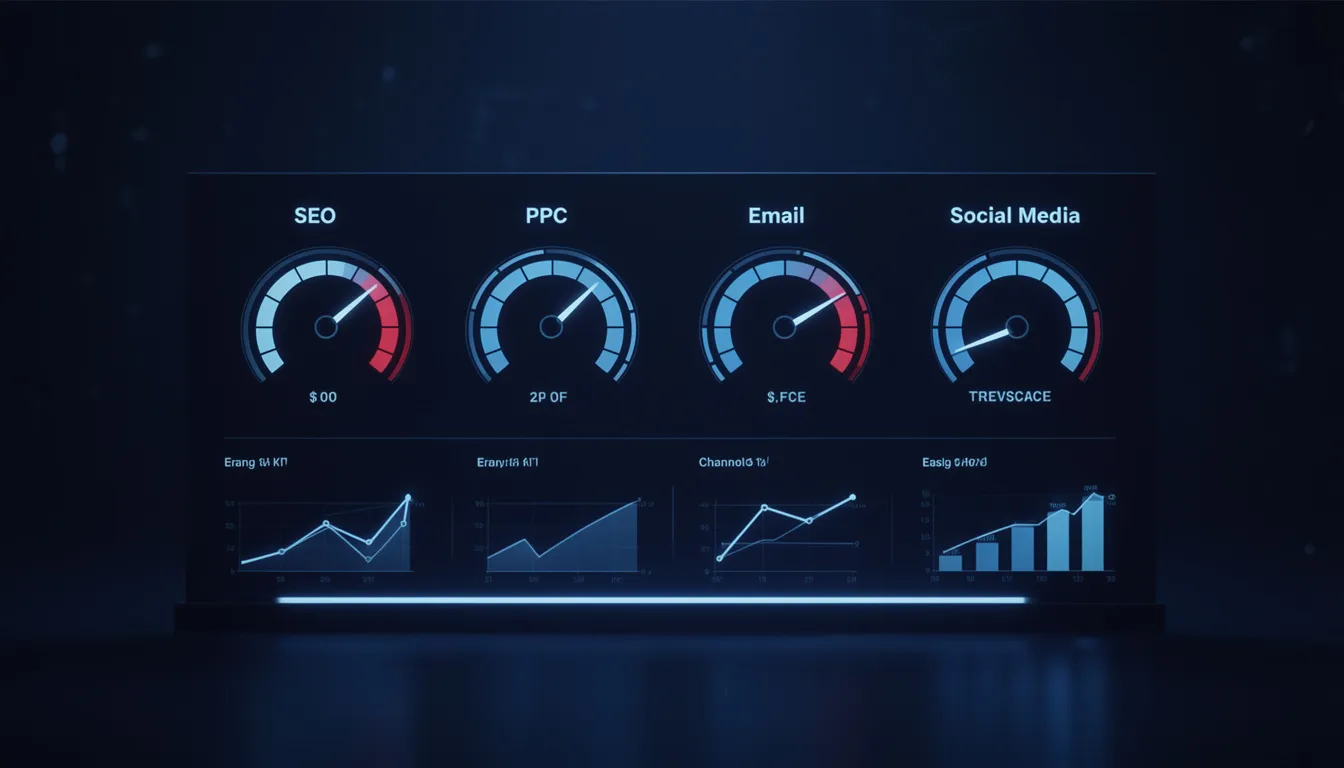
The marketing KPIs that matter depend on your channel, funnel stage, and role. At a minimum, every marketing team should track: Customer Acquisition Cost (CAC), Marketing Qualified Leads (MQLs), Conversion Rate, Customer Lifetime Value (CLV), and Marketing-Sourced Revenue. Beyond these five, the right KPIs depend on your primary channels: SEO teams track organic traffic and keyword rankings, PPC teams track ROAS and cost per acquisition, email teams track revenue per email and list growth rate, and content teams track traffic per post and content-sourced pipeline. The most common mistake is tracking too many metrics, 15-20 KPIs dilute focus. Elite marketing teams track 5-8 primary KPIs with clear targets and review them weekly.
What Are Marketing KPIs
A KPI (Key Performance Indicator) is a quantifiable metric that measures how effectively a team or organization is achieving its key business objectives. Marketing KPIs specifically measure the performance and impact of marketing activities.
Not all metrics are KPIs. The distinction matters because teams that treat everything as a KPI end up measuring everything and optimizing nothing.
KPIs vs. Metrics vs. Vanity Metrics
| Category | Definition | Example | Why It Matters (or Does Not) |
|---|---|---|---|
| KPI | A metric directly tied to a business objective with a specific target | Marketing-sourced revenue: $2M/quarter | Drives decisions and resource allocation |
| Metric | A measurement that provides useful context but is not a primary objective | Website bounce rate: 45% | Helps diagnose issues but is not a goal in itself |
| Vanity metric | A number that looks impressive but does not connect to business outcomes | Social media followers: 50,000 | Feels good in reports but does not drive revenue |
How to tell if something is a KPI or a vanity metric:
- Can you tie it to revenue? If yes, potential KPI.
- Does improving it directly improve business results? If yes, potential KPI.
- Would the CEO care about this number? If yes, likely a KPI.
- Does it change your behavior or resource allocation? If yes, KPI. If not, it is a metric or vanity metric.
The KPI Hierarchy
Marketing KPIs should cascade from business objectives down to channel-specific metrics. The hierarchy looks like this:
Level 1, Business KPIs (CEO/CFO level): Revenue, profit margin, market share, CAC payback period.
Level 2, Marketing KPIs (CMO level): Marketing-sourced revenue, total pipeline generated, blended CAC, CLV:CAC ratio.
Level 3, Channel KPIs (Channel manager level): Organic traffic, paid ROAS, email revenue, social engagement rate.
Level 4, Tactical metrics (Individual contributor level): Click-through rate, open rate, bounce rate, page load speed.
Each level should support the level above it. If a channel KPI improves but the marketing KPI above it does not, the channel KPI is not actually driving business results.
Marketing KPIs by Channel
The right metrics and approaches vary significantly by context.
SEO KPIs
| KPI | What It Measures | Target/Benchmark | Measurement Tool |
|---|---|---|---|
| Organic traffic | Visitors from unpaid search results | +10-20% YoY growth | GA4, Google Search Console |
| Keyword rankings | Position for target keywords | Top 3 for primary, top 10 for secondary | Ahrefs, SEMrush, Moz |
| Organic conversion rate | % of organic visitors who convert | 2-5% (B2B), 1-3% (B2C) | GA4 |
| Organic revenue | Revenue from organic search visitors | Should be largest digital channel for mature sites | GA4 + CRM |
| Click-through rate (CTR) | % of impressions that result in clicks | 3-5% average, 10%+ for position 1 | Google Search Console |
| Domain authority/rating | Overall site authority score | Depends on competitive set | Ahrefs (DR), Moz (DA) |
| Backlink growth | New referring domains per month | 5-20 new domains/month (depends on strategy) | Ahrefs, Majestic |
| Page load speed | Core Web Vitals (LCP, FID, CLS) | LCP <2.5s, FID <100ms, CLS <0.1 | PageSpeed Insights, CrUX |
SEO KPI priorities by maturity:
- Year 1: Focus on keyword rankings and organic traffic (leading indicators)
- Year 2: Shift focus to organic conversions and revenue (lagging indicators)
- Year 3+: Optimize for organic revenue per page and content ROI
PPC KPIs
| KPI | What It Measures | Target/Benchmark | Measurement Tool |
|---|---|---|---|
| ROAS | Revenue per dollar of ad spend | 3:1 to 5:1 (varies by industry) | Google Ads, Meta Ads Manager |
| Cost per acquisition (CPA) | Cost to acquire a customer through paid ads | Varies by industry (see CAC benchmarks) | Ad platforms + CRM |
| Click-through rate (CTR) | % of ad impressions that result in clicks | Search: 3-6%, Display: 0.5-1%, Social: 0.8-1.5% | Ad platforms |
| Conversion rate | % of ad clicks that result in a conversion | Search: 3-5%, Display: 0.5-1%, Social: 1-3% | Ad platforms + GA4 |
| Quality Score | Google’s rating of ad relevance (1-10) | 7+ for brand terms, 6+ for non-brand | Google Ads |
| Impression share | % of available impressions your ads captured | 80%+ for brand, 30-60% for non-brand | Google Ads |
| Cost per click (CPC) | Average cost per ad click | Varies widely: $0.50-$10+ | Ad platforms |
| Budget utilization | % of available budget actually spent | 90-100% for performing campaigns | Ad platforms |
PPC KPI priorities:
- When launching: Focus on CTR and Quality Score (ad relevance)
- When optimizing: Focus on CPA and conversion rate (efficiency)
- When scaling: Focus on ROAS and impression share (growth within profitability)
Email Marketing KPIs
| KPI | What It Measures | Target/Benchmark | Measurement Tool |
|---|---|---|---|
| Revenue per email | Average revenue generated per email sent | $0.05-$0.25 (e-commerce), varies for B2B | ESP + revenue tracking |
| Open rate | % of delivered emails that are opened | 20-25% (Apple MPP has inflated this) | ESP (Klaviyo, Mailchimp, etc.) |
| Click-through rate | % of delivered emails that receive a click | 2-5% | ESP |
| Click-to-open rate (CTOR) | % of opens that result in a click | 10-15% | ESP |
| Conversion rate | % of email clicks that result in a conversion | 1-5% | ESP + GA4 |
| List growth rate | Net new subscribers per month | 2-5% monthly growth | ESP |
| Unsubscribe rate | % of recipients who unsubscribe | <0.5% per send | ESP |
| Revenue per subscriber | Total email revenue / total subscribers | Varies; track for trending | ESP + revenue tracking |
Email KPI note: Since Apple’s Mail Privacy Protection (MPP) in 2021, open rates are artificially inflated. Rely more on click-through rate, conversion rate, and revenue per email as primary KPIs.
Social Media KPIs
| KPI | What It Measures | Target/Benchmark | Measurement Tool |
|---|---|---|---|
| Engagement rate | Interactions per impression or follower | 1-3% (Instagram), 0.5-1% (LinkedIn), 0.05-0.1% (X) | Native analytics, Sprout Social |
| Reach | Unique users who saw your content | Depends on audience size and platform | Native analytics |
| Social traffic | Website visits from social channels | 5-15% of total traffic | GA4 |
| Social conversions | Conversions attributed to social | Track both last-click and assisted | GA4 |
| Share of voice | Your brand mentions vs. competitors | >25% in your niche is strong | Brandwatch, Mention |
| Follower growth rate | Net new followers per month | 2-5% monthly | Native analytics |
| Video views / watch time | Content consumption depth | 50%+ average watch time | Native analytics |
| Social sentiment | Ratio of positive to negative mentions | >3:1 positive to negative | Brandwatch, Sprout Social |
Social media KPI priorities:
- Brand awareness goal: Reach, impressions, share of voice
- Engagement goal: Engagement rate, video watch time, comments
- Revenue goal: Social traffic, social conversions, social-sourced pipeline
Content Marketing KPIs
| KPI | What It Measures | Target/Benchmark | Measurement Tool |
|---|---|---|---|
| Traffic per post | Average sessions generated per content piece | 500-2,000/month for established blogs | GA4 |
| Content-sourced leads | Leads where content was the first touch | 30-50% of total leads for content-driven companies | CRM + attribution |
| Content-influenced pipeline | Pipeline where content was in the journey | 50-70% of total pipeline | CRM + attribution |
| Time on page | Average engagement time per page | 2-4 minutes for long-form content | GA4 |
| Content conversion rate | % of content visitors who convert | 1-3% for blog, 5-15% for gated content | GA4 |
| Content production velocity | Pieces published per month | 8-12 for a dedicated content team | Editorial calendar |
| Backlinks per post | Average referring domains per content piece | 5-20 for high-quality content | Ahrefs |
| Content ROI | Revenue attributed to content / content investment | 3:1 to 6:1 after 12 months | CRM + cost tracking |
Marketing KPIs by Funnel Stage
The right metrics and approaches vary significantly by context.
Awareness Stage KPIs
These KPIs measure whether your target audience knows you exist.
| KPI | Formula | Benchmark |
|---|---|---|
| Brand awareness | Survey-based: “Have you heard of [brand]?” | Depends on market maturity |
| Total website traffic | Unique visitors per month | +10-20% YoY growth |
| Organic search impressions | Search Console impressions | +15-25% YoY growth |
| Social reach | Total unique users reached | +10-15% monthly |
| Share of voice | Brand mentions / (brand + competitor mentions) | >20% in your category |
| Branded search volume | Monthly searches for your brand name | +10-30% YoY growth |
Consideration Stage KPIs
These KPIs measure whether aware prospects are evaluating your solution.
| KPI | Formula | Benchmark |
|---|---|---|
| Marketing Qualified Leads (MQLs) | Leads meeting qualification criteria | Varies by model |
| Content engagement | Downloads, webinar registrations, video completions | +10% QoQ growth |
| Return visitor rate | Returning visitors / total visitors | 25-40% |
| Email subscribers | New opt-ins per month | 2-5% list growth |
| Demo/trial requests | Inbound requests for product evaluation | Depends on sales model |
| Cost per lead (CPL) | Total marketing spend / leads generated | $5-$500 depending on industry |
Conversion Stage KPIs
These KPIs measure whether evaluating prospects are becoming customers.
| KPI | Formula | Benchmark |
|---|---|---|
| Sales Qualified Leads (SQLs) | MQLs accepted by sales | 25-40% of MQLs |
| MQL-to-SQL conversion rate | SQLs / MQLs × 100 | 25-40% |
| SQL-to-opportunity rate | Opportunities / SQLs × 100 | 50-70% |
| Opportunity-to-close rate | Closed-won / Opportunities × 100 | 15-30% (B2B) |
| Sales cycle length | Average days from MQL to closed-won | 30-90 days (SMB), 90-180 (enterprise) |
| Customer Acquisition Cost | Total sales + marketing spend / new customers | Varies widely by industry |
Retention Stage KPIs
These KPIs measure whether customers are staying and growing.
| KPI | Formula | Benchmark |
|---|---|---|
| Customer retention rate | ((End customers - New) / Start customers) × 100 | 85-95% (SaaS), 20-30% (e-commerce) |
| Net Dollar Retention | (Starting MRR + Expansion - Contraction - Churn) / Starting MRR | 100-130% (SaaS) |
| Net Promoter Score | % Promoters - % Detractors | 30-50 (good), 50+ (excellent) |
| Customer Lifetime Value | ARPA × Gross Margin / Churn Rate | 3-5× CAC |
| Repeat purchase rate | Customers who bought 2+ times / total customers | 25-40% (e-commerce) |
| Expansion revenue % | Expansion MRR / Total new MRR | 20-40% for mature SaaS |
Marketing KPIs by Role
The right metrics and approaches vary significantly by context.
CMO / VP of Marketing KPIs
The CMO’s dashboard should connect marketing to business outcomes. These are the 6-8 KPIs that belong in every board meeting.
| KPI | Why It Matters | Target Setting Approach |
|---|---|---|
| Marketing-sourced revenue | Proves marketing drives business results | % of total revenue (typically 30-60%) |
| Marketing-influenced revenue | Shows total impact including assist touches | % of total pipeline (typically 50-80%) |
| Blended CAC | Shows acquisition efficiency | Compare to CLV (target 3:1+) |
| CAC payback period | Shows time to recover investment | Target <18 months |
| Marketing ROI | Shows return on total marketing investment | Target 5:1 or higher |
| Pipeline velocity | Shows how fast deals move through funnel | Pipeline × Win Rate × ACV / Sales Cycle |
| Brand awareness / share of voice | Shows market position | Relative to top 3 competitors |
Demand Generation / Growth Marketing KPIs
| KPI | Why It Matters | Weekly Review? |
|---|---|---|
| MQLs generated | Pipeline input | Yes |
| MQL-to-SQL conversion rate | Lead quality indicator | Yes |
| Cost per MQL | Efficiency metric | Yes |
| Pipeline generated | Revenue potential | Yes |
| Channel-specific ROAS | Channel health | Yes |
| Landing page conversion rates | Conversion efficiency | Yes |
| Speed-to-lead | Response time impact on conversion | Yes |
| Campaign ROI | Individual campaign performance | Monthly |
Content Marketing KPIs
| KPI | Why It Matters | Review Cadence |
|---|---|---|
| Organic traffic growth | Content reach expanding | Weekly |
| Content-sourced leads | Content driving pipeline | Weekly |
| Top-performing pages | Content strategy validation | Monthly |
| Content production velocity | Team output | Weekly |
| Keyword rankings | SEO content effectiveness | Monthly |
| Backlinks earned | Content authority | Monthly |
| Content conversion rate | Content persuasiveness | Monthly |
| Content ROI | Business impact | Quarterly |
Product Marketing KPIs
| KPI | Why It Matters | Review Cadence |
|---|---|---|
| Win rate | Messaging and positioning effectiveness | Monthly |
| Competitive win rate | Performance against specific competitors | Monthly |
| Sales cycle length | Enablement effectiveness | Monthly |
| Feature adoption rate | Launch effectiveness | Per launch |
| Content usage by sales | Enablement material relevance | Monthly |
| Analyst/review sentiment | Market perception | Quarterly |
| Expansion revenue | Cross-sell/upsell effectiveness | Monthly |
Growth / Lifecycle Marketing KPIs
| KPI | Why It Matters | Review Cadence |
|---|---|---|
| Activation rate | % of signups who reach “aha moment” | Weekly |
| Time to value | Speed of activation | Weekly |
| Free-to-paid conversion | Monetization efficiency | Weekly |
| Retention curve | Cohort health over time | Monthly |
| Net Dollar Retention | Existing customer revenue growth | Monthly |
| Referral rate | Organic growth loop | Monthly |
| Experiment velocity | Tests run per week | Weekly |
| Experiment win rate | % of tests that produce positive results | Monthly |
How to Build a Marketing KPI Dashboard
Follow this process from start to finish.
Step 1: Define Your Dashboard Audience
Different audiences need different dashboards:
| Audience | KPIs to Include | Update Frequency | Complexity |
|---|---|---|---|
| Board/C-Suite | 5-6 business KPIs | Monthly | Simple, trends and comparisons |
| Marketing leadership | 8-12 marketing KPIs | Weekly | Moderate, with drill-down |
| Channel managers | 5-8 channel KPIs | Daily | Detailed, with tactical metrics |
| Individual contributors | 3-5 personal KPIs | Real-time | Tactical, tied to daily work |
Step 2: Choose Your Dashboard Tool
| Tool | Best For | Price | Key Strength |
|---|---|---|---|
| Looker Studio | Free, Google-ecosystem | Free | Native GA4/Google Ads integration |
| Tableau | Enterprise visualization | $75/user/month | Advanced analytics and visualization |
| Power BI | Microsoft ecosystem | $10/user/month | Excel integration, affordable |
| Databox | Marketing-specific dashboards | Free to $47/month | Pre-built marketing templates |
| Klipfolio | Real-time dashboards | $99/month | 100+ data source connectors |
| HubSpot Dashboards | HubSpot users | Included | Native CRM + marketing data |
| Domo | Enterprise with many data sources | Custom pricing | Data warehouse + visualization |
Step 3: Design Your Dashboard Layout
The ICED framework for dashboard design:
- I, Immediate insight: The top of the dashboard should answer “Are we on track?” in under 5 seconds. Use large KPI numbers with trend arrows (up/down) and red/yellow/green status indicators.
- C, Context: Below the summary, provide context. Show KPIs against targets, compare to previous period, and display trends over time.
- E, Exploration: Include drill-down capability. If pipeline is down, the viewer should be able to click into pipeline by channel, by campaign, by source.
- D, Detail: At the bottom, provide the granular data tables for those who want to investigate specific numbers.
Step 4: Set Review Cadences
| Meeting | Frequency | Duration | KPIs Reviewed | Decision Made |
|---|---|---|---|---|
| Daily standup | Daily | 10 min | Channel performance, anomalies | Tactical adjustments |
| Weekly review | Weekly | 30 min | All primary KPIs vs. targets | Budget shifts, campaign changes |
| Monthly business review | Monthly | 60 min | Business + marketing KPIs | Strategy adjustments |
| Quarterly planning | Quarterly | 2-4 hours | All KPIs + benchmarks | Budget allocation, target setting |
Step 5: Build Alert Systems
Do not rely on people checking dashboards. Set up automated alerts for:
- KPI drops more than 20% below target
- Sudden traffic drops (potential technical issues)
- CPA exceeding threshold by 15%+
- Conversion rate drops across any major channel
- Budget pacing ahead of or behind plan
- Lead volume drops that will affect pipeline in 30-60 days
Marketing KPI Benchmarks by Industry
The right metrics and approaches vary significantly by context.
SaaS
| KPI | Early Stage (<$5M ARR) | Growth ($5M-$50M ARR) | Scale ($50M+ ARR) |
|---|---|---|---|
| Marketing as % of revenue | 20-30% | 15-25% | 10-15% |
| CAC (blended) | $500-$2,000 | $1,000-$5,000 | $2,000-$10,000 |
| CAC payback (months) | 12-18 | 15-20 | 18-24 |
| MQL-to-customer rate | 2-5% | 3-7% | 5-10% |
| Net Dollar Retention | 90-110% | 100-120% | 110-130% |
| Website conversion rate | 1-3% | 2-4% | 3-5% |
| Organic traffic % | 20-30% | 30-50% | 40-60% |
E-commerce
| KPI | Small (<$5M revenue) | Mid ($5M-$50M) | Large ($50M+) |
|---|---|---|---|
| Marketing as % of revenue | 10-20% | 8-15% | 5-12% |
| Blended ROAS | 2:1 to 4:1 | 3:1 to 5:1 | 4:1 to 8:1 |
| Email revenue % | 15-25% | 20-35% | 25-40% |
| Cart abandonment rate | 70-80% | 65-75% | 60-70% |
| Average order value | Varies | +5-10% YoY target | +3-5% YoY target |
| Repeat purchase rate | 15-25% | 25-35% | 30-45% |
B2B Services
| KPI | Small firm | Mid-size firm | Large firm |
|---|---|---|---|
| Marketing as % of revenue | 5-10% | 3-8% | 2-5% |
| CAC | $2,000-$10,000 | $5,000-$25,000 | $10,000-$50,000 |
| Referral as % of new business | 40-60% | 30-50% | 20-40% |
| Content marketing ROI | 3:1 to 5:1 | 4:1 to 7:1 | 5:1 to 10:1 |
| Client retention rate | 75-85% | 80-90% | 85-95% |
| Average sales cycle | 30-60 days | 60-120 days | 90-180 days |
How to Set KPI Targets
Follow this process from start to finish.
The Three-Input Method
The best KPI targets combine three inputs:
-
Historical performance: What did you achieve last period? Apply a realistic growth rate (10-20% improvement for optimizing, 30-50% for investing in a new area).
-
Industry benchmarks: Where do you stand versus peers? If your conversion rate is 1% and the industry average is 3%, there is room to improve.
-
Business requirements: What does the business plan require from marketing? If the company needs $10M in new revenue and marketing is responsible for 40%, marketing needs to generate $4M. Work backward from that number to set channel targets.
Example target-setting process:
| Step | Calculation | Result |
|---|---|---|
| Company revenue target | Board-set | $20M |
| Marketing’s revenue share | Historical: 35% | $7M |
| Average deal size | Historical | $25,000 |
| Deals needed | $7M / $25K | 280 deals |
| Opportunity-to-close rate | Historical: 20% | Need 1,400 opportunities |
| MQL-to-opportunity rate | Historical: 30% | Need 4,667 MQLs |
| Monthly MQL target | 4,667 / 12 | 389 MQLs/month |
| Budget needed (at $150 CPL) | 4,667 × $150 | $700,000 |
SMART KPI Framework
Every KPI target should be:
- S, Specific: “Increase organic traffic” is not a KPI. “Increase organic traffic to the blog by 25% from 40,000 to 50,000 monthly sessions” is a KPI.
- M, Measurable: You must be able to track it accurately. If you cannot measure it reliably, it is not a valid KPI.
- A, Achievable: A 300% improvement in one quarter is unrealistic. A 20% improvement with a new strategy and investment might be achievable.
- R, Relevant: The KPI must connect to a business outcome. “Increase Instagram followers by 50%” is not relevant if Instagram does not drive business results.
- T, Time-bound: Every target needs a deadline. “Q2 2026” or “By June 30”, not “eventually.”
Stretch vs. Committed Targets
Best practice is to set two tiers of targets:
- Committed target (80% confidence): The number you are confident you will hit. This is what goes into the financial plan.
- Stretch target (30% confidence): The aspirational number that requires everything to go right. This is what the team aims for.
Example: Committed MQL target = 350/month. Stretch MQL target = 450/month. The team plans for 350 and strives for 450.
Common Marketing KPI Mistakes
These benchmarks help you measure performance against industry standards.
Mistake 1: Tracking Too Many KPIs
If you have 30 KPIs, you have zero KPIs. Nobody can optimize 30 metrics simultaneously. Limit each role to 5-8 primary KPIs. Everything else is a supporting metric that only gets attention when a primary KPI underperforms.
Mistake 2: Measuring Activity Instead of Outcomes
“Published 12 blog posts” is an activity. “Blog posts generated 450 leads” is an outcome. “Sent 50,000 emails” is an activity. “Email campaigns generated $125,000 in revenue” is an outcome. Always tie KPIs to outcomes, not outputs.
Mistake 3: Not Connecting KPIs to Revenue
Every marketing KPI should connect to revenue within 1-2 steps. Organic traffic connects to revenue through: traffic → leads → opportunities → revenue. If a KPI does not connect to revenue, question whether it belongs on the dashboard.
Mistake 4: Setting Targets Without Data
Targets pulled from thin air create two problems: they are either too easy (the team coasts) or impossible (the team gives up). Use historical data, benchmarks, and business requirements to set evidence-based targets.
Mistake 5: Ignoring Leading Indicators
Revenue is a lagging indicator, by the time revenue drops, the problem started months ago. Include leading indicators on your dashboard: website traffic trends, MQL volume, pipeline creation rate, content production velocity. These give you early warning.
Mistake 6: Comparing Incomparable Numbers
Comparing your startup’s metrics to enterprise benchmarks (or vice versa) leads to wrong conclusions. Always benchmark against companies of similar size, industry, and business model. A 2% website conversion rate is excellent for enterprise SaaS and mediocre for DTC e-commerce.
Mistake 7: Not Reviewing KPIs Regularly
A dashboard that nobody looks at is decoration. Embed KPI review into weekly team meetings. When a KPI misses its target for 2+ consecutive weeks, it triggers an investigation, not at the end of the quarter when it is too late to recover.
Mistake 8: Changing KPIs Too Frequently
Every time you change a KPI, you lose the ability to compare to historical performance. Commit to a set of KPIs for at least 2-3 quarters. Adjust targets quarterly, but change the KPIs themselves only at annual planning.
Related Reading
- Marketing ROI: Calculate and Improve It (2026)
- Marketing Analytics: What to Measure in 2026
- Data-Driven Marketing: Evidence Over Gut Feel
- Customer Lifetime Value (CLV): Formula Guide
- Why Multi-Touch Attribution Fails in B2B (And Alternatives)
Frequently Asked Questions
Here is what matters most in practice.
What is a marketing KPI?
A marketing KPI is a quantifiable metric that measures progress toward a specific marketing objective. Unlike general metrics (which provide information), KPIs have defined targets and are used to make decisions. Examples: Marketing Qualified Leads with a target of 400/month, Customer Acquisition Cost with a target of $500, and Marketing-Sourced Revenue with a target of $2M/quarter.
What are the top 5 marketing KPIs every team should track?
The five universal marketing KPIs are: (1) Customer Acquisition Cost (CAC), what it costs to win a customer, (2) Marketing Qualified Leads (MQLs), pipeline input, (3) Conversion Rate, efficiency of turning visitors into customers, (4) Customer Lifetime Value (CLV), long-term value of customers acquired, and (5) Marketing-Sourced Revenue, total revenue attributable to marketing. These five connect marketing activities to business outcomes regardless of your industry or business model.
How many KPIs should a marketing team track?
5-8 primary KPIs per role or team. A CMO should have 6-8 KPIs on their executive dashboard. A channel manager should have 5-8 channel-specific KPIs. Individual contributors should have 3-5 personal KPIs. In total, a marketing organization might track 20-30 metrics, but each person should focus on only their 5-8 primary ones.
What is the difference between a KPI and a metric?
A KPI is a metric that has been designated as a key measure of success, with a specific target and review cadence. All KPIs are metrics, but not all metrics are KPIs. Website traffic is a metric. “Increase organic website traffic to 50,000 monthly sessions by Q3” is a KPI. The difference is the target, the timeline, and the accountability.
How do you set marketing KPI targets?
Use the three-input method: (1) Historical performance, what you achieved previously plus a growth rate, (2) Industry benchmarks, how you compare to peers, (3) Business requirements, what the business plan requires from marketing. Work backward from revenue targets to determine lead, traffic, and conversion targets. Set both committed (80% confidence) and stretch (30% confidence) targets.
What marketing KPIs should a CMO report to the board?
Board-level KPIs should focus on business impact: (1) Marketing-sourced revenue and pipeline, (2) Customer Acquisition Cost and CLV:CAC ratio, (3) CAC payback period, (4) Marketing ROI, (5) Pipeline velocity, and (6) Brand awareness or share of voice (if relevant). Avoid channel-level metrics in board presentations, the board wants to know if marketing is generating returns, not whether email open rates improved.
What are the best KPI dashboard tools?
For free: Google Looker Studio (excellent for Google-ecosystem data). For marketing-specific: Databox ($47/month, pre-built templates). For enterprise: Tableau ($75/user/month) or Power BI ($10/user/month). For HubSpot users: HubSpot’s built-in dashboards. The best tool is the one your team will actually use daily.
How often should you review marketing KPIs?
Daily: Quick check on ad spend, traffic anomalies, and campaign performance. Weekly: Full KPI review against targets with the marketing team (30 minutes). Monthly: Business review with marketing leadership and stakeholders (60 minutes). Quarterly: Strategic review, assess KPIs, adjust targets, and reallocate budget.
What is a vanity metric?
A vanity metric is a number that looks impressive but does not connect to business outcomes or drive decisions. Common examples: social media followers (unless social drives revenue), page views without conversion context, total email list size (without engagement or revenue correlation), and press mentions (without traffic or pipeline attribution). Vanity metrics make you feel good. KPIs make you act.
How do you know if your KPIs are working?
Your KPIs are working if: (1) The team knows their KPIs without looking them up, (2) Weekly reviews lead to specific action items, (3) Resource allocation decisions reference KPI data, (4) Improving a channel KPI improves the business KPI above it, and (5) The business is growing in the direction the KPIs measure. If KPIs exist but do not change behavior, they are not working, either the KPIs are wrong or the review process is broken.
Last verified: March 2026
Ready to grow your business?
Get a marketing strategy tailored to your goals and budget.
Start a Project

![50+ B2B Marketing Benchmarks for 2026 [Data Report]](/_astro/b2b-marketing-benchmarks-2026.DCk7h65w_Z7IJC.webp)