
SEO Report QA: Check the Numbers Before Client Delivery
This article contains affiliate links — I may earn a commission at no extra cost to you. Disclosure
How Do You Check an SEO Report Before Sending It?
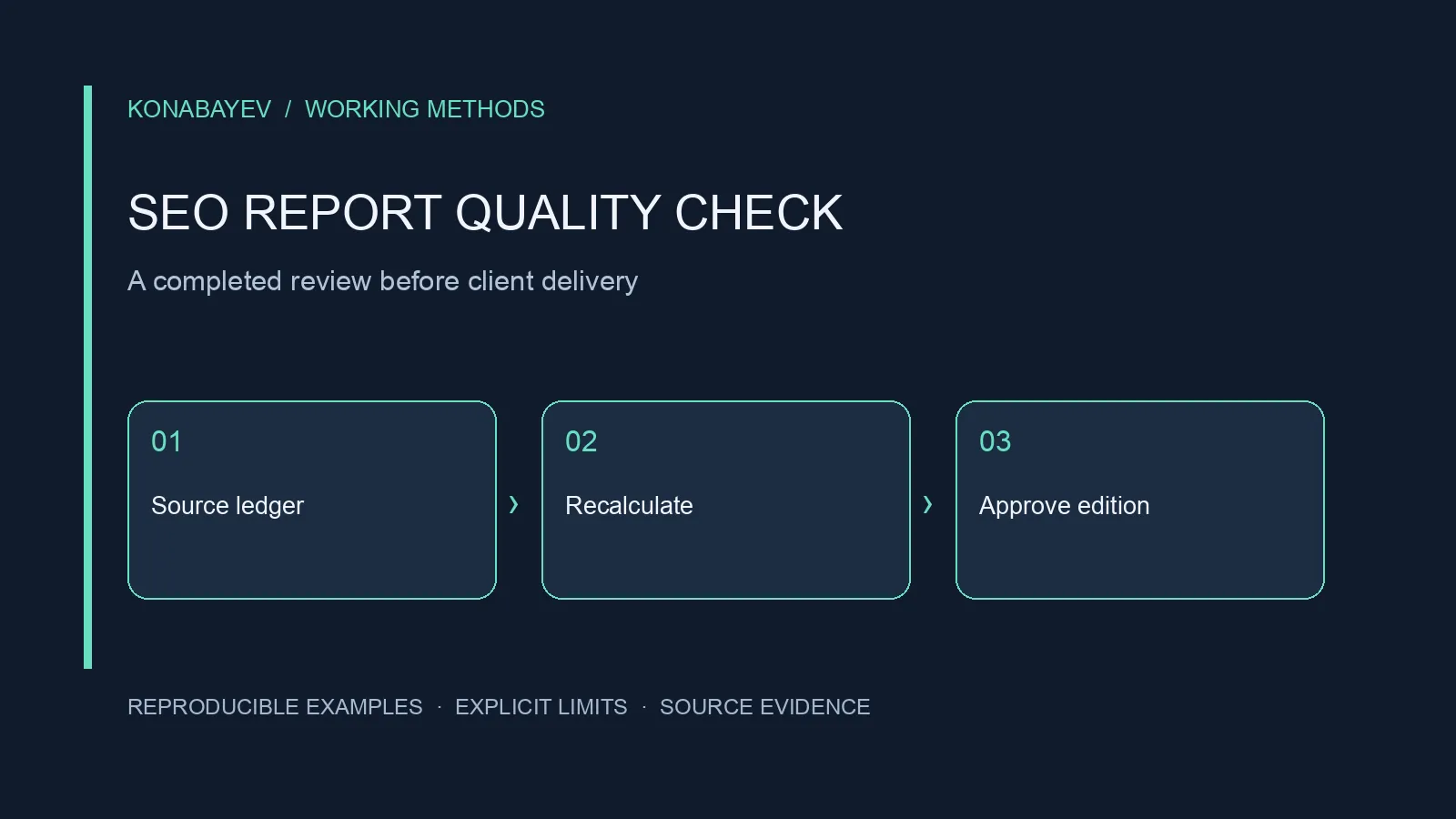
Check the report’s scope, source exports, arithmetic and business claims before approving delivery. A report passes when another reviewer can reproduce its headline numbers and see what remains unknown. Start with the acceptance worksheet, then follow the fictional example below. This is an authored review procedure, not an audit of a real client or a ranking improvement study.
A visually convincing dashboard can still compare different populations, average percentages incorrectly or call form submissions qualified leads. The review should find those errors before the client uses the report to approve budget. It should also prevent the opposite mistake: discarding useful measurements simply because two systems count different things.
This guide owns report acceptance. The reporting software comparison covers platform selection; the GSC and GA4 reconciliation worksheet covers traffic-count differences. Here, the deliverable is a review record with evidence, defects, decisions and a named approver.
1. Agree on the Reporting Contract
Define what the report must establish before choosing charts. Write down the client goal, period, covered property, population and outcome definitions. If the agreement says “qualified organic enquiries,” a screenshot of all website form submissions does not satisfy it. If the report covers Google Web search, traffic from other engines should not silently enter its denominator.
Use one contract per report edition:
| Field | Fictional example | What the reviewer checks |
|---|---|---|
| Goal | Qualified enquiries from organic landing visits | Qualification evidence exists |
| Period | September 1–28, compared with August 4–31 | Both windows contain 28 days |
| Search scope | Named GSC property, Web, all countries/devices | Export settings match the label |
| Visit scope | Named GA4 property, agreed session acquisition filter | Other channels are not silently included |
| Lead definition | Unique enquiry with recorded qualification decision | Events, contacts and qualified leads stay separate |
| Currency | USD, excluding refunds and taxes where stated | Revenue definitions are written down |
| Tracking changes | Form event revised September 15 | Before/after totals may require separate interpretation |
The periods and figures in this article are synthetic. Replace them with your actual contract; do not copy the worked results into a client deck. Define the business question in a sentence: “Did the agreed organic population produce more qualified enquiries during a comparable measurement window?” That question makes missing qualification data visible immediately.
Ask the owner to resolve any contract ambiguity before final approval. A reviewer may prepare a draft with unresolved fields, but should not silently choose a convenient definition and publish a definitive result. The report can honestly say that visit volume is known while qualified outcomes are not yet reconciled.
2. Preserve the Source and Scope of Every Headline Number
Keep a source record behind each headline metric. The record should include the export name, collection date, selected filters, unit, time zone where relevant, aggregation level and calculation. Store the unedited export separately from the presentation table. If a colleague cannot locate the input, the number is not reproducible even if the chart looks familiar.
Google’s Search Console Performance overview defines clicks, impressions, CTR and average position and distinguishes the chart from dimension-grouped tables. Its explanation also notes that the newest data can be preliminary. Those are reasons to preserve the report settings and data status, rather than assuming that every downloaded row shares one interpretation.
For the fictional report, create four evidence records:
E01: GSC export used for the published search totals.E02: GA4 export used for the agreed organic session population.E03: contact ledger with unique enquiry IDs and qualification decisions.E04: tracking-change log covering the compared windows.
Each record should point to its original file or approved location. Do not copy personal contact details into a public report. A count reconciled against a restricted ledger can be published with an explanation of the method, while access to the underlying personal records remains limited to authorized reviewers.
Treat “not available” as a status. An absent country breakdown, missing source export or unreviewed lead should not become zero. Google specifically notes that some unavailable values displayed as ~ or - can become zeros in downloaded report data. Preserve that context before arithmetic turns an unavailable metric into a measured absence.
3. Recalculate Totals, Rates and Changes
Calculate rates from the relevant totals, then check changes in both absolute and relative terms. Averaging row percentages gives each row equal weight, even when the rows have very different denominators. That may answer an intentional row-level question, but it does not generally produce the aggregate rate for the combined population.
Consider this authored two-row example:
| Row | Clicks | Impressions | CTR |
|---|---|---|---|
| A | 80 | 1,000 | 8% |
| B | 20 | 9,000 | approximately 0.2222% |
| Combined | 100 | 10,000 | 1% |
The unweighted mean of the two row CTRs is approximately 4.1111%. The combined CTR is 100 ÷ 10,000 = 1%. Publishing the unweighted figure as the combined CTR would overstate this synthetic result. Keep the population boundary with the calculation: these rows are an invented disjoint example, not a claim that arbitrary GSC page rows can always be added into the property total.
Next, check a period comparison:
| Metric | Earlier window | Later window | Arithmetic change on the unsplit windows |
|---|---|---|---|
| Clicks | 120 | 90 | −30 clicks; −25% |
| Impressions | 6,000 | 6,000 | No change in this aggregate |
| CTR | 2% | 1.5% | −0.5 percentage points; −25% relative |
| Recorded qualified enquiries | 12 | 15 | +3 enquiries; +25% |
The enquiry increase does not prove that the SEO work caused it. The fictional table only establishes arithmetic under the stated counts. When the earlier count is zero, percentage growth is undefined under the usual change formula; report the absolute change and explain the zero baseline instead of inventing a growth percentage.
Run these checks on the published values after rounding as well as on the underlying exact inputs. A rounded percentage can appear inconsistent with visible integer counts. Keep full precision in the calculation and state the displayed precision so that a reviewer can distinguish rounding from an actual arithmetic defect.
4. Check Aggregation Before Calling a Difference an Error
Two valid exports can differ because they aggregate different populations. Do not force every table subtotal to equal a chart total without checking the tool’s documented grouping. Equally, do not dismiss an unexplained difference by saying that analytics tools never agree. Record the specific reason you established and the remaining unresolved amount.
The fully read Search Console overview distinguishes property-level and page-level aggregation. Keep those views separate in the evidence record. A slide labelled “total search visibility” needs the selected property and search settings; a table of selected landing pages needs its own scope label. Google’s linked dimensions and data groupings reference is further reading; its separate body was unavailable during this research pass.
For visit data, use the acquisition scope named in the contract. A report should identify its actual selected dimension and filter instead of treating every source field as interchangeable. Google’s GA4 Traffic acquisition documentation is a related reference already used in the site’s reconciliation guide; its current body could not be retrieved in this pass. Verify the selected fields in the actual account rather than inferring them from this reference link.
In the fictional ledger, 90 GSC clicks and 84 GA4 sessions are side-by-side measurements. Their difference is six counts across different measurement units. Calling it “six lost visitors” would introduce an unsupported identity link. The reviewer should ask whether redirects, tracking coverage, timing or acquisition definitions explain part of the discrepancy, while retaining any unresolved part as unknown.
The useful deliverable is a short reconciliation note, not a forced equality. It might read: “The two systems use different units; source settings are recorded, and we have not linked individual clicks to sessions. The visit series remains suitable for its own within-system comparison, subject to the September 15 tracking change.”
5. Inspect the Outcome and Revenue Claims
Separate recorded actions, unique enquiries, qualified leads and recognized financial outcomes. A form event does not establish a unique person. A contact record does not establish a sales-qualified lead. Pipeline value does not establish revenue, and revenue does not automatically establish collected cash or profit.
Work through the synthetic lead ledger:
| Stage | Count | Interpretation |
|---|---|---|
| Form events | 18 | Recorded submissions before review |
| Unique enquiry IDs | 16 | Two additional events attach to existing enquiry IDs |
| Qualified enquiries | 15 | One unique enquiry fails the authored qualification rule |
| Opportunities | 4 | Four recorded sales opportunities, not four purchases |
| Collected payments | Unknown | No payment ledger supplied |
The defensible statement is “15 qualified enquiries under the recorded review rule.” “18 new customers” is wrong for this example. “SEO produced four sales” also exceeds the available evidence. Unknown payment data remains unknown; it should not become a $0 revenue result or an optimistic estimate presented as observed revenue.
If modeled revenue is useful for planning, put it in a separate scenario section with explicit assumptions. For example, three hypothetical purchases at $500 would total $1,500 before any other adjustment. That arithmetic says nothing about how many purchases actually occurred. The SEO ROI calculator can support an explicit scenario, while the client report should retain observed outcomes and attribution limits.
Do not multiply all reported leads by average deal value and label the result revenue. If the audience needs a forecast, name it as a forecast, disclose the assumed probability and horizon, and keep it separate from measured financial results. The reviewer should be able to point to the boundary in the finished slide.
6. Review the Explanation and the Proposed Actions
Every explanation needs evidence appropriate to its claim, and every action needs an owner and a checkable result. A deployment preceding a traffic change establishes sequence, not causation. A plausible explanation should be labelled as a hypothesis until the investigation supports a stronger conclusion.
A commercial reporting guide from Oviond emphasizes business interpretation, report periods, evidence and prioritized actions. This procedure adds an explicit acceptance ledger with corrected calculations and error classifications. The competitor page was read as a reporting reference; this article does not test its software or compare provider performance.
Replace “the update fixed SEO” with a statement the inputs can support: “The technical change shipped on September 10. Search clicks subsequently changed; we have not isolated its effect from the other changes and demand conditions.” That still records useful work without inventing attribution.
For each proposed action, include its decision reason and stopping condition:
| Action | Owner | Reason | Acceptance signal |
|---|---|---|---|
| Reconcile duplicate form events | Analytics owner | Events exceed unique enquiry IDs | Reviewed IDs explain the difference |
| Separate the tracking-change period | Report owner | Event definition changed mid-window | Both definitions are visible in the report |
| Investigate falling click cohort | SEO owner | Decline is concentrated in selected pages | Page-level evidence and limitations recorded |
| Hold revenue conclusion | Client owner | Payment evidence unavailable | Obtain approved financial reconciliation |
Prefer a short list of material actions over an exhaustive chart commentary. A change with no owner and no acceptance signal is difficult to execute or review next month. A legitimate decision to leave a stable metric alone can also be recorded; reporting does not require creating work for every fluctuation.
7. Record Defects and Approve the Corrected Edition
Use a defect ledger so that approval attaches to a specific corrected report. The downloadable worksheet contains authored checks and fictional findings; it is not a completed client audit. Copy the procedure into your own report workflow, add evidence references and record who reviewed the corrections.
The worked example identifies five material defects:
- Aggregate CTR calculated as a mean of row percentages: replace 4.1111% with 1% for the stated synthetic population.
- CTR change described only as “down 0.5%”: write 0.5 percentage points or 25% relative, with the intended meaning explicit.
- Eighteen form events labelled new customers: retain the stages and publish 15 qualified enquiries only under the recorded rule.
- Six-count cross-tool gap labelled lost visitors: replace with a scoped reconciliation note and unresolved status.
- SEO work credited with observed revenue despite unavailable payment data: hold that conclusion and separate any planning model.
These are authored defects, not discoveries from real customer data. They demonstrate how the acceptance process changes the deliverable. The corrected report can pass arithmetic and source checks while its revenue conclusion remains on hold. Avoid forcing one overall pass if an important component is still unresolved.
Approval should record an edition identifier, review date, input export versions, remaining caveats and approver. If a source export changes after approval, publish a corrected edition rather than silently replacing the numbers. That makes the next review traceable and prevents a client from comparing two different underlying editions as though they were identical.
8. Choose Tools After the Review Procedure Works
A spreadsheet and preserved exports are enough to establish this acceptance workflow. Reporting software becomes useful when collection, refresh, access or delivery work creates an actual bottleneck. Automated presentation does not remove the need to inspect source boundaries, formulas and business claims.
If you already use SE Ranking, evaluate how its current report workflow fits your agreed sources and review process. This is a partner link: I may receive a commission. No current plan, price, connector entitlement or automated accuracy guarantee is established by that link. Validate the required features against the current account before buying or promising them to a client.
For help defining the report contract and reconciling the evidence, the marketing audit service is the relevant next step. The inquiry should state the scope, sources and unresolved decisions. Do not send unrestricted customer exports through a public contact form; agree on an authorized evidence-sharing route before transferring sensitive data.
Related resources include the five-metric AI search report when citations and referrals are involved, and the marketing analytics guide for broader measurement design. Use the smallest tool set that supports the decision, then verify the real report output rather than assuming the integration makes every claim reliable.
FAQ: SEO Client Report Acceptance
Who should approve an SEO report?
The report owner should prepare it and a named reviewer should check the source boundaries, calculations and claims. The client’s authorized owner resolves business definitions such as qualified enquiry or recognized revenue. Approval belongs to a specific edition, not an endlessly changing dashboard.
Must GSC clicks equal GA4 sessions?
No. They are different measurements. Preserve each tool’s selected population and acquisition scope, investigate material discrepancies and report what remains unresolved. Do not infer one-to-one visitor identity or call every difference tracking loss without evidence that supports that explanation.
Can I average CTR across pages?
You can intentionally compute a mean of page-level percentages, but label it as that statistic. To calculate the combined CTR for a valid combined population, divide total clicks by total impressions. First confirm that the rows can be aggregated for the question you are answering.
What if the previous period had zero leads?
Report the absolute change and explain the zero baseline. The usual relative growth formula divides by the earlier count, so a zero earlier count does not produce a defined percentage. Confirm that zero reflects an observed count rather than unavailable tracking or an omitted export.
Can AI write the report commentary?
It can draft commentary from approved inputs, but a reviewer must check every statement about causes, outcomes and financial results. Preserve unknowns, prevent source text from becoming instructions, and ensure the final wording matches the evidence rather than a persuasive story generated around it.
Does passing this checklist prove SEO improved revenue?
No. It establishes that the report’s reviewed claims fit its recorded evidence and assumptions. Demonstrating revenue improvement requires appropriate outcome data, attribution limits and comparable measurement. A report can pass the review while correctly stating that the financial effect is not established.
Last checked: October 4, 2026. The worksheet, defects and numerical examples are authored. The Search Console overview and Oviond reporting page were read in full; the two separately linked Google reference bodies were unavailable. No client result, vendor software accuracy or ranking improvement is measured here.
AI Marketing Revenue Leak Audit
$500 founding audit with a revenue leak map and 30-day fix plan.
View service detailsGoogle Preferred Sources
See more of my research in Google
Add Konabayev.com as a preferred source to find more fresh marketing and AI research in Google Search.
Have a relevant product or documented use case? View sponsorship formats and editorial requirements.