CRM First-Year Cost Model: 81 Hypothetical Scenarios
Direct Answer
A CRM’s first-year modeled cost is twelve months of recurring charges plus the one-time costs included in the scenario. The price per licensed seat, cost per active user and cash needed at signing answer different questions.
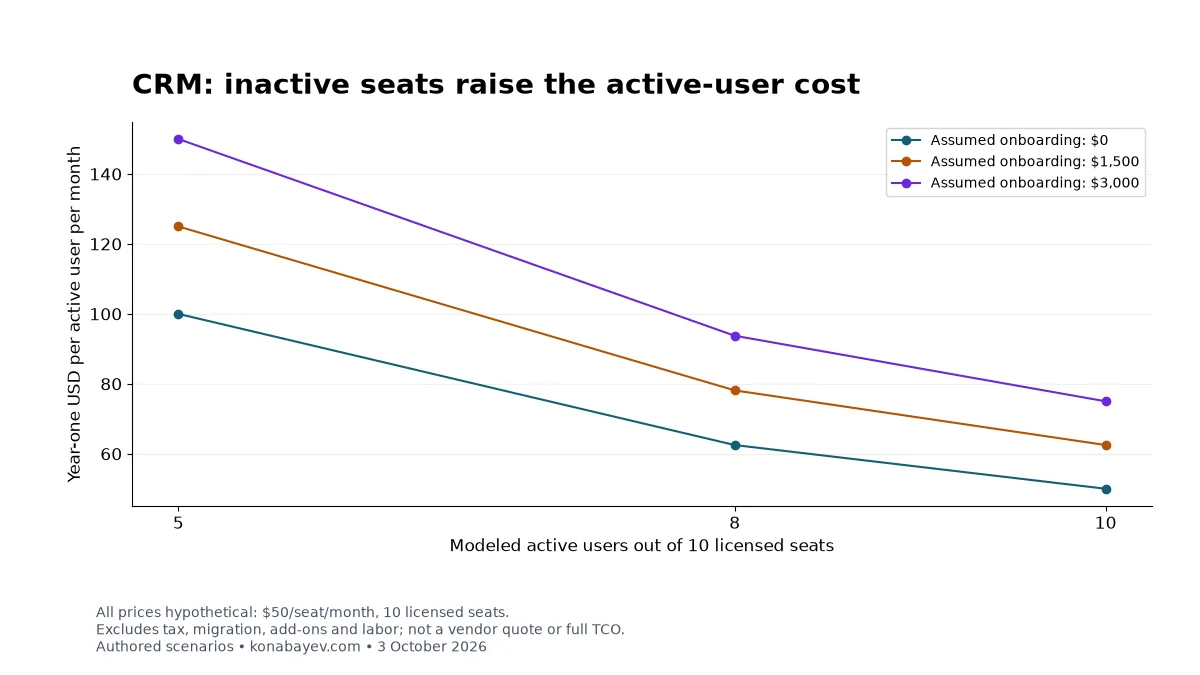
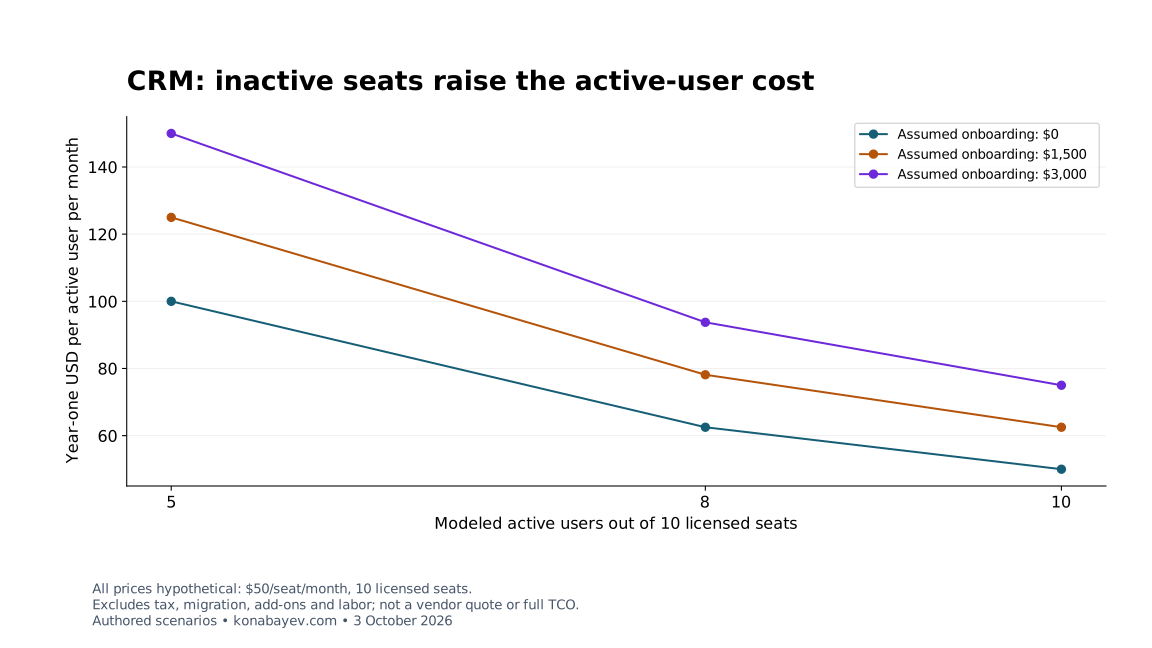
In our illustrative control scenario, ten seats at an assumed $50 per month plus $1,500 onboarding produce $7,500 in first-year modeled cost. With eight active users, that is $78.125 per active-user month, or $78.13 rounded to cents. Monthly installments require $2,000 in month one; annual upfront payment requires $7,500 under the same assumed annual price.
These are authored calculations, not vendor quotes, observed customer costs, industry averages or ROI results. The dataset contains 81 hypothetical configurations. Use it to identify questions for a written quote, then replace assumptions with verified terms.
Downloads: CSV · JSON · JSONL · Reproducible Node.js module
What the 81 Scenarios Contain
The grid varies four explicitly chosen inputs; none is an observed market distribution.
| Input | Hypothetical values | Meaning |
|---|---|---|
| Monthly price per licensed seat | $25, $50, $100 | USD assumptions, not current vendor rates |
| Licensed seats | 5, 10, 20 | All purchased seats remain billed |
| Active-user fraction | 50%, 80%, 100% | Assumed utilization before integer rounding |
| One-time onboarding | $0, $1,500, $3,000 | Assumed quote component due in month one |
Three choices for each input produce 3 × 3 × 3 × 3 = 81 rows. Monthly add-ons and migration are fixed at zero as exclusions from this scenario, not evidence that they are free. An omitted item in a real proposal remains an unknown quote item until clarified.
The grid excludes tax, internal labor, integrations, opportunity cost, financing and other unmodeled charges. It therefore is not complete total cost of ownership. No CRM brand is assigned to a row.
Reproduce the Calculation
The downloadable module is the calculation source; the article and chart explain its outputs.
For each row:
- Monthly recurring cost = licensed seats × assumed monthly seat price + assumed monthly add-ons.
- First-year modeled cost = 12 × monthly recurring cost + onboarding + migration.
- Active users = the integer floor of licensed seats × assumed active fraction.
- Cost per active-user month = first-year modeled cost ÷ 12 ÷ active users.
The module floors the count; it does not clamp it to a minimum. In the published 81-row grid, the smallest result is two active users, so no row divides by zero. If you extend the grid to zero active users, the per-active-user ratio is undefined and must be handled explicitly; it should not be reported as zero.
Download the module and run:
node growth-cost-models.mjs --out ./data
node growth-cost-models.mjs --out ./data --check
It reproduces this dataset alongside the companion cost models. Fractional outputs are rounded to six decimal places in downloads. Counts and whole-dollar inputs are exact. Scenario IDs identify input combinations, not surveyed customers.
Worked Example: Ten Seats, Eight Active Users
Scenario crm-50-10-80-1500 separates the recurring subscription, first-year allocation and payment schedule.
| Measure | Calculation | Result |
|---|---|---|
| Monthly recurring cost | 10 × $50 | $500 |
| Annual recurring cost | 12 × $500 | $6,000 |
| First-year modeled cost | $6,000 + $1,500 | $7,500 |
| Per licensed-seat month | $7,500 ÷ 12 ÷ 10 | $62.50 |
| Per active-user month | $7,500 ÷ 12 ÷ 8 | $78.125 |
| Conditional renewal year | 12 × $500, if recurring terms remain unchanged | $6,000 |
The $62.50 allocation includes the one-time fee spread over the year. It does not mean the vendor invoices $62.50 per seat each month. The active-user ratio changes the denominator; it does not add a charge to the invoice.
Conditional renewal excludes repeating the onboarding fee and assumes unchanged prices, seats and scope. It is not a prediction of the renewal quote. A contract may change those inputs or introduce additional charges.
Why Active-User Rounding Matters
Five licensed seats at an assumed 50% active fraction become two active users, not two and a half. The model floors the count, so realized utilization is 2 ÷ 5 = 40%.
For scenario crm-25-5-50-0, annual modeled cost is $1,500. Dividing by twelve months and two active users gives $62.50 per active-user month. Using 2.5 users would produce a different ratio that does not match the dataset.
For an actual seat audit, define “active” around a useful role-specific action during an explicit window. A login alone may not demonstrate successful use. Check administrators, integration accounts and people on leave before recommending removal.
Inactive licenses remain billed in this model. Removing access also does not automatically reduce a contractual commitment. Verify reassignment and reduction terms before treating a seat change as savings.
Annual Cost and Month-One Cash Are Different
The two modeled payment schedules have equal annual cost by assumption and different cash timing.
| Payment schedule, control scenario | Month one | Months two through twelve | First-year total |
|---|---|---|---|
| Monthly installments | $2,000 | $5,500 combined | $7,500 |
| Annual upfront | $7,500 | $0 within the fixed scenario | $7,500 |
The model assumes onboarding and migration charges are due at the start. It assumes no annual-prepayment discount, financing cost or later purchases. The zero in later months does not imply that expansion, overages or new services would be free.
Monthly billing does not establish month-to-month cancellation rights. Ask separately about payment frequency, contractual term, refunds, renewal notice and the date when seat reductions take effect.
What the Official Source Does and Does Not Establish
The observed official source supplies a reason to check billing units, not the monetary inputs for this model.
The HubSpot Marketing Hub pricing page, inspected on October 3, 2026, displays marketing-contact allowances, included Core Seats and additional-seat information. Those are distinct billing dimensions. A marketing contact is not an active employee using the CRM.
The pricing page checked on that date did not establish a complete onboarding fee schedule, migration price, cancellation right or renewal quote. It is a Marketing Hub snapshot, not evidence for every CRM product or Sales Hub contract. None of the grid’s $25/$50/$100 seat prices or $0/$1,500/$3,000 onboarding values comes from that page.
For product-specific evaluation, read the separately scoped HubSpot pricing guide and CRM guide for small businesses. Preserve their source dates and confirm the written offer before purchase.
A Quote Template and Assumption Ledger
Ask for the commercial terms that determine the model before comparing headline prices.
Copy this request into your procurement notes:
Please itemize the exact product and edition, seat types and counts, billing unit, recurring price, currency, payment schedule and contractual term. Identify mandatory onboarding, optional services, migration, add-ons, usage limits, taxes and overage treatment. State renewal rules, cancellation requirements and when seat reductions take effect. Mark excluded items explicitly.
Then maintain a simple ledger:
| Item | Evidence | Status |
|---|---|---|
| Seat rate and count | Dated written quote | Confirmed or unresolved |
| Active users | Defined internal usage report | Observed for that window |
| Onboarding scope | Statement of work | Required, optional or unresolved |
| Migration and integrations | Technical scope and quote | Included, excluded or unresolved |
| Renewal and cancellation | Contract terms | Confirmed or unresolved |
Keep hypothetical inputs separate from confirmed terms. If migration is unquoted, do not replace “unknown” with zero in an approved budget. Use the HubSpot versus Salesforce evaluation for functional questions separately from this arithmetic.
If the unresolved issue is measurement, routing or marketing operations rather than the software invoice alone, review the paid marketing audit scope and availability. A model cannot replace implementation discovery.
Methodology and Limits
This is a deterministic sensitivity model published on October 3, 2026. It is not a field study, vendor ranking or estimate of how much companies typically spend.
The public JSON records the assumptions and data dictionary, including realized active fraction and both cash schedules. Verification checks cover the hand-calculated control, the five-seat rounding case, unique scenario IDs, cash conservation and agreement across CSV, JSON and JSONL.
The model keeps users and prices constant throughout the year. It excludes phased rollout, midyear hiring, discounts, seat classes, base platform fees and minimum commitments. If those apply, extend the quote calculation rather than mapping a complex contract onto an unsuitable row.
Higher cost per active user does not establish poor productivity or justify removing that user. Lower modeled cost does not establish product fit, successful adoption or positive ROI. Those require operational and financial evidence beyond the model.
Frequently Asked Questions
Are these real CRM prices?
No. Every monetary and utilization input is hypothetical. The official Marketing Hub observation explains why billing dimensions matter; it does not validate the model’s seat rates or onboarding fees.
Does monthly payment mean I can cancel monthly?
No such right is assumed. Payment schedule and contractual commitment are separate. Confirm cancellation and refund terms in the actual agreement.
Why does 50% utilization of five seats show two active users?
The model floors 2.5 to two whole users and reports the realized fraction as 40%. This rule is explicit so the cost denominator can be reproduced.
Is the renewal figure a forecast?
No. It is recurring annual cost conditional on unchanged rates, seats and scope, without another onboarding fee. It does not predict a vendor’s renewal terms.
How should I cite or reuse the model?
Identify it as an authored scenario model, retain the input assumptions and cite the version and scenario ID. Do not describe rows as surveyed businesses or the results as observed industry benchmarks.
Cite This Model
Tugelbay Konabayev. “CRM First-Year Cost Model: 81 Hypothetical Scenarios.” Konabayev.com, October 3, 2026. Version 1.0.0. https://konabayev.com/blog/crm-first-year-cost-model/
Last verified: October 3, 2026. Verification covers the stated model, exports and narrow official-source observation; it does not establish current vendor quotes or complete ownership costs.
Google Preferred Sources
See more of my research in Google
Add Konabayev.com as a preferred source to find more fresh marketing and AI research in Google Search.
Have a relevant product or documented use case? View sponsorship formats and editorial requirements.